

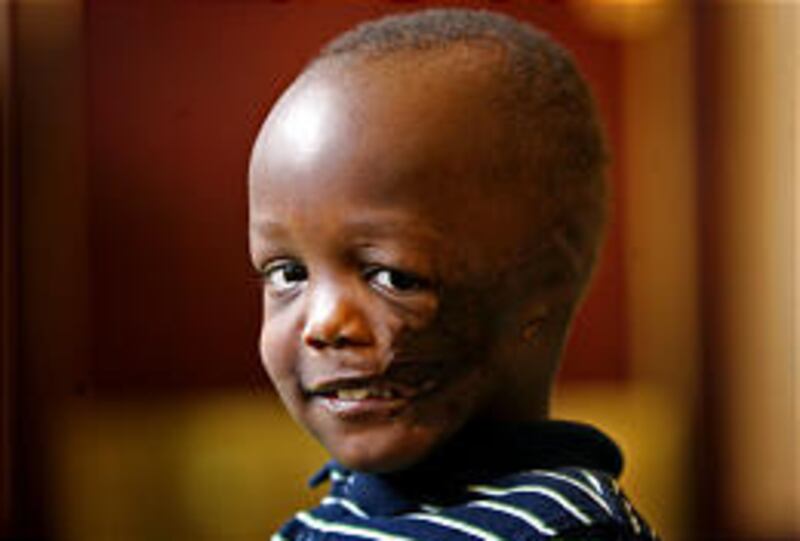

From the right side, Daniel Wachira is just a happy little 4-year-old, entranced with his red toy car. He's laughing as he steers it carefully along the stripe in the carpet of a Salt Lake City hotel.
Look from the front or the left, though, and you can understand why Texas surgeons plan a series of operations to fashion a jawbone from one of his ribs and a cheek from muscle in his back. His face disappears on that side, starting just below his eye. He has no left ear.
When Daniel was a day old, his mother abandoned him in a trash heap in Nairobi, Kenya. When rescuers found him, he'd been ravaged by a dog that was desperately searching for food.
Daniel's trip to the United States was arranged by Feed the Children and its co-founders, Larry and Frances Jones. The Joneses, who live in Oklahoma, brought the child to Salt Lake City, where they are receiving donations for their charity work. They are caring for him until his surgery, now planned for June 1. Originally, it was planned for this week.
The National Association of Music Education Conference collected money from children across the country and presented a check to the charity during a concert featuring the Mormon Tabernacle Choir and the Oak Ridge Boys Friday. Tonight, the Dirty Dozen Brass Band concert at the Salt Palace will benefit Feed the Children.
Daniel doesn't really know that he's different, since he's pretty much the way he's always been. And although he's fluent in English and Swahili, it's also clear he doesn't understand everything that will happen to him when he goes into a hospital in Houston. It has to be done soon, because his scars are beginning to impede his ability to speak. Right now, his youth offers a better chance of scars that will fade and the ability for bones to grow as he does.
The Joneses know Daniel's story to the smallest detail, just as they know other stories of children worldwide who suffer hunger and disease and abandonment. More than 25 years ago, Jones, a soft-spoken Baptist minister, was in Haiti when a little boy asked him for a nickel to buy a roll. He gave it. Then the boy asked for three pennies, because for that price he could get it sliced and buttered. Jones figured the boy needed a drink, too, and gave him 20 cents.
Jones was touched but didn't know he was about to light a fire. He told the story when he got back to Oklahoma, and farmers who heard it started giving wheat. Then he and Frances had to find a place to store the wheat. And trucks to move it. And Feed the Children was born. Today it is an international organization that has helped millions, most of them children, in 115 countries including the United States. In America, Jones says, the money is spent on the serious needs, including hunger, in the communities where it's raised.
When he was found, Daniel was taken to a center for abandoned children that Feed the Children operates in Kenya, and there he's been for almost four years. Two years ago, when he'd grown enough that his scars were stretched tight, he had a skin graft. But once again, his lips are being pulled tight and it's getting hard to talk. The more he grows, the more disfiguring his wounds become.
British Airways flew the boy from Nairobi to London gratis, then American Airlines took over the journey. Dr. Sean Boutros, a Houston craniofacial surgeon, offered to donate the surgery, while his hospital, Memorial Hermann City Hospital, said it will absorb all other related costs.
The surgery will be done in several stages. He'll have more skin grafting. Eventually, he will get an ear. It will likely be a decade before the child outgrows his new face and needs more work.
Facilitating a surgery for a desperately needy child is not the organization's primary function, although Jones can recount several cases. There was the boy badly damaged in the Sierra Leone rebel war. He was so smart that, after surgery, he passed five grades of school in one year. A NASA scientist adopted him, Jones laughs. Or the girl from Bosnia who lost her father and her legs to mortar fire. Now she works for Save the Children.
The organization focuses mostly on basics like hunger. Jones says it's not just a Third World problem.
"Throw a dart at a map and wherever it hits, you'll find serious needs," he says. The agency has 55 trucks that haul food to needy communities in the U.S. alone.
E-mail: lois@desnews.com