

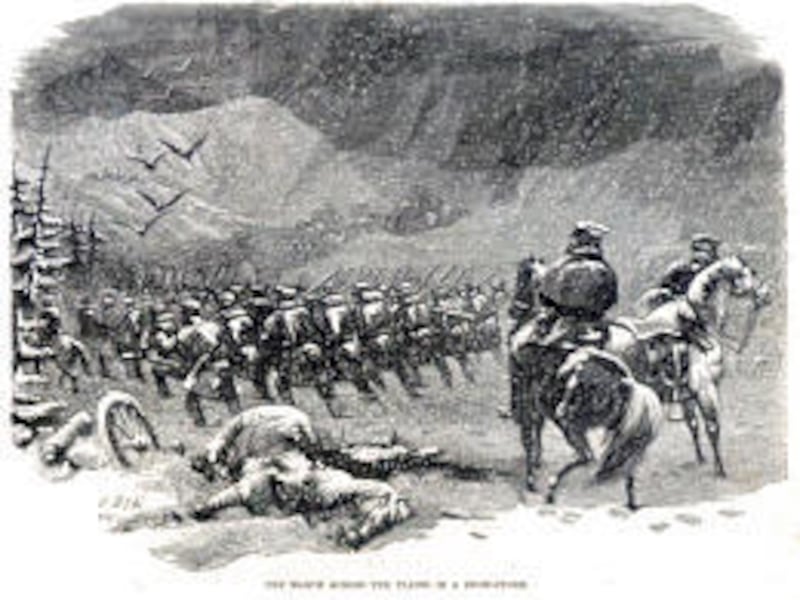
Texans will always remember the Alamo. Massachusetts residents will forever revere the battle of Lexington and Concord. But a group of historians fear that Utahns, and the rest of the world, have largely forgotten the "Utah War."
They hope to change that as the 150th anniversary of that 1857-58 armed struggle between Mormons and an "invading" federal army — which was in many ways a prelude to the soon-to-follow Civil War — approaches next year.
The Utah War Sesquicentennial Committee outlined plans for that at a press briefing Wednesday — which include encouraging publication of several new books, calling for numerous historical papers at upcoming conferences, and offering tours and information for the press designed to ignite general interest.
"We hope that we can bring to light, in a variety of ways, new views, new ideas," said Richard W. Sadler, chairman of the group of historians from major universities and the federal and state governments plus some independent scholars.
Why should Utahns care? "The Utah War dramatically changed Mormon history and Utah history," said Gene Sessions, a Weber State University historian who is a committee member and co-author of the only book now in print directly about the conflict, titled, "Camp Floyd and the Mormons: The Utah War."
He said that before the war, Utah was essentially a theocracy led by leaders of The Church of Jesus Christ of Latter-day Saints — but that would disappear, changing how Mormons and non-Mormons interact in the state and helping attract more non-Mormons to Utah.
"Nationally, this was important, too. It would cripple the (James) Buchanan administration almost from the start. If he had had more (political) capital, he may have been able to do more to avoid the Civil War," Sessions said. "It was only four years before Fort Sumter, and he sent off most of the Army to Utah." The press called it "Buchanan's Blunder."
Historian Ardis E. Powell, a committee member, noted that scores of the Civil War's famous generals participated as junior officers in the Utah War or were stationed at Camp Floyd, where the Army settled in Utah to watch the Mormons. "It became field training for them," she said.
Sadler said new scholarship and thinking is emerging about the causes of the war, what ended it and its effects — which he expects historians to explore at length.
Traditionally, historians said it began when federal judges (accused of immorality by Mormons) convinced Buchanan that Mormons refused to subject themselves to judges' rulings and federal law. So Buchanan sent an army led by Col. Albert Sidney Johnston to install a new governor to replace Brigham Young and to ensure laws were followed.
Mormons viewed it as a renewal of old persecution and believed the Army was coming to destroy them. They armed for defense and evacuated Salt Lake City. Mormon militia ran off the army's livestock, burned its supplies and otherwise harassed it, stalling it enough to force it to spend a deadly winter in Wyoming.
Some historians have argued that Buchanan was a Southern sympathizer who wanted to move the Army out of place before the Civil War. Others said he tried to show the South the government would not allow perceived rebellion. Others said he tried to divert attention from slavery to the other so-called "twin relic of barbarism," polygamy.
Arguments also rage whether Mormons won a David vs. Goliath type of victory through raids on Johnston's Army, or whether they essentially surrendered to government demands after some face-saving concessions were allowed.
E-mail: lee@desnews.com