



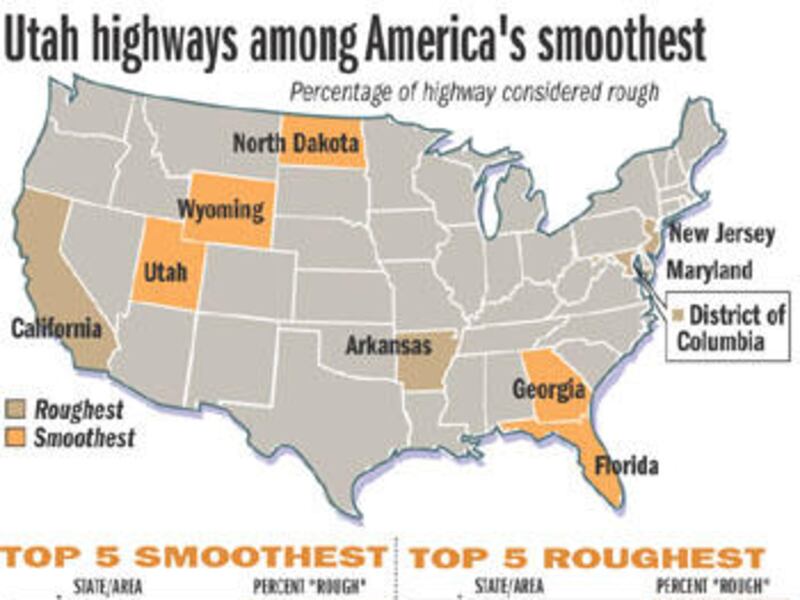
Utahns drive the fifth-smoothest highways of any state. Really.
But, as motorists bouncing through a construction zone might think, roads are still far from perfect.
Officials measure the roughness of every mile of federal and state highways each year, using vans equipped with high-tech lasers and computers. Deseret Morning News analysis of resulting data shows that Utah has the fifth-lowest percentage among states of highways that federal guidelines consider "rough" or worse.
"I'm really not surprised," said David Creer, executive director of the Utah Trucking Association. Truckers, of course, drive on more highways in more states than most motorists.
"Our industry does believe we in Utah have some of the best roads," he said. "They are well taken care of, especially considering our winter conditions. . . . We really applaud UDOT (the Utah Department of Transportation) for doing a great job of maintaining roads."
Rolayne Fairclough, spokeswoman for the American Automobile Association, may be like most everyday motorists — she was a bit more surprised at the findings. But she said, "I think we all know of problem areas, but when we travel to others states we find we really do have pretty good roads in Utah."
But highways here still vary greatly from place to place, from seemingly smooth as glass to rough enough to shake dental work loose.
Major findings from a Morning News analysis of the data it requested from the state and federal governments include:
Using federal criteria, just 2.4 percent of state and federal highways in Utah are considered "rough." The only states that scored better or as well are: Georgia, 0.5 percent; North Dakota, 0.6 percent; Wyoming, 1.0 percent; and Florida, 2.4 percent.
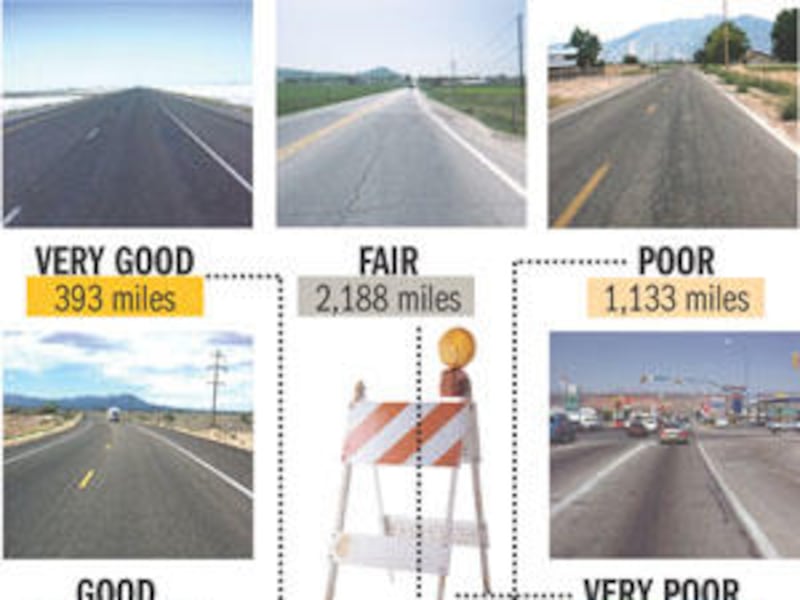
Utah uses somewhat different measures to determine what it calls "ride quality," which include not only the roughness data reported to the federal government but also additional data on road cracking, rutting and shifting. Under those standards, the state ranks 7 percent of its highways as "very good"; 30 percent are "good"; 38 percent are "fair"; 20 percent "poor"; and 6 percent "very poor."
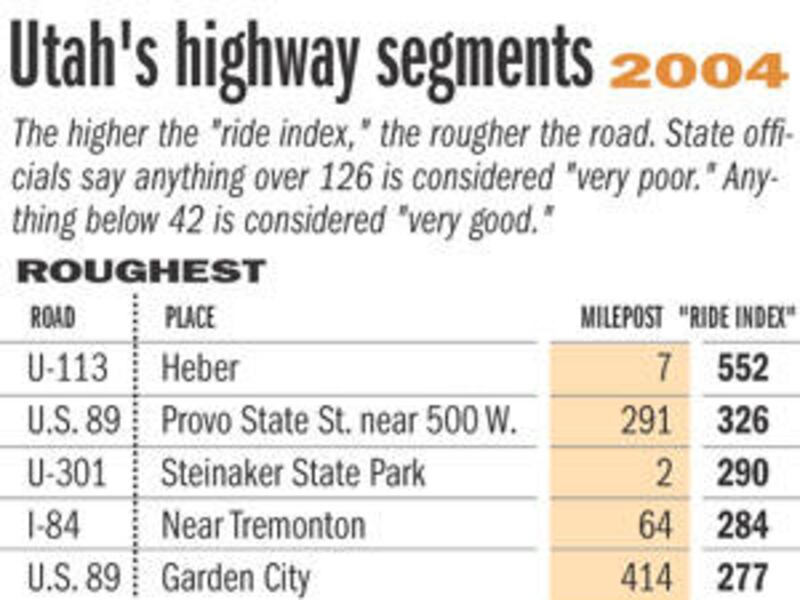
The single roughest one-mile segment of highway in the state in 2004 is on U-113 near Heber (on the road to Midway.)
Three one-mile segments of interstate freeway tied as the smoothest: I-15 near the Springville interchange; I-15 at the North Ogden interchange; and a stretch of I-80 about 30 miles east of Wendover.
The overall smoothest highway in Utah in 2004, based on the average of scores for all its individual segments, is U-193 in Clearfield, along the southern border of Hill Air Force Base.
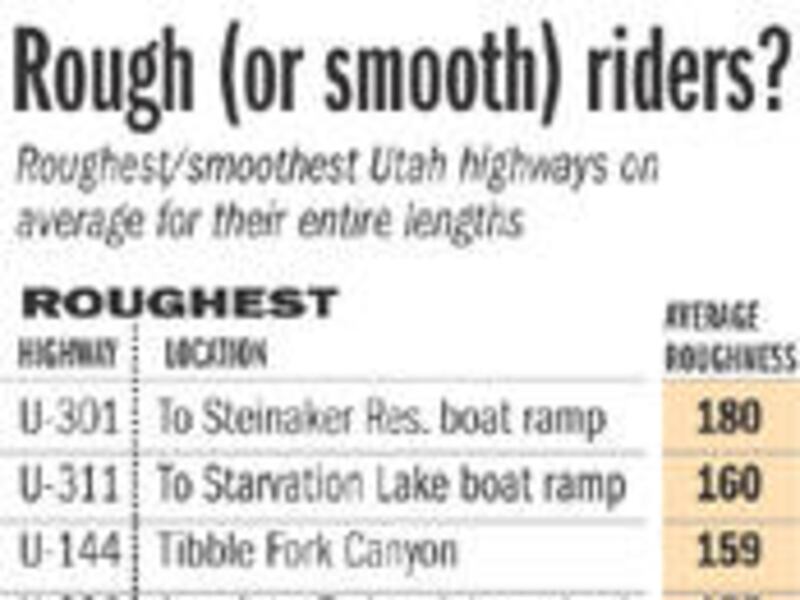
The roughest overall highway for its entire length is U-301, a short road around Steinaker State Park.
Measuring roughness
Using vehicles equipped with lasers and computers, states annually measure the roughness of all state and federal highways according to the "International Roughness Index" (IRI). State measurements are reported to the Federal Highway Works Administration; the lower the index, the smoother the pavement. The federal government considers an IRI of up to 60 as "smooth" and an IRI of over 175 to be "rough."
Although index data gathering methods are similar across the country, measurements are "not necessarily comparable" because devices and how they're calibrated differ state to state, federal transportation administrators have noted in agency publications.
"That being said, I believe we compare very favorably to most states in our pavement condition," says Carlos M. Braceras, deputy director of the Utah Department of Transportation.
In fact, under federal criteria, data show that only 2.4 percent of Utah highways were "rough" or worse in 2003 — seven times better than the national average of 16.7 percent of all highways considered rough or worse, and 40 times better than the worst-in-the-nation District of Columbia, which reported that 87.3 percent of its highways are considered rough or worse.
Good roads, less cost
Braceras says Utah highways are likely in such good relative condition because of a "good roads cost less" philosophy the state adopted about 15 years ago to save money and extend road life. In short, Braceras said, small-cost repairs of early decay greatly extends a road's life and spares the state the much higher expense of repairing a road allowed to deteriorate.
"It has allowed us to stretch our dollars," Braceras says.
"Sometimes, when a road gets to a point that we cannot do a cheap fix, we'll make a conscious decision to let it go and do a reconstruction on it (later). So I do get comments from folks quite often saying, 'Why are you working on that road, it's perfect, but this other one over here needs work?'
"Well, that one is going to take much more money, and if we wait a couple of years, it's not going to cost much more to do it," Braceras said.
"The needs in the state far outpace our ability to fund them, both from preservation and (expanding) capacity," he said. "But by following a 'good roads cost less' philosophy, we're able to optimize those funds we do have. I am very comfortable in saying that we are doing a good job with pavement preservation, and it's paying dividends."
Ride quality
When to do those relatively early, cheap and minor repairs is determined not only on the roughness index reported to the federal government but also on additional data on pavement cracking, rutting and shifting. Signs of deterioration are also monitored in photographs taken of every 50-foot section of every highway every two years.
With such additional information beyond raw roughness data, the state calculates a "ride quality" index. Under that measurement, which was based on data gathered in 2004, 7 percent of Utah highways are "very good"; 30 percent are "good"; 38 percent are "fair"; 20 percent are "poor"; and 6 percent "very poor."
Braceras said the state has created goals to have 90 percent of its interstate mileage in fair or better condition, along with 70 percent of its other arterial highways and 50 percent of collector highways.
Data for 2004 show it is meeting or exceeding such goals: 90 percent of interstate miles were "fair or better," as were nearly 80 percent of arterials and about 60 percent of collectors.
Braceras said the state's road maintenance approach that the higher the speed the smoother the road, meaning freeways must have fewer imperfections than arterials and collectors that have lower speed limits.
Braceras said that based on current annual surveys of road conditions, UDOT estimates pavement work will cost û180 million a year.
Rough riders, easy riders
Morning News analysis discloses the roughest and smoothest highways in the state. The data are for 2004 and do not reflect repairs made this summer or any recent damage.
For entire lengths of highways, the smoothest overall was U-193 in Clearfield. Its average IRI (what a passenger in the middle of the car would feel) was 39. State officials consider anything between 0 and 42 as "very good" or very smooth on asphalt roads and U-193 manages to average such smoothness for its entire length.
Other entire highways considered the smoothest were U-90 (200 South in Brigham City, with an IRI of 52); U-159 from Garrison to U.S. 6 near the Nevada border (52 ); U-28 from Gunnison to Nephi (54); and U-152 (the Van Winkle Expressway, 55). Note that the state considers ride index numbers between 42 and 65 as "good" on asphalt.
Meanwhile, the single roughest overall highway was U-301 around Steinaker Reservoir. Its ride index was a whopping 180. State officials consider any ride index over 126 to be "very poor" or rough.
Other rough highways included: U-311 around Starvation Lake (IRI of 160); U-144 in Tibble Fork Canyon (IRI of 159); U-296, the road around the American Fork Training School (155); and U-316 to San Juan State Park from U-261 (152).
"The smoothest roads are the ones that had the most recent treatment," Braceras said. "The roughest are in sections that we give lower priority. For example, it isn't as important to have a really smooth road to the boat ramp at Steinaker Reservoir as it is for I-15 (to be smooth). It carries a lot more cars."
Segment data
Data for individual one-mile segments of highways, as opposed to averages for entire highways, also often reflect such priorities.
For example, the 10 smoothest individual one-mile segments of highway in Utah are all on interstate freeways. So are 18 of the top 20 and 36 of the top 40.
All of those top 40 have "ride indexes" of 27 or below, all well within the range considered "very good."
The worst individual segments tend to be lesser traveled roads but sometimes also include sections of Interstates or other major highways.
The worst of the worst was a segment of U-113 near Heber, with an astronomical "ride index" of 552, more than four times higher than the "ride index" point of 126 where roads are considered "very poor" or very rough.
Other segments with high ride indexes (before this summer's road work) were: U.S. 89, State Street in Provo near 500 West, with a ride index of 326; part of U-301 around Steinaker State Park (ride index of 290); a section of I-84 near Tremonton (ride index 284); and U.S. 89 near Garden City (ride index of 277.)
"There are very good spots, and some that are really bad," Braceras acknowledges. "We've got some big projects programmed over the next few years to address the worst pieces," especially those on interstates, he said.
Some of the lesser-used roads in poor shape may have to wait a long time for improvements.
"It's important to acknowledge that we look at the function of these roads" to determine priorities for repairs and funding, Braceras said. "The commission and the department put money on roads that serve a higher function and a higher priority."
 Deseret Morning News graphic Deseret Morning News graphic Smoothest and roughest rides in UtahRequires Adobe Acrobat. Smoothest and roughest rides in UtahRequires Adobe Acrobat. | |
Region 1Box Elder, Davis, WeberMorgan, Cache and Rich counties
Region 2Salt Lake, Summitand Tooele counties
Region 3Utah, Juab, Wastach, DuchesneUintah and Daggett counties
Price DistrictCarbon, Emery, Grandand San Juan counties
Cedar DistrictMillard, Beaver, Ironand Washington counties
Richfield DistrictSanpete, Sevier, Wayne, PiuteGarfield and Kane counties
Downloading graphics require Adobe Acrobat.
E-mail: lee@desnews.com