

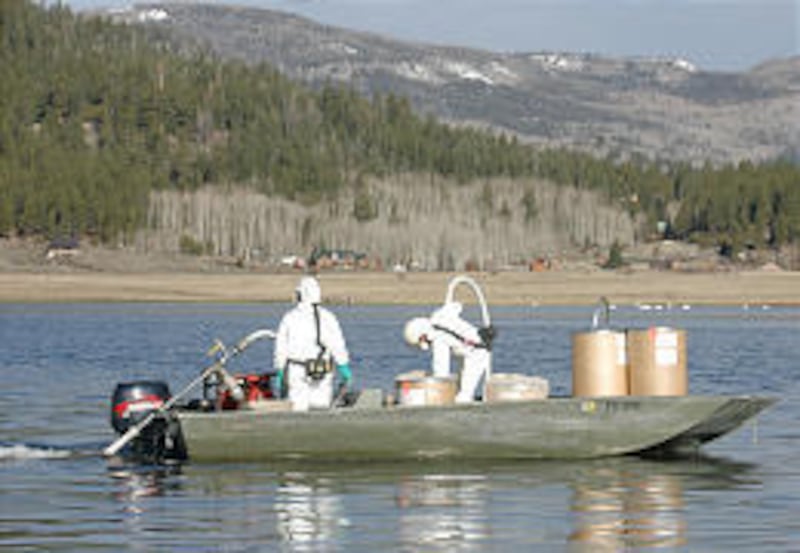



PANGUITCH LAKE, Garfield County — The first on the water were the pelicans, grebes and loons, followed a short time later by the boats and a couple of hours later by fish — dead fish.
The birds came to dine, the boats showed up to spread rotenone in the water, and the fish, in most cases, were simply victims of their own success. There were just too many nuisance fish in Panguitch Lake and not enough of the fish people want — trout.
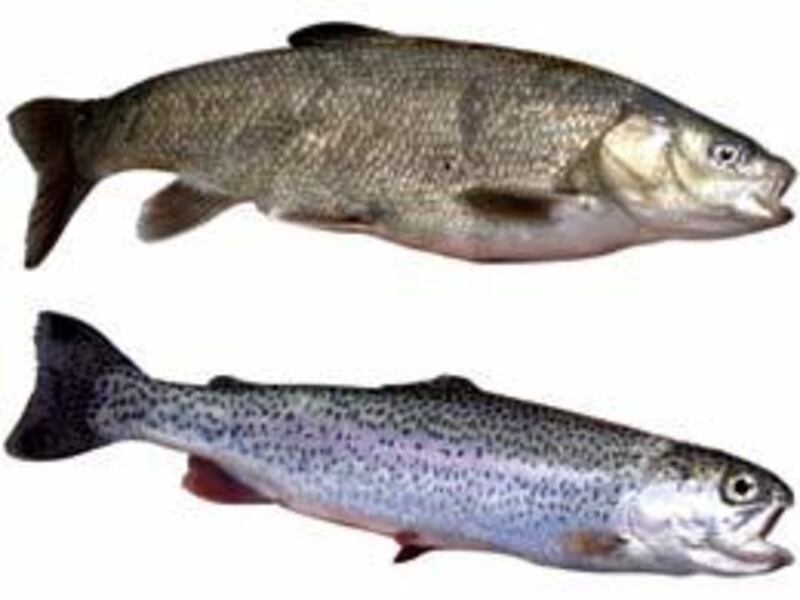
Most of the fish that surfaced last week after treatment were Utah chubs, more commonly referred to in unfriendly tones as "just chubs."
Chubs are the mosquitoes of game fishing. They're an annoying fish fishermen would sooner not see at all, certainly not on the tip of their hooks.
The problem is chubs are a survivor. They can easily outdo rainbow trout, the most common game fish in Utah, which is why, explained Roger Wilson, game-fish coordinator for the Utah Division of Wildlife Resources, "The biomass in (Panguitch Lake) is 95 percent chub and only 5 percent trout."
And, added Douglas Messerly, Southern Region director for the DWR, "The prospects of any improvement were dim."
In the spring of 2005, a town meeting was held in Panguitch to try to arrive at a cure for the problem.
"This has been a very highly controversial subject," continued Messerly. "This fishery is very important to the economy of this area. Businesses have a very short season, usually from Memorial Day to Labor Day, and we wanted to be very sensitive to that issue."
As it stands now, the lake will likely not be fishable on Memorial Day.
Roughly 78 percent of those who fish the shores of Panguitch Lake are non-residents, which is why this lake is so important to local businesses. The highest number of non-residents come into Utah from Nevada.
The meeting was well-attended. And, at the meeting, Messerly said, he asked for suggestions, "no matter how wacky, and we got some pretty far-out recommendations. We looked at everything, including going to commercial fishermen to harvest the chubs, and even looked at birds and tried to figure out just how many fish a pelican would or could eat."
A committee was formed, consisting of biologists, business owners and public officials. After narrowing options down, the decision was made to go with a spring fish kill and a very aggressive program to restart fishing.
"Our plan is to have people fishing within 30 to 45 days," said Wilson.
Rotenone was spread over the lake on May 2. The plan is to give the lake three weeks to detoxify, then restock it with catchable trout and reopen to fishing by June 3 or June 10 at the latest.
"Our original plan was to begin treatment around April 15 when ice typically comes off. This would have allowed us to have the lake open by Memorial Day," said Wilson, "but Mother Nature threw us a curve. We still had ice on the lake on the 15th."
This was the third time the lake had been treated over the past 35 years. Previous treatments were in 1970 and 1991, one year after the historic treatment of Strawberry Reservoir.
Generally, rotenone treatments are done in the fall, when water temperatures are warmer and rotenone, which is biodegradable, more quickly dissipates.
"We decided on a spring treatment because of the lack of vegetation in the water at this time," said Messerly. "In the fall, we would have had a problem getting rotenone through all of the vegetation patches in the water. Ideally, what we're looking for is a 100 percent kill on the chubs. We treated in the fall in 1991, with all the vegetation in the water, and the very next year we found chubs in our gillnets, so we knew we didn't get all of them.
"But even then, we've had 15 years of good fishing. With this treatment we're hoping we can control the chubs and we won't have to treat again. We do know the chubs will come back."
No one knows how the Utah chubs made it into Panguitch Lake. They are not native to the lake. It is believed they were illegally planted. It's likely a fishermen brought in a bucket of live chubs to use as bait, which is illegal, and at the end of the day dumped the remaining fish in the lake.
Over time the chubs, which compete for the same foods as rainbow, overran the lake. In one cove, following the treatment, a group of DWR officers counted nearly 5,000 dead chubs and only 12 trout. Some of the chubs weighed up to a pound and a half, which is big for a chub.
Sentinel fish will be placed in the lake and when the rotenone is completely gone, the lake will be restocked. Wilson believes it should be around the week of May 28.
Plans are to restock with 50,000 catchable rainbow trout. "Which," said Messerly, "is probably more trout than were in the lake before treatment.
"For us, bringing the lake back this quickly is unusual and a big expense, but we believe it is necessary because of the recreational opportunities this lake provides and, when you look around, we don't have many high-mountain lakes in southern Utah for fishing."
Back in 1990, Strawberry was treated in late August, but wasn't open to fishing until the first of January. The biomass — chubs versus trout — was about the same at Strawberry as it was at Panguitch.
Along with the catchable trout, the DWR also plans to plant around 200,000 Bear Lake cutthroat along with some tiger trout in the fall. The cutthroat is a predator fish and is being stocked to help control the chubs if and when they return. The cutthroat were also stocked in Strawberry.
Some 70,000 pounds of rotenone were used at a cost of $250,000. This expense does not include the cost of the 130 DWR officers and biologists on site. The rotenone was mixed with water and then spread over the surface of the lake. Airboats were used to spread the chemical into shallow areas around the lake's shoreline.
Crews on shore walked the banks of nearby streams spreading liquid rotenone.
Over the years, Panguitch has been one of Utah's most popular fishing waters. Strawberry gets more pressure over the course of a year, but Panguitch, being smaller, gets more pressure per surface acre. The latest findings show Strawberry gets about 100 hours of fishing pressure per acre, where Panguitch gets about 125 hours per acre. Currently, Strawberry covers about 14,000 surface acres where Panguitch is around 1,200 surface acres.
Over the years, Panguitch has become well-known for growing big fish. Native Americans, in fact, gave Panguitch its name, which means "Big Fish." Biologists expect that it won't be long before fishermen are routinely catching trout weighing up to a pound and a half and larger.
Rotenone is the preferred method of treatment because it is a naturally occurring product made from the roots of trees found in South America. Introduced to the water, it inhibits the ability of fish to get oxygen out of the water. It is not harmful to birds or animals that may eat the fish or drink the water.
Within the next few years, Messerly believes it may be necessary to introduce a slot limit regulation on Panguitch, something similar to the one at Strawberry, where all cutthroat trout between 15 and 22 inches must be released. This will help to maintain predator fish at a size where they can control chubs.
General consensus was that it was better to start the treatment sooner rather than later, and that the sooner the chubs were gone and the trout were able to live uninhibited the better fishing will be. The test, of course, will come in a couple of weeks.
E-mail: grass@desnews.com