

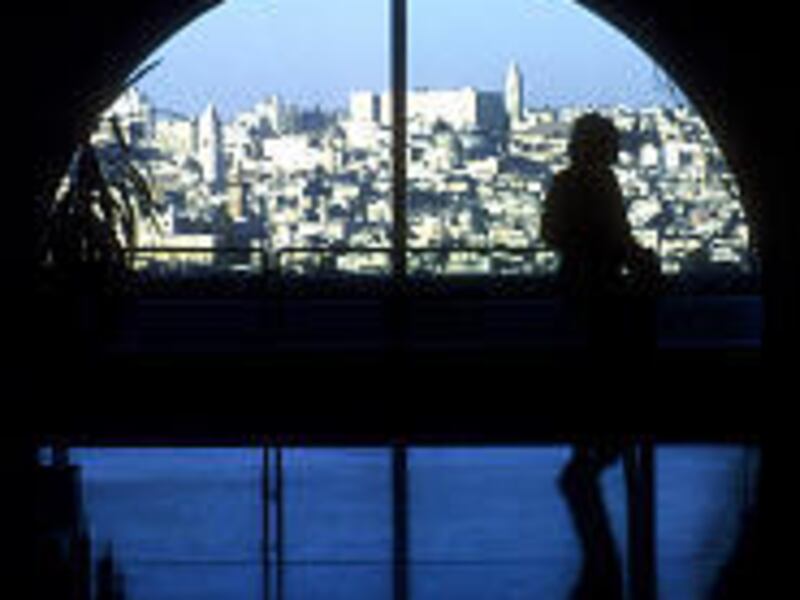
PROVO — Brigham Young University announced Friday that students will return this fall to the school's Jerusalem Center for the first time since 2000.
The decision to hold fall semester classes at the center, located in east Jerusalem on the Mount of Olives, was made after consulting with government and leaders of The Church of Jesus Christ of Latter-day Saints, which operates BYU.
Administrators had hoped to provide the study abroad program at the center since the program was interrupted in 2000 due to violence in Jerusalem, said Jim Kearl, BYU assistant to the president for the Jerusalem Center.
"We always wanted to return, of course," he said. "Having it closed denied a whole generation of students a marvelous opportunity to study in the area. For young LDS members of the church, the Old and New Testaments just come alive when you study them in their historic and geographic setting. Now looked like a good time to go back."
The announcement to reopen student programs this fall came somewhat as a surprise because Israel remains on the U.S. State Department's travel advisory list, which cautions U.S. citizens to carefully consider the necessity of traveling to the area.
Kearl said that despite the advisory, BYU feels it is safe to bring students back to the Holy Land. The advisory applies more to the West Bank and Gaza, rather than to Israel proper, he said, and the BYU program will limit its travel to the safest areas.
The program might include visits to Jordan or Egypt, but BYU has not yet made a decision.
Kearl said the program will also be more tightly structured this year than in the past. Students accepted for the fall 2006 program will live at the Jerusalem Center and travel to historic sites but will have less free time to wander the streets and will spend more time under direct supervision of center personnel, he said.
Classes will cover ancient and modern Near Eastern history, Near Eastern languages and cultures, and the Gospels in the New Testament.
The center will be staffed this fall by two BYU faculty members, the executive director of the center, an Israeli and the associate director, a Palestinian.
The structure of the program will also be slightly different than in the past. Only about 40 students will be allowed in this fall, whereas more than 150 were selected before the closure, and only BYU juniors and seniors will qualify to apply.
Kearl said BYU set the limitations mainly for safety and staffing reasons. By limiting the numbers to 40, the center can take all the students in one bus.
"Part of it is the logistics of getting a program together by fall, and part of it is about being cautious," Kearl said. "Things have changed a lot in the Holy Land in the past 5 1/2 years. We need to relearn how to do this."
The program will expand if there is interest.
BYU sent home 174 students a month early from a semester at the center in 2000 after violence in Jerusalem's streets made it unsafe to remain in the area.
The students had been kept inside the center for more than a month before being sent home.
Kristy Bott, who was a BYU student in Jerusalem that semester, said even though she saw a bus explode and violence, she never worried about her own safety while in the Holy Land.
"There's always trouble over there, and I don't know if anyone would ever think it's a perfectly safe thing to be there (in Jerusalem), but I was never scared," she said. "When we were there, it got worse and worse, but I felt completely safe. I knew they (BYU professors and Jerusalem Center administrators) would take care of us. Maybe I was completely oblivious, but I was never scared. I was just so excited to be there." Student programs have remained suspended since Bott's group was flown back to the United States in November 2000.
It was the second time the program shut down since its opening in 1987. It was closed once before in 1991 during the Gulf War.
Despite the closure of the student program, the Jerusalem Center stayed open, hosting concerts, workshops, tours and visitors. Bott said she had no doubt students who applied to this year's program would be kept far from harm's way. "Honestly, as long as they follow the rules and only go to the places where they're supposed to go, they'll be fine," she said. "It's never going to be completely safe, but if they trust the faculty and people with them, they'll be kept safe. I think the more people who get to go and experience it, the better. I'm jealous. I want to go back."
BYU officials expect the announcement will create some excitement around campus. This summer is the first time applications have been accepted since 2001, when BYU stopped taking names for future enrollment at the center after the 9/11 attacks. "I just have to figure out a way of going without my girlfriend getting mad," said Jonah Barnes, a junior at BYU. "Of course it's not going to be as safe as the United States — nowhere is. But to experience the Holy Land, to really see the place you talk about so much in church—that would be awesome."
Application materials will be available June 16, and the Jerusalem Center's Provo office will begin taking applications June 26. They will be due July 7.
The future of the student program will depend on the political climate and events in the Middle East, Kearl said. If things go well, it is possible the program will again expand to its previous size.
E-mail: alinford@desnews.com