


On July 16, 1846 — 160 years ago — in response to a U.S. government request for enlistees to fight in the Mexican War, a group of approximately 500 volunteers was mustered into the U.S. Army at Council Bluffs, Iowa.
Instead of a uniform, each volunteer received $42. Most of them gave that to the families they would leave behind, and they marched off in their frontier clothes, surely wondering if they would ever see their loved ones again.
They marched for some 2,000 miles, a trek that took six months and was filled with untold hardship.
The story of the Mormon Battalion, as this group came to be called, is "an amazing story of faith, sacrifice and patriotism," says M. Gordon Johnson, who re-creates the life of the soldiers in a monologue presentation. "Most people know very little about it. The story's been a well-kept secret, and that's a shame."
Johnson is not alone in wanting to preserve and promote the legacy of the Mormon Battalion. A modern, nonprofit U.S. Mormon Battalion heritage organization has been created to do just that.
The group will be observing Mormon Battalion Heritage Day on Saturday with a program at the LDS Bountiful Regional Center. Guest speaker will be Elder L. Tom Perry of the Quorum of the Twelve Apostles of the Church of Jesus Christ of Latter-day Saints. Johnson will be doing a segment from his "Soldier's Tale"; music will be provided by the Sterling Singers. There will be a video, displays and other information.
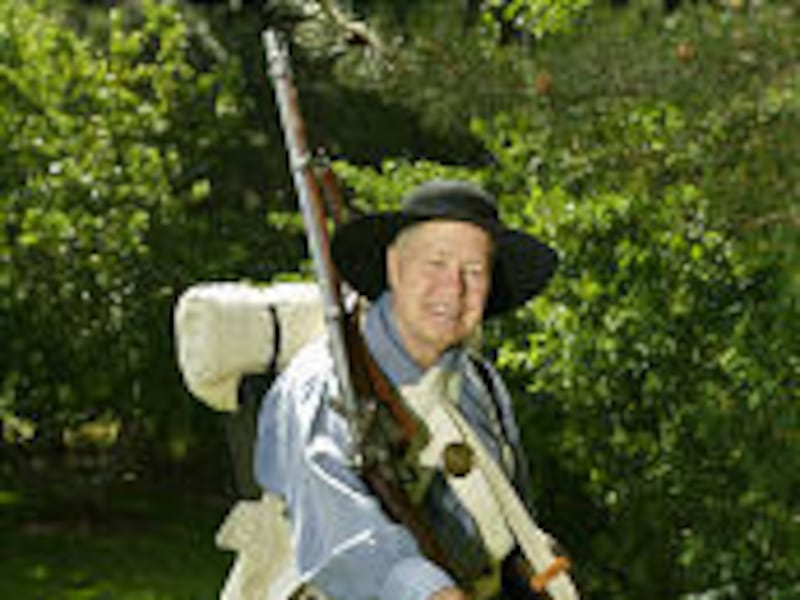
Johnson put his program together while serving as director of the Mormon Battalion Visitors Center in San Diego. He put together a script based on journal excerpts and other research, and he came up with an outfit and the accoutrements of a military man — not original, but authentic replicas of the knapsack, canteen, bayonet baldric and musket the soldier would have had.
The program was much-requested throughout the San Diego area. Since returning home, he's started to get calls here. He hopes it helps people understand a little of what the soldiers went through.
"The musket weighs about 10 pounds," Johnson explains. "The soldier would have also carried about 60 one-ounce balls, plus black powder. The knapsack held his clothing and necessities, and the canteen would have held three pints of water. Some canteens were made of wood, and if they started to leak, the soldier poured beeswax inside to plug the holes. That worked fine — unless you were out in the hot sun and the wax melted."
After their shoes wore out, the soldiers wrapped their feet in animal skins. Each man was also issued a thin wool blanket.
Loaded head-to-foot, marching through heat and cold, sometimes wading in sand up to their ankles, "it was a pretty grueling march — one of the greatest marches in U.S. military history," says Johnson.
About 35 women and 45 children accompanied the battalion; there were also teamsters, aids, scouts and other personnel.
The battalion never had to fight a battle — unless you count the time they were attacked by bulls, says Johnson. But sickness and hardship took its toll; 22 soldiers and eight nonsoldiers died.
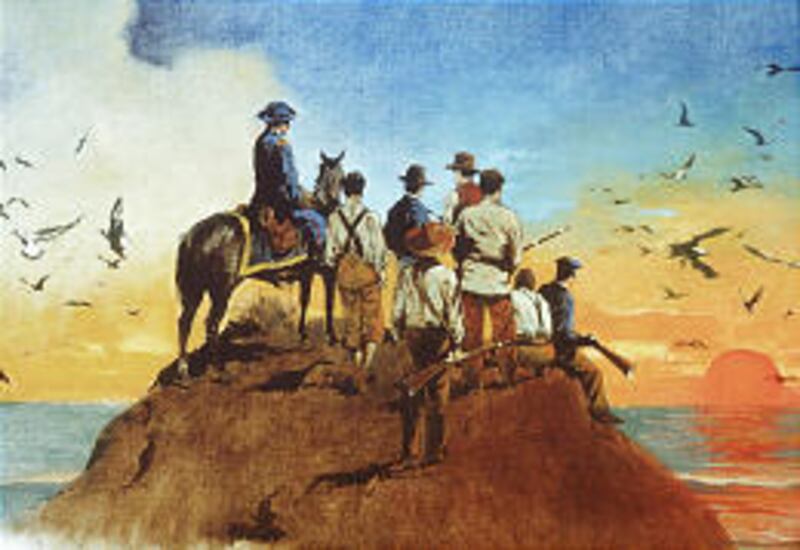
When they at last reached the Pacific Ocean, "tears filled their eyes. They sat in silence for about 20 minutes," says Johnson. "They had been singing about the Pacific since they left Nauvoo, and there it was — calm and beautiful, like a mirror."
Although they did not fight, the Mormon Battalion made a huge contribution, says Jay Todd, chairman of the Heritage Day 2006 committee. "The Mormon Battalion was part of the Army of the West, involved in the campaign that brought all or parts of seven states into the country."
The greatest contributions of the Battalion were in trailblazing and road-building and in serving as an army of occupation. "No one knew quite how the allegiances of the Californios, as they called them, would go," says Todd. "The Mormon Battalion played a significant role in changing their ideas about Americans."
The detachment that was left in San Diego built buildings, wells and roads. They made the first kiln-fired bricks, which they used to build the first courthouse. "Their contribution was such that when they were scheduled to leave, a petition was signed by all the adult members of the community asking that they stay — or that another company of Mormonitos be sent," says Johnson.
Soldiers who were not left in San Diego marched on up the coast. They helped establish Fort Moore at Los Angeles and helped Col. Stephen Kearney establish his authority.
When their year of enlistment was up, many of the soldiers returned to their families in Iowa; others to the Salt Lake Valley. A few re-enlisted; some stayed in California to earn more money. Some of those worked for John Sutter and were part of the discovery of gold that kicked off the rush to California.
"They could have stayed and become wealthy," says Johnson, "but they returned home to something more precious than gold — their families."
The U.S. Mormon Battalion heritage group is organized into several companies throughout Utah and the Midwest. Membership is open to anyone; about half the members are descendants of battalion soldiers.
Members work to mark graves of battalion members and also help Boy Scout groups earn trail patches. Re-enactors participate in local parades and historical events. They also "seek to fulfill the Utah governor's proclamation that there be an annual Mormon Battalion Heritage Day," says Todd.
The story of the Mormon Battalion is an important one in Mormon history, he adds. "But it is also important in military history and in American history."
If you go
What: Mormon Battalion Heritage Day
When: Saturday, 10:30 a.m.-noon
Where: LDS Bountiful Regional Center, 835 E. 200 North, North Salt Lake
How much: free
E-mail: carma@desnews.com