



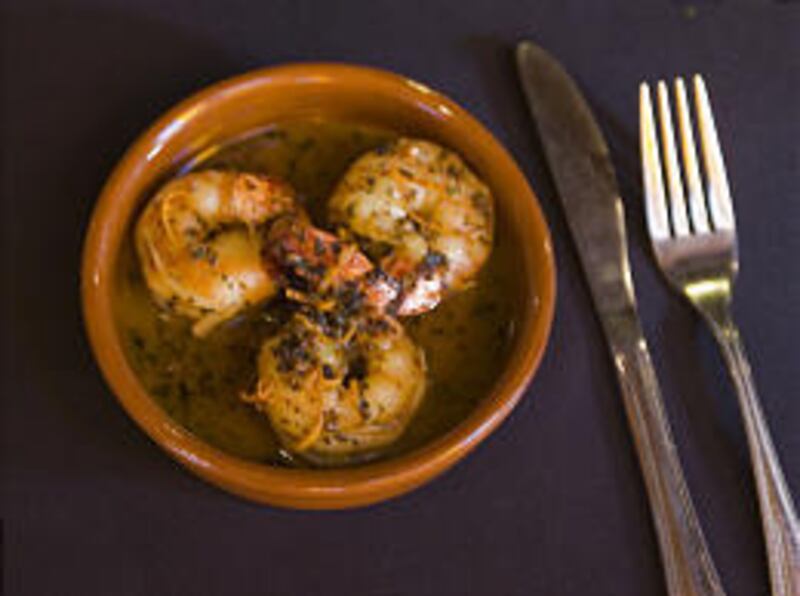


It's a small world, after all. "Super-size" is out — "small plates" are in.
Although the Spanish term "tapas" is the current buzzword, the same idea crosses many other cuisines: the Chinese have dim sum; the Italians, antipasti; Americans, appetizers.
But whatever you call it, right now, small is big. Less is more.
Locally, here are a few signs of the times:
A new cookbook, "Small Plates: Meals as Appetizers" by Salt Lake's Marguerite Henderson, has garnered national attention, with reviews with Publisher's Weekly and MSNBC.com. Published by Gibbs Smith in Layton, the book has already sold nearly 5,000 copies. Henderson got the idea after teaching several cooking classes with the same title. "They (the classes) sold out immediately, and I had to do them over and over. I see this as a big trend."
Squatters Pub Brewery is opening a "small plate" restaurant on the two top floors of its building in July. Called Zola, it will be devoted to small-portion dishes from around the world, according to founding partner Jeff Polychronis.
"It a trend that we are seeing, most big cities have small-plates restaurants. Even here, people are ordering more appetizers. Also, we wanted a concept that wouldn't compete with what are doing here at Squatters."
Cafe Madrid, a small Spanish restaurant known for its traditional tapas (a Spanish term for appetizer) was named Best Restaurant this year by Salt Lake City magazine.
The Metropolitan restaurant has launched "Bar Bites," described as "scrumptious, shareable, tapas-style taste sensations for $8 each." Dishes include tuna tartare, beef short rib and truffled pommes frites.
All the tapas talk isn't news to Shaun Jacobson, manager of the downtown restaurant Martine, which is known for tapas-style dining. Back in September 2004, Bon Appetit magazine praised the restaurant's Moroccan braised beef and noted that "small plates" are a hot trend. Martine applies the term "tapas" loosely, because many have North African, French and Italian influences, as well as Spanish.
"Right now, our most popular one is the grape leaf-wrapped halibut," Jacobson said.
So what's the difference between "small plates" — or "tapas" — and appetizers? Or just smaller servings of the usual entrees?
Well, for starters, "tapas" aren't the usual artichoke dip and buffalo wings.
"They're similar to our entrees but more unique ingredients, a little bit more creative, and in small portions so you can try a number of different things and share if you want," Jacobson said.
Intense, bold flavors are another hallmark, said Henderson. "I don't think it's a fad, it's been around a long time," she added. "We used to call it 'grazing' back in the '80s."
"When you see 12 things on the menu and you want to try them all, with small plates you can at least try a few of them instead of just one," said Paul Willardson, one of the chefs working on Zola's menu. The dishes there will range in price from $2-$12.
Henderson says when she visits restaurants, she tends to order appetizers, "because they're more intriguing. A big entree is often just too much to eat. For that same $30, you could get three or four small plates to sample, with a lot of different textures and tastes."
"It takes a lot of the risk out of dining, because it's not like you're ordering a $20-something dish that you might not like," said Peter Cole, a partner in Squatters. "It's also a fun way of eating, with lots of sharing."
Henderson said the concept is great for home cooks who want to entertain without the stress of doing a big meal in courses.
"You could use any one of these dishes as a main course, and then supplement it with another small plate, such as the portobello mushroom turnovers," said Henderson. "The book has recipes for salads and soups or chowders that you could do as a small plate, too. The colors are gorgeous, and you don't have to wait for each course to be ready, you just bring them all out at the same time."
One favorite from the book is the Asian beef salad served over sesame slaw. "It's a salad but it does have beef in it, so you can make a meal out of it," said Henderson, who cooked the dishes for all the photos in the book. "Also, there's the Sicilian Swiss chard with pancetta and beans. You can add a crusty bread, and you've got a meal. Every one of these recipes I've done in my class or on TV, so I know they work." (Henderson appears every Wednesday on KSL-TV's "News at Noon.")
The word "tapa" means "lid," or "cover" in Spanish, said J.C. Pino of Cafe Madrid. "They originated centuries ago as small portions of food that were used to cover the wine glass so the mosquitoes wouldn't get in," he said. "Then people started the tradition of 'Give me a bite of yours and you can taste some of mine,' and the dishes began calling for deeper flavors and matching wines. Some are very sophisticated, but it's always related to small portions."
Most of the tapas at Cafe Madrid afford two to three bites for a group of four people, and are $13-$14 each, Pino said. Cafe Madrid's signature tapa is a red piquillo pepper stuffed with fish pate. Piquillo peppers, grown in Spain, are tear-drop shaped and smoky in flavor.
Cafe Madrid also has bacon-wrapped shrimp with bechamel sauce, and sausage cooked in a black mission fig sauce. These are two separate tapas, but "we recommend that they be ordered and tasted together, because you get a wonderful explosion of flavor," Pino said.
Zola's chefs prefer the term "small plates" instead of "tapas," to define their eclectic menu. Some dishes will change every week, depending on what's fresh and in season, said Carl Fiessinger, one of Zola's chefs who has been experimenting in the kitchen to come up with ideas for the menu.
Dishes that have made the cut so far include thin-sliced french fries studded with crispy sage leaves, paella, thin-sliced flank steak and jumbo shrimp sauteed with orange zest, coriander and smoked paprika. Ice creams employ unusual combinations, such as raspberry-wasabi, cinnamon-basil and carrot-lavender. There's also a vanilla goat's milk custard with caramelized figs and honey.
PEAR AND GORGONZOLA CROSTADA
1 recipe All-Purpose Piecrust, omitting sugar (see below), or purchased pie crust or puff pastry sheets
2 red onions, thinly sliced
2 tablespoon butter or olive oil
1 teaspoon kosher salt
3 D'Anjou or Comice pears
1 1/2 to 2 cups crumbled Gorgonzola cheese
1/2 cup almond slices, chopped walnuts or pine nuts
2 tablespoon butter, cut into small pieces
Roll out the pie crust pastry to a 14-inch diameter circle and place on a parchment-lined 14-inch round pizza pan. To make smaller crostadas, divide the dough in half and roll out each half to a 10-inch diameter circle and place each round of dough on a parchment-lined baking sheet.
Saute the onions in butter or oil with salt for 8-10 minutes on low heat until soft and caramelized. Cool to room temperature. Cut the pears vertically into 1/8-inch thick slices, removing any seeds. Spread the onions on the pastry evenly, leaving a 1-inch border all around the pastry. Top each pastry with the thinly sliced pears, cut side up, in a single layer. Sprinkle with cheese and nuts, and dot with bits of butter.
Fold up the 1-inch border over the filling so there is a band of crust around the outer edge. Bake in a pre-heated oven at 425 degrees on the middle shelf for 20-25 minute until golden brown and the cheese is bubbly.
Remove from oven and cool slightly before cutting into pieces. Makes 6 to 8 servings.
Note: Pears may be substituted with 12 large fresh black mission figs, cut in half lengthwise.
— "Small Plates," by Marguerite Henderson, Gibbs Smith, $18.95
ALL-PURPOSE PIE CRUST
2 cups all-purpose flour
1/2 cup cold butter, cut into small pieces
1/2 cup cold shortening, cut into small pieces
1 teaspoon kosher salt
1 tablespoon sugar (omit if using a savory filling)
1/4 to 1/2 cup ice water
Combine flour, butter, shortening, salt and sugar (if using) in a food processor or mixing bowl. Pulse on and off if using a processor, or cut in if using a pastry cutter, until butter and shortening are the size of peas. Add enough ice water, a few tablespoons at a time, until the dough is soft, but not wet, when pressed together. Divide the dough in half, form a ball with each half, wrap in plastic, and refrigerate until ready to use.
— "Small Plates," by Marguerite Henderson
FREE-FORM RAVIOLI WITH CRABMEAT AND SHRIMP
4 tablespoons butter
2 large shallots, peeled and chopped
1 medium zucchini, thinly sliced or julienned
2 carrots, peeled, thinly sliced or julienned
1 cup heavy cream
2 cups chicken broth
3 tablespoons tomato paste
1 teaspoon kosher salt
1/2 teaspoon ground white pepper
1/2 pound crabmeat or lobster meat
1/2 pound raw shrimp, peeled and coarsely chopped
3/4 cup chopped fresh chives, divided
1/2 cup chopped fresh basil leaves
2 quarts water
1 teaspoon kosher salt
12 large wonton wrappers (about 5-by-5 inches)
Heat butter in a medium saucepan. Add shallots, zucchini and carrots. Saute 2-3 minutes, then add cream, broth, tomato paste, salt and pepper. Simmer 3 minutes until thickened slightly. Add crabmeat or lobster meat and shrimp. Cook 2 minutes until shrimp are pink, but be careful not to boil. Add 1/4 cup chives and basil.
While making the sauce, bring 2 quarts of water with salt to a boil. Add wonton wrappers, two at a time, and cook for 1 minute. Remove the wrappers from the water with a slotted spoon and place on a platter lined with paper towels. When all are cooked, place two wrappers in each of six serving bowls and ladle some of the crabmeat-shrimp sauce over the free-form "ravioli." Sprinkle with remaining chives and serve at once. Makes 6 servings.
— "Small Plates," by Marguerite Henderson
WARM MOZZARELLA AND TOMATO BRUSCHETTA
1 loaf Italian bread
Olive oil
Topping:
2 garlic cloves, minced
1/3 cup balsamic vinegar
2/3 cup olive oil
2 shallots, minced
1 tablespoon capers
1 teaspoon kosher salt
1/4 teaspoon coarse ground black pepper
1/2 cup pitted Kalamata olives, chopped
1/2 cup fresh basil leaves
8 Roma tomatoes
1 pound fresh mozzarella, cut into 16 slices
Cut bread into 1/2-inch slices on the diagonal to make about 16 slices. Brush with olive oil and toast in the oven in a single layer for 10 minutes at 375 degrees, or grill on an outdoor grill.
Place baguette slices in a single layer on a serving platter. In a bowl, combine the garlic, vinegar, oil, shallots, capers, salt, pepper, olives and basil. Whisk well. Slice each of the tomatoes into 4 slices, lengthwise, to make 32 slices. Place a slice of tomato in a large baking dish, top with a slice of mozzarella, then top with another slice of tomato. Repeat this process until you have 16 tomato and mozzarella stacks. Drizzle each with the vinaigrette. The recipe can be made an hour ahead up to this point.
Place the baking dish in a preheated oven at 400 degrees for 8-10 minutes, until cheese is melted. Remove from oven and place on tomato stack on each toasted bread round. Makes 8 servings (2 bruschetta each).
— "Small Plates," by Marguerite Henderson
E-mail: vphillips@desnews.com