

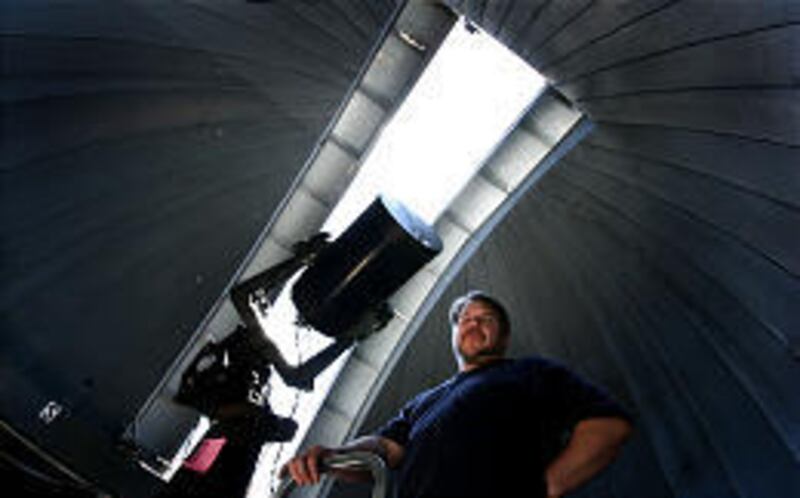

Utah's amateur astronomers have long known that some of the country's best observing is available in the southern part of the state. Now those stellar conditions have prompted the University of Utah to plan a robotic observatory there.
In fact, the U.'s project could be the first of a series of optical observatories to be built in the region, says Dave Kieda, professor of physics at the university.
Last week, the university announced that the Willard L. Eccles Foundation had donated $600,000 so the U. could build "a 32-inch (diameter), research-class, optical telescope in southern Utah."
The reflector, with its massive mount and tracking machinery, would be housed in an observatory whose location is not yet determined. It would be run by remote control, giving observers the chance to use the instrument without driving to it.
Besides researchers and university students, the telescope could be used for public star parties and astronomy camps. It could provide "dedicated observing time for high school, middle schools and community groups," according to the U.'s press release.
Although huge in terms of privately owned telescopes, the instrument is not large for a research facility. But scientists are carrying out important work with relatively small telescopes, Kieda noted.
"Because we own it, we can point it at whatever we want. . . . We can be free to explore and try a lot of surveying."
If something unusual turns up, the operators could seek a closer look using the Hubble Space Telescope or another big 'scope. "That's how a lot of science is getting done right now," Kieda added.
The university is already looking at several possible sites, he said, speaking by phone from Tucson, Ariz. The sites are dry settings at 9,500 to 11,000 feet altitude, outside proposed wilderness areas and with minimum light pollution.
According to the U., potential sites for the newly-announced optical observatory include Boulder and Parker mountains on the Aquarius Plateau near Loa, Wayne County; near Escalante; Frisco Peak about 20 miles west of Milford, Beaver County; and John's Valley near Hatch, Garfield County. But university officials emphasize they may examine other areas.
By mid-September the search should be narrowed to one or two places. Next, planners will talk to counties and mayors of nearby localities about the proposal.
"In the meantime the telescope will be on order," said Kieda.
The instrument will take about two years to fabricate. In the summer of 2007 ground may be broken and a trailer and concrete pads set up. In the spring of 2008 the manufacturers will begin installation, while university experts work on robotic features and a camera.
"By summer of 2008, it'll probably be pretty much ready to go," he said.
Meanwhile, several smaller telescopes and instruments will remain in use on top of the U.'s South Physics Building on campus. "In fact, Clark Planetarium (based at The Gateway) started using it this summer," Kieda added.
He was in Tucson working to build telescopes of a different sort for a project he directs, the Utah High Energy Energy Astrophysics Institute, which is seeking answer to mysterious, high-powered cosmic rays. The project is an international effort involving Japanese researchers and others in the U.S. Wayne Springer, associate professor of physics who is heading the optical observatory project, said that in 2000, the Willard L. Eccles Foundation donated $88,000 to upgrade the South Physics Building facility. The intention was to help build an astronomy program at the university. Today, the Astronomy Initiative Committee in the Physics Department is working toward that end, he said. The upgrade allowed Springer to teach a course on observational astronomy, where students learn to use telescopes, CCD camera and spectrographs.
"This fall we're offering an astronomy minor" in the U.'s curriculum, and he hopes a major in astronomy will be developed, leading to a graduate program in the field. "Having this research-capable observatory in southern Utah would be an important stepping stone to doing all that," Springer said.
Building the remotely operated observatory at high altitude in southern Utah makes sense to the experts. "Anyone who's been to southern Utah, looks at the night sky, it's like, 'Wow, it's gorgeous," Springer said.
The region has been neglected by the professional astronomical community. But Kieda points out that previous astronomical hotbeds near Phoenix and Tucson are feeling the invasion of light pollution.
National Park Service visibility tables show that seeing is better in southern Utah than in southern Arizona, he said. Some places in the Beehive state have a horizontal view of 120 or 130 miles, while at certain times in Tucson — especially during the summer monsoon season — it's lucky to see 10 miles horizontally because of rain and dust.
Southern Utah, Kieda said, is a "really promising area." Others already are interested in collaborating in the project, Kieda added. "I think you're going to see more telescopes once you get this first telescope built" and the astronomical community sees the results. Meanwhile, additional funds for roads, power, communications and other needs will be needed from the university and the state. According to Springer, quoted by the U., these could cost as much as $300,000 beyond the funding presently available.
E-MAIL: bau@desnews.com