

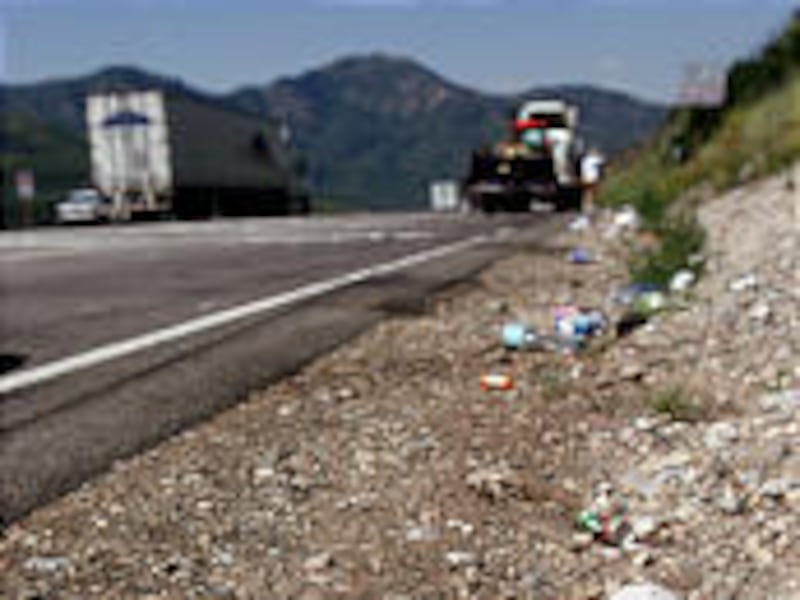

PARLEYS CANYON — Just to see the glistening, yellow-filled bottles is bad enough, but then the smell begins to permeate your nostrils, like the caustic sting of ammonia.
The culprit: urine and other human wastes, tossed on the side of the road in plastic bottles or bags, and left to bake in the sun. They've been dubbed "trucker bombs," and in Utah, this type of roadside waste is on the rise, according to state officials.
"We used to have certain areas of the interstate that we knew were problems, but now we're seeing it everywhere," said Nile Easton, spokesman for the Utah Department of Transportation. "Once you get out of the city, it's difficult to walk 50 yards without seeing some form of garbage or urine-filled bottle or bag of feces strewn across the side of the road."
During a recent trip up Parleys Canyon, 45 waste-filled bottles and bags were counted along a 100-yard stretch of road. Last year, UDOT estimates it removed upwards of 30,000 of these "trucker bombs" from the side of state highways.
UDOT does not track the specific cost of removing urine-filled bottles and other containers with human waste from the highway. But the agency spent $1.78 million in fiscal 2006 for general litter removal. In fiscal 2005, it spent $1.4 million.
"We could do a lot of good things with that money, outside of having to pick up people's urine-filled containers," said Easton.
It's also a "continuing problem" that could impact public health, said Jeff Snelling, watershed manager for Salt Lake City.
"Currently, there is no reason why the public should be concerned that this could cause problems with our drinking water supply," Snelling said. "However, any kind of feces, urine or item that contains bacteria — we want to discourage that in the watershed."
UDOT recently began hanging posters and maps at state rest areas to remind truck drivers and motorists to properly dispose of waste-filled containers. But David Creer, executive director of the Utah Trucking Association, said Wednesday that it may take a lot more than that to curb the problem. New federal regulations enacted in the past two years have limited how and when truck drivers can take bathroom breaks, Creer said. Drivers used to be able to "log out" when they were eating or making a rest stop, but now they're on-the-clock at all times during their shifts.
Taking a bathroom break cuts into the amount of time that drivers have to deliver their goods. Also, said Creer, there are not enough places for truckers to stop, even though Utah has over 70 rest areas.
"We think it's disgusting and it should never take place," Creer said. "But a good question would be, How can they be helped to encourage this not to happen?"
Chris Warrington, a truck driver from Wausaukee, Wis., said he regularly sees drivers toss urine-filled bottles from the cabs of their trucks. They do it, he said, because it's easier than stopping.
"It's kind of sad," said Warrington, who was testing his brakes in Parleys Canyon before heading into Salt Lake City.
A spokeswoman from the Federal Highway Administration said Wednesday that the agency was not aware of any federal programs to cut the proliferation of roadside waste.
In Utah, the fine for littering human waste is at least $100 per violation.
In Colorado, lawmakers last year increased the fine for littering human waste on the highway from $40 to $500, but it hasn't solved the problem, said Stacey Stegman, spokeswoman for the Colorado Department of Transportation. CDOT spends about $5 million a year on litter pickup, according to Stegman.
Easton, from UDOT, said Wednesday that he was hopeful truckers and other motorists would follow the advice printed on the posters now hanging at rest stops: "Please don't toss it out."
"It's a pretty disgusting thing to do," he said, "and it's a pretty disgusting thing to clean up."
E-mail: nwarburton@desnews.com