

Been swimming this summer? If it was more than 60 years ago and you were a northern Utah resident,your main aqua experience probably wouldn't have been in a swimming pool or reservoir, but rather the Great Salt Lake.
In a modern world full of technological inventions and conveniences, do we, at times, neglect the simple pleasures?
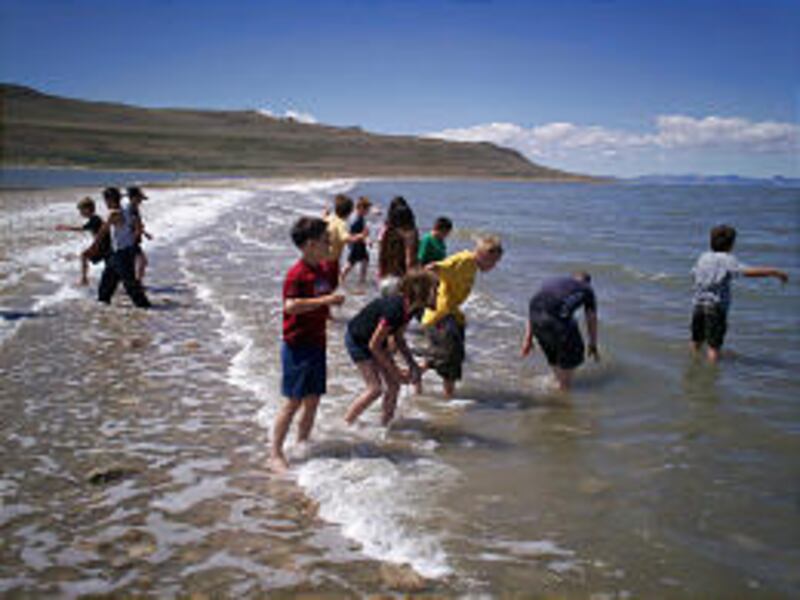
After a field trip last spring to the shores of the Great Salt Lake at Antelope Island with a bus full of fourth-graders, you've got to think so. Somewhat bored on the desert landscape of Antelope Island, the kids all came alive with energy and excitement once they headed for the briny lake waters.
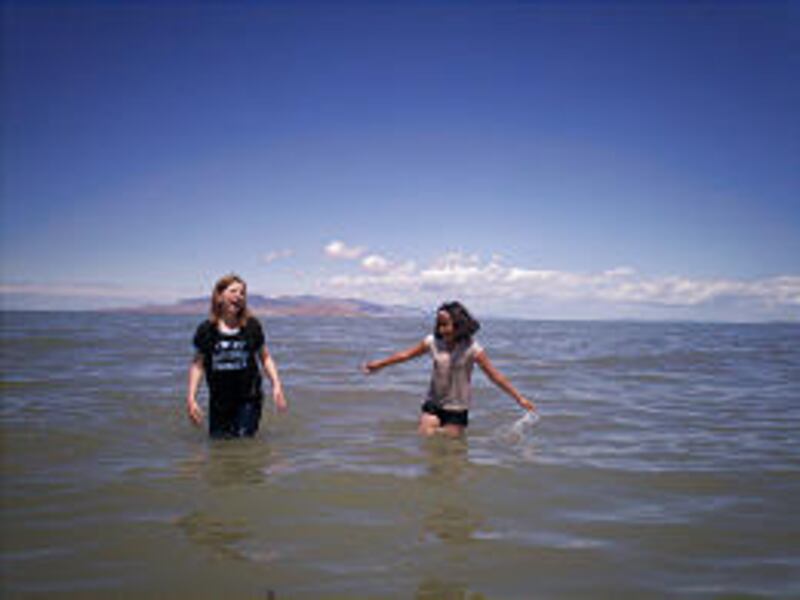
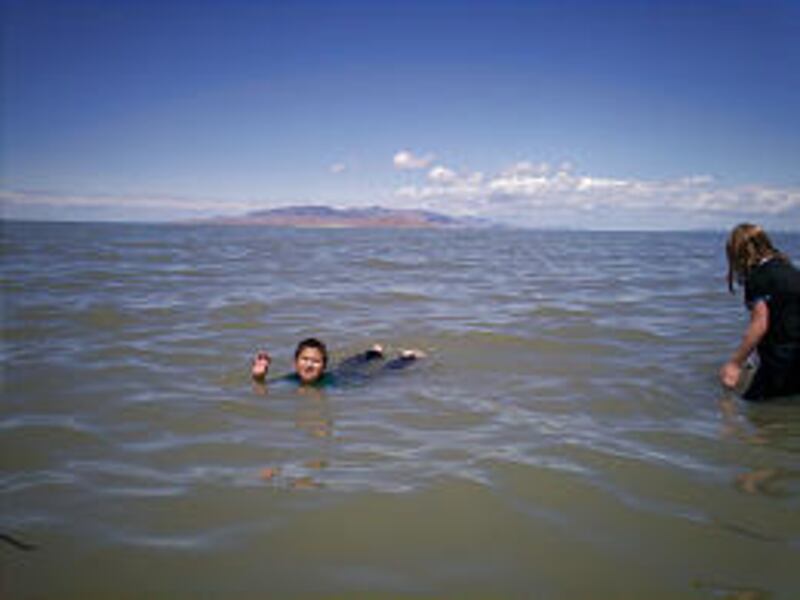
Gabriel Padilla, Abrial Garcia and Jenni Brockman — three fourth-graders at Layton's Vae View Elementary School this past year — couldn't resist swimming in the lake, despite the advice of their teacher.
Padilla, in particular, discovered the water was warm and that you could float with little or no effort.
His classmates stuck to wading and discovered other pleasures with the lake.
"I like playing in the sand, making sand castles and water pools," said Jaden Minor.
"I like skipping rocks," Andrew Astle said.
The students were in no hurry to leave the lake's shore and had to be rounded up like errant sheep.
Before World War II, "floating like a cork" in the Great Salt Lake each summer was probably as common as going to movies is today.
It used to be one of the hottest things along the Wasatch Front. Indeed, you might say we have a buoyant past.
"Try to sink'" and "Come on in, the water's fine — you can't sink" were all catch phrases of the Victorian era. LDS Church leader and pioneer Wilford Woodruff believed the Great Salt Lake should have been named the eighth wonder of the world.
Indeed, Utahns did more than name their city (originally Great Salt Lake City) after this large body of water — they seemed to have an instant love for it. Floating in the lake was how many of them wanted to spend their leisure time during the warmer months of the year.
As early as July 27, 1847, some pioneers had tried floating in the lake. Early pioneers described lake swimming as floating like a pickle or like an empty bottle. It was an unusual sensation, where waders became lighter and lighter and finally floated in the buoyant waters.
On July 4, 1851, hundreds of Salt Lake residents traveled to Black Rock beach on the south shore for a special day of picnicking and bathing. Brigham Young and Heber C. Kimball were on that trip, as was a brass band. Some people even slept overnight on the beaches before heading home the next day.
The coming of the railroad in the early 1870s finally spurred official lake resort development. The ride to Great Salt Lake beaches was reduced to less than an hour by the iron horse.
Eight bathing resorts sprang up around the eastern and southern shores of Utah's inland sea between Syracuse (Davis County) on the north and Lake Point (Tooele County) on the south between 1870 and 1893. It was bathing because you couldn't truly swim in such salty water. But that was one of its attractions — lakegoers didn't have to know how to swim.Claims were once made that lake waters could stop nervous disorders, rheumatism and other illnesses. Some people wore a handkerchief underneath their bathing cap so if a dose of salt hit their eyes, they had a clean cloth to wipe it away.
The Syracuse resort was located just north of today's entrance to the Antelope Island causeway.
Lagoon's first location was some 3 1/2 miles west of where it is today.
But when the lake began receding in the 1890s, salt flats produced the dreaded "lake stink," though some claimed the smell would grow on you and soon become almost pleasant.
In 1870, the lake's level was 4,210 feet above sea level. By 1890, that level had dropped to 4,204 feet, and by 1900, it was 4,201.
The most famous of the lakeshore resorts was Saltair, with up to a mile-long berm that went from Saltair to the lake's water in the 1940s and 1950s, and the resort's pilings looked like they were stuck in mud. It was no longer convenient for Saltair patrons to bathe in the lake.
Then the automobile became a love of Americans. By 1952, this had killed local passenger railroads. There was no longer train service to the lake. The Bamberger Railroad between Salt Lake City and Ogden died, also.
Utahns had their own cars to visit canyons, the state's national parks or drive to the Salt Lake beaches themselves. Motion picture theaters also became more popular.
Beach parties also no longer favored salt water.
The public realization in the 1950s that raw sewage had been dumped in the Great Salt Lake for decades — and the discovery that the lake's briny water didn't purify such waste — hurt local residents' attitudes toward lake swimming.
A resurrected Black Rock resort opened in 1933. Dancing on top of the rock was still a novelty in the Big Band era. A short-lived, small resort at Sunset Back on the lake's south shore also opened in 1934.
However, by the mid-1960s, I-80 had cut through the southern part of the lake and created a frontage road system that made it inconvenient to reach both Saltair and Black Rock, and the lake's water level was nearly at an all-time low at 4,191 feet above sea level. Most Utahns' love affair with the Salt Lake had evolved. It was OK to visit the lake's shore once in a while or to drive across the causeway to Antelope Island, but to actually swim in that lake water? Forget it.
The post-World War II generation abandoned the lake for a new world of diversified interests such as TV, movie theaters and sporting events.
E-mail: lynn@desnews.com