


PROVO — For someone typing four words a second, Jeff Eaton looks amazingly calm sitting in a courtroom, recording every word.
As one of only two stenographers — or certified court reporters — for 4th District Court, Eaton's fingers are usually in motion. Eaton and his co-worker, Barbera Surrey, are the eyes and ears of court proceedings, creating a verbatim record of everything everyone says.
Eaton and Surrey both attended court reporting school in California, where there are an abundance of fast-fingered typists.
But Utah's pool of speedy typists is a bit smaller. Until Surrey was hired almost four weeks ago, Eaton carried the 4th District load alone for seven months.
"It's like learning the piano," Eaton says of the stenography language. "It takes years (but) it becomes totally reflexive. Like a Bach or Beethoven, you don't think where your fingers go. Instead of pressing keys and hearing sounds, I hear sounds and press keys."
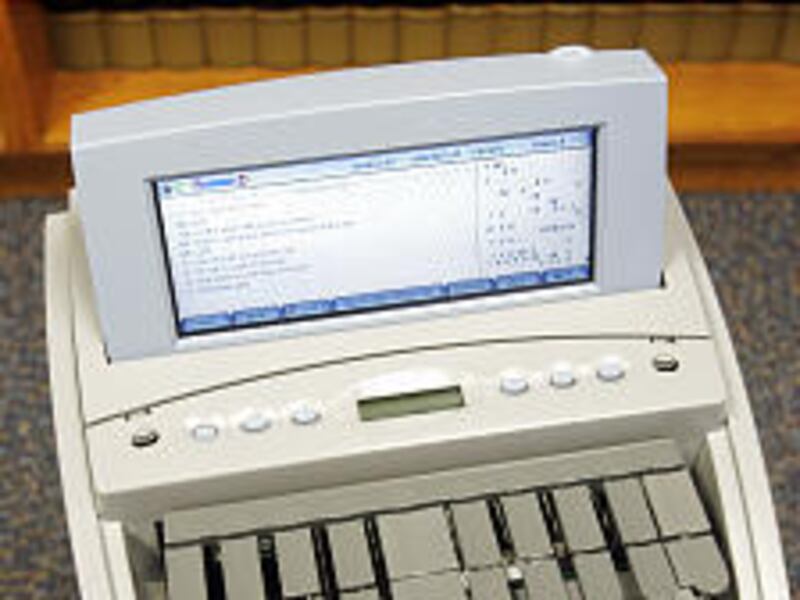
The reporters sit quietly in front of the judge, with a laptop wirelessly connected to their stenography machine. The 25-key device is smaller than a traditional keyboard and has no markings on its gray keys.
Unlike the traditional QWERTY keyboard, where one key is one letter, on a court reporter's machine there's an alphabet on each hand. Keys can represent letters as well as entire words and even phrases.
Using her right thumb, index finger, pinky and middle finger hitting two keys, Surrey can get the phrase "Your honor" in one stroke.
The special language and key system allows the stenographers to quietly type the legal patter at speeds nearing 300 words per minute. But more than just getting the words down, it's also important to note the circumstances and the context of comments, Surrey said.
Sometimes, she said, she'll have to stop and ask for clarification.
An attorney may ask a witness, "How long have you known someone?"
The answer: "For years."
Or could that be "four years?"
Or what about a witness who is trying to recall an event and says, "I don't . . . know." Does that mean they don't know or they remembered and decided in the negative — "I don't . . . no."
Those are the little things Surrey focuses on to ensure that later, when she's transcribing the stenography letters into readable English, she can make an accurate record.
"The reporter keeps an eye and ear on things that no one else (does)," Surrey said. "The No. 1 thing is the integrity of the record. In some cases, people can be put to death. You better have a good record."
For those who don't want the stress of a courtroom, there is freelance court reporting, which consists mainly of depositions — lengthy interviews between attorneys and witnesses.
Heather White works as a freelance court reporter for Citicourt Reporting in Salt Lake City.
"I could never have another job where I could make this kind of money and make my own hours," said White, who started in 1998.
She makes around $3.30 a page, as well as set fees of $75 for a half-day, $150 for a full day.
She travels to lawyer's offices around the state and takes time off when she needs. However, unlike certified court reporters employed by the government court system, White doesn't have health-care benefits or an insurance package.
Salary for a beginning certified court reporter ranges from $38,000 to $46,000 in Utah, Eaton said. Both agree it's a good job — especially with the perks of paid holidays and the court-provided expensive equipment.
But freelance or salaried, it's still a tough profession. Eaton started his schooling with 17 other students. He graduated in three years. One woman graduated in six.
Some just don't make it through all the classes — classes above and beyond stenography basics.
"You almost have to know as much law as an attorney, as much medicine as an open-heart surgeon and as much English as a college professor," Surrey said.
Utah used to have a stenography school in Murray, but it closed a few years ago, Eaton said.
But despite long days — often 12 or 13 hours long — it's a job that neither wants to give up. "Reporting was going to be a stepping stone to something else," Eaton said. "But I've not been able to find anything to replace the satisfaction."
Surrey admits it's a tough job but says she enjoys the challenge.
"Even though it's trying, there are a lot of personal rewards," Surrey said. " It's nice to be a part of the team and see justice done . . . knowing that you had an important part in it."
E-mail: sisraelsen@desnews.com