


OGDEN — For some 140 million years, the creatures we know as dinosaurs ruled the planet. Then, relatively suddenly and quite mysteriously, they disappeared — so completely that some 65 millions years later when early "bone hunters" began to come across enormous fossils, they had no clue what they were looking at.
It has taken the past two centuries to piece it all together, and even now there are gaps and holes.
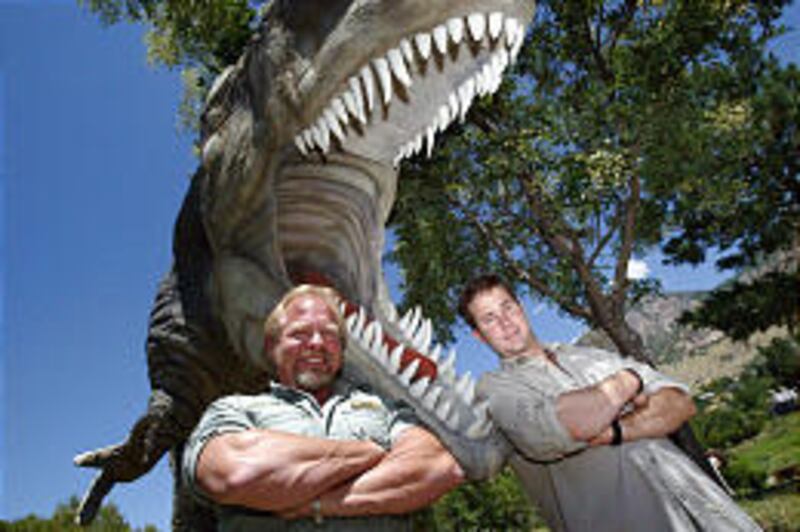
So far, paleontologists have uncovered about 125 different species of dinosaurs, says Kevin Ireland, executive director of Ogden's George S. Eccles Dinosaur Park. "But there are a lot more we haven't found. Scientists estimate that maybe about one-tenth of what's out there has been discovered."
Dinosaurs played an important part in the history of this planet, he says, and the study of them is not a dead science or even a dry-as-dust one, but a dynamic, ongoing discipline where new things are being learned all the time. "There's still a plethora of new, exciting discoveries to be made."
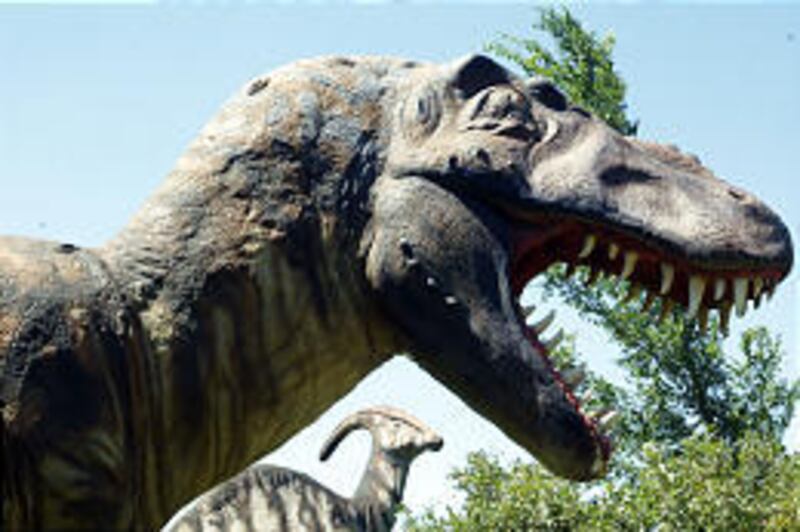
At the park, they are excited to be a part of that, he says. But for some time, it has seemed like the dinosaur park has been a well-kept secret all it's own. "We're trying to change all that," says Ireland. "We want to let people know that this is the largest dinosaur park in the country. We have more than a hundred models of dinosaurs scattered over eight acres, and what's more, 99 percent of them are indigenous to Utah."
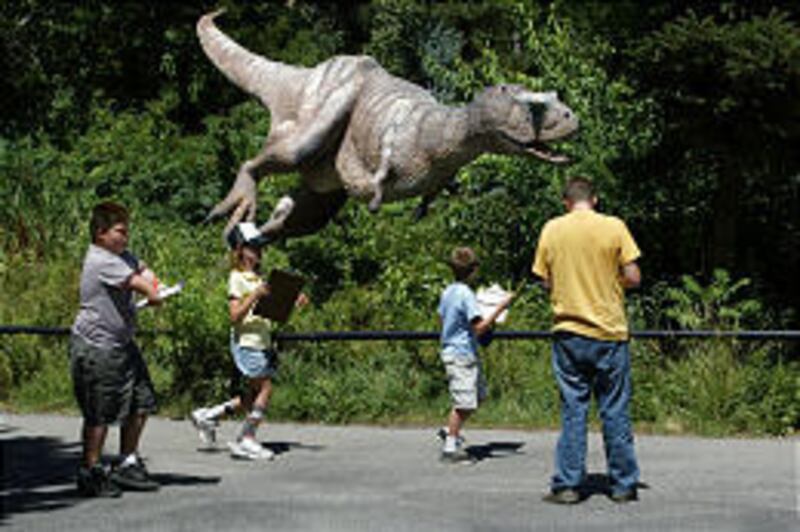
The dinosaurs are life-size or large-scale replicas and are tucked among trees and foliage, so that wandering the trails becomes an exciting journey of discovery. Intermittent sounds of roars and crunching footsteps also add to the ambience. "We want it to be fun, maybe even a bit scary at times," says Ireland. "We don't want dinosaurs to seem musty, old."
Even more than that, says park spokesman Zane the Dino Brain, "we want to make it cool to be into dinosaurs. We like to say we have cool down to a science."
Zane was introduced this summer. "He's the 'Mickey Mouse' of the park," explains Ireland. "He'll be an identifiable presence that knows all about dinosaurs."
"We want kids to know that science is not for nerds, it's for adventurers," says Zane. "Paleontologists dig up big, beautiful bones." He'd like to be able to do for paleontology what Indiana Jones did for archaeology, he says. "This is the place for an intense, bigger-than-life look at adventure from the dinosaur's world."
In addition to the dinosaur models in the park, the Elizabeth Dee Shaw Stewart Museum offers a look at the early history of the science. There, the "fathers of paleontology" are honored. Men such as Georges Cuvier (1769-1832), who worked at the French Natural History Museum studying mammoths and mastodons. He was the first to demonstrate that they were not related to modern elephants.
There's William Buckland (1784-1856), who identified the first teeth and limb bones and inaugurated the scientific investigation of them that continues to this day. And, Sir Richard Owen (1804-1892), who invented the word "dinosaur" — terrible lizard — for the extinct group of fossil reptiles.
A fascinating little exhibit here shows models of a crystal iguanodon and how, using the very same bones, it was put together in three different ways. In the 1850s, it was thought to have walked on all fours, and what later proved to be a thumb spike was used as a horn. By the 1950s, it was thought that the dinosaur walked erect, with its tail on the ground. From the 21st century comes the model that shows the tail being used for balance as all the limbs were used for walking.
The museum also contains skeletal models of several species of dinosaurs, including torvosauris, titanosaur, Tyrannosaurus-Rex and triceratops. Upstairs are a couple of robotic dinosaurs. A T-Rex attacks a triceratops, which is protecting her babies, in a scene that plays out with sound, movement and atmosphere.
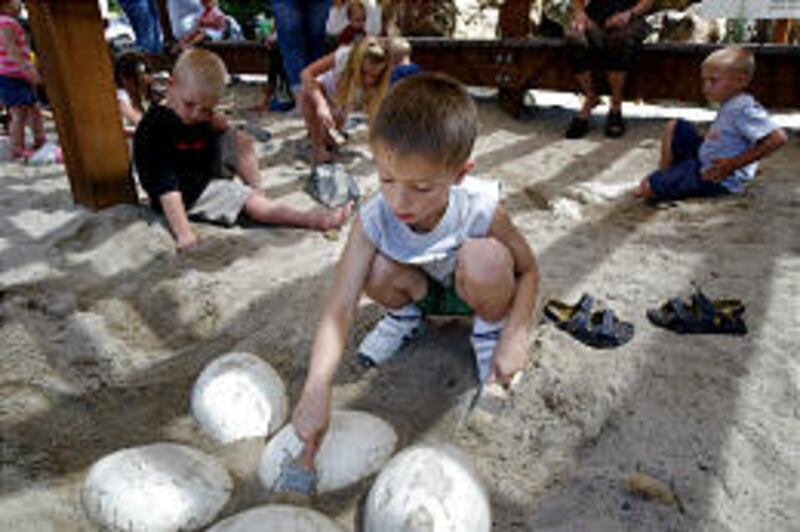
There's also an activity center, where children can pan for gold, split geodes and dig for gems. Outside in the park, there's an area where they can uncover the bones of a fossilized dinosaur. During the summer, the park has a full program of Dino Day Camps and art classes for kids ranging from 4 to 12 in age. "Education is a very important part of what we do," says Ireland.
Along those lines, he is also very proud of the state-of-the-art lab where scientists and volunteers, working under the direction of the state paleontologist, carefully prepare recently excavated bones for further study. "They come to us in field jackets, which encase the bone in plaster. Our people cut off the jacket and then clean and glue the bone together." It's a process that is meticulous and precise and can take up to six months or a year on just one bone.
"When they are finished, the bone's packed up and shipped to its owner, whether that's the Smithsonian or the Museum of Natural History or whomever."
Most are bones that have been found at the Cleveland-Lloyd Quarry in central Utah, the Dalton-Wells quarry near Moab or the Kalico Gulch quarry in northwest Colorado.
The volunteers are trained in special classes. Visitors to the museum can watch the process through the lab's glass windows. "It's a rare and unique opportunity," says Ireland.
Ogden's George S. Eccles Dinosaur Park is just over 12 years old. "The museum was added on four years ago," says Ireland. The complex is built over what was once a waste area. "They were trying to beautify Ogden, and came up with the idea for a dinosaur park."
They are still getting bigger and better all the time. For example, the museum was recently redecorated to add atmospheric paintings on the walls. They are hoping to add a guided tour with headsets that will provide more information about the dinosaurs in the park. They are adding an iguana exhibit, and hope to expand classes and educational activities.
There's also Zane the Dino Brain, who adds a cool, hip element. "We've got fun down to a science. We've got curiosity down to a science," he says.
He may know a lot about dinosaurs, but every now and then, he says, he gets tripped up by a 4-year-old who knows more. Zane gets a big kick out of that.
There's just something about dinosaurs that capture our imaginations, he says, something about the size and the mystique and the fact that they don't exist anymore.
"Here you can see the bones, you can see the colors of the skin. It's fascinating," adds Ireland. "Especially for kids, big is cool. And nothing's bigger than dinosaurs."
E-MAIL: carma@desnews.com