
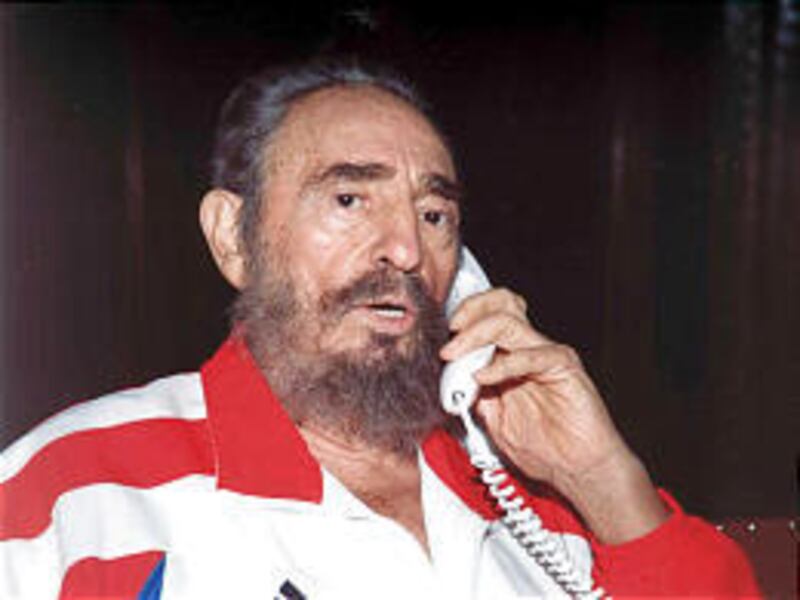
HAVANA — The first photographs of an ailing Fidel Castro appeared Sunday in a local newspaper along with a message attributed to the Cuban leader saying he was improving but still faces grave risks and a long recovery.
Raul Castro, Fidel's younger brother, also appeared in public Sunday for the first time since he became acting president two weeks ago, greeting Venezuelan President Hugo Chavez at the Havana airport.
The two men saluted and embraced but said nothing publicly. Chavez arrived in Havana around midday to celebrate Fidel Castro's 80th birthday Sunday.
Dressed in an Adidas warm-up suit, Fidel Castro is seen in the photographs speaking on the telephone, captured in a close-up with his hand supporting his chin, and posing with a supplement to Saturday's edition of the Communist Party daily Granma, a proof-of-life image designed to dispel rumors the 80-year-old leader could be dead.
Castro looks worn after undergoing intestinal surgery two weeks ago, but he also appears attentive, sitting upright in a chair, and his dark eyes look straight into the camera. A neatly made bed appears in the background of one photograph.
"I feel very happy," Castro said in a brief statement accompanying the four photographs published Sunday in the Juventud Rebelde newspaper.
"For all those who care about my health, I promise to fight for it."
But Castro gave a guarded assessment of his medical condition, explaining that he has "considerably improved" yet warned Cubans "to be ready to face any adverse news."
The streets of Havana were buzzing with news of the photographs, which were taken by Cuban authorities and could not be independently authenticated. Even though the supplement was included in Saturday's paper, some observers pointed out that it could have been printed days or weeks ago.
A line appeared early in front of Israel Alvarez's kiosk in Old Havana to snap up copies of Juventud Rebelde.
"I don't have any more," said Alvarez, 73, who sold his quota of 200 newspapers before 11 a.m.
Holding up his own copy of the paper, Alvarez said it brought him "great joy" to see the Cuban leader alive and expressed confidence that Castro "will live a lot longer."
But Rene Campos, who had just purchased a newspaper from Alvarez, said he thought Castro looked "old" and "deteriorated" and said he was unsure if the Cuban leader could return to his legendary work schedule.
"Look at his face and under his eyes," said Campos, a 78-year-old store clerk. "I don't see him in the same condition."
Drew Blakeney, a representative for the U.S. Interests Section in Havana, declined to comment on the photographs and referred questions to Washington.
Pepe Hernandez, president of the Cuban American National Foundation, a powerful Miami-based exile group, said that Castro looked "impressive" in the photographs but that the images could have been altered.
He said the photographs would dispel the notion among some exiles that Castro is dead. Yet they did little to clarify the state of Castro's health or whether he can ever return to power.
"We don't know if he can move or not or whether he can talk or not," Hernandez said. "We have no concrete answers on what is going to be the future of Cuba."
Damian Fernandez, director of the Cuban Research Institute at Florida International University, said Castro's warning to Cubans to prepare for adverse news indicates his health is precarious and he is laying the groundwork for a succession.
"He is getting the Cuban people ready for something," Fernandez said. "Between the lines he's saying that life goes on — that the revolution will live on — even if I'm not here."
Fernandez said it also was crucial for Raul Castro to appear at the airport to greet Chavez, who is providing well over $1 billion a year in assistance to Cuba.
"If there were any instance that required Raul to show his face it was this one because Chavez is a lifeline for Raul and Cuba," Fernandez said. "Here in Raul and Chavez you have Fidel's dual successors."
The startling photographs and Raul Castro's first public appearance come on a day when the elder Castro, a Latin American icon and the world's longest serving head of government, celebrated his 80th birthday.
Elaborate birthday celebrations were postponed until early December after Castro underwent surgery. He has not appeared in public since the operation.
Despite the tension and uncertainty in Cuba, a concert was held in Castro's honor Saturday night along the Malecon, Havana's seaside boulevard, and a photographic exhibit of Castro's life opened Saturday in Old Havana.
Castro is the only leader most Cubans have ever known, and he is treated by the state-run media and by his own ministers as an all-knowing figure that is infallible.
"He's never made a mistake in his life," said Daisi Prendes, a 43-year-old farmer from Castro's hometown of Biran in eastern Cuba. "Whoever doesn't love Fidel doesn't love anything."
Praising Castro for providing her with a home, free health care and education for her five children, Prendes said she got the opportunity to meet the Cuban leader last year when he came to Biran to inaugurate a school. She wanted to thank him personally.
"I was right next to him," she recalled. "I wanted to give him a kiss but I couldn't. I was so emotional. I was crying. I couldn't say anything."
But the continued political repression in Cuba has chipped away at Castro's international image, while also sowing fear on an island where some Cubans are afraid to speak his name, preferring instead to use their hand to make the shape of a beard.
Hardships at home also have led even Cubans who admire his audacity and courage in the face of continued U.S. aggression to question his leadership.
"He went up into the mountains. He won the guerrilla war. That's not a movie. That's real life and you've got to respect him for that," said one Cuban who asked not to be identified out of fear of government retribution.
"But I hope he's not around much longer," the Cuban added. "I don't want my kids to live though this. I don't want to have to send them to another country."