


Most Utahns continue to consider themselves more patriotic as a result of the Sept. 11, 2001, attacks on the United States — but a growing number no longer share that feeling, according to a new poll.
While 72 percent of residents surveyed statewide for the latest Deseret Morning News/KSL-TV poll said they have a deeper sense of patriotism post-9/11, nearly one-fourth said they don't.
The poll, conducted for the newspaper and television station by Dan Jones & Associates, was conducted Aug. 28-31 of 425 Utahns and has a margin of error of plus or minus 5 percent.
The results are a significant change from the first time Utahns were asked that question, in October 2001. Then, an overwhelming 92 percent considered themselves more patriotic with just 8 percent saying the attacks hadn't affected their level of patriotism.
"Immediately after, we really were a united country," said Kirk Jowers, director of the University of Utah's Hinckley Institute of Politics. "So there really was that strong feeling of America and sticking together. We didn't yet have the baggage."
Concerns raised about some of the methods used by the Bush administration to counter terrorism — such as questioning the patriotism of anyone opposed to war — has caused conflicting feelings among many Americans in the past five years, Jowers said.
"That whole mentality of, 'either you support the war or you're not patriotic' was a turn-off to people," he said. "We all want our government to protect us, but we're very divided on how it does that and what measures we will accept. Utah is no exception."
Pollster Dan Jones agreed. "More people are starting to question the war," he said, even in Utah. Jones said it would take something on the scale of capturing terrorist leader Osama bin Laden "for the people to become more united and feel we are starting to win the battle."
The divide created over whether dissent can be considered patriotic was evident in the reaction to protests surrounding President Bush's visit to Salt Lake City last month to deliver the first in a series of speeches intended to boost lagging support for the war in Iraq.
Salt Lake Mayor Rocky Anderson's involvement in an anti-war rally during the visit attracted both cheers and jeers from Utahns, and some of his critics went so far as to challenge his patriotism.
But even as the president warned during his speech to the American Legion that giving up the fight overseas would mean facing terrorists here at home, he made a point of describing those who want to end the country's involvement in Iraq as both sincere and patriotic.
"Bush finally realized there can be patriotic protesters," Jowers said, something that could eventually help reverse the trend identified in the poll results as people decided they couldn't call themselves patriotic "in the sense it was being defined by their government."
That drop in patriotic feeling does not mean, however, that Utahns feel the administration's efforts haven't been effective. The poll found that 73 percent believed the country's anti-terrorism efforts have made the United States safer than it was on Sept. 11, 2001.
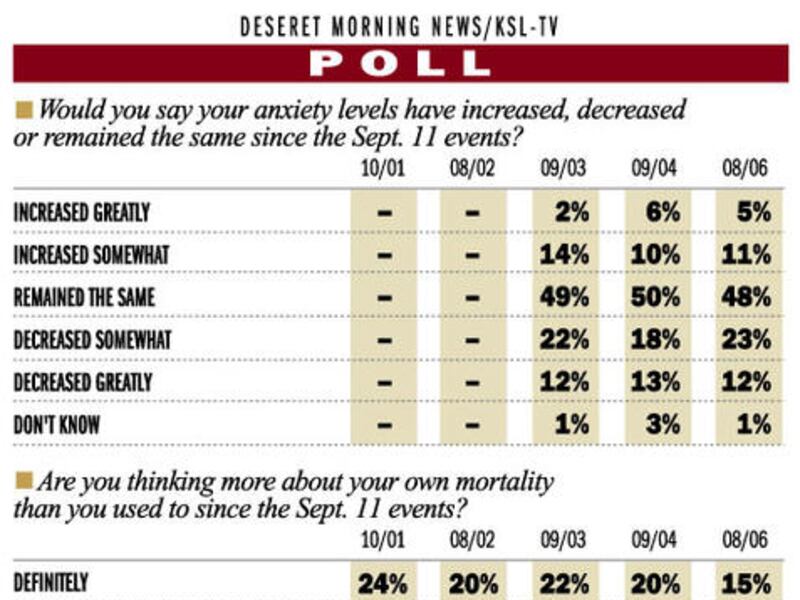
And 60 percent of Utahns polled said they did not believe it was likely they or someone they know would someday become a victim of a terrorist act on U.S. soil. Around one-third of respondents over the past three years have said their anxiety levels have decreased.
"Utah still supports its president more than any other state in the country, and this poll seems to bear out that it has faith in the way he's protecting us from terrorism," Jowers said. "But as in the rest of the country, there are people here who have issues."
That's inevitable, he said, in the long-term aftermath of the attacks.
"Nobody wants another 9/11 attack to occur, and yet we are conflicted about how far the administration has to go to protect us. Every step the administration takes in the name of keeping us safe will cause questions."
E-mail: lisa@desnews.com