

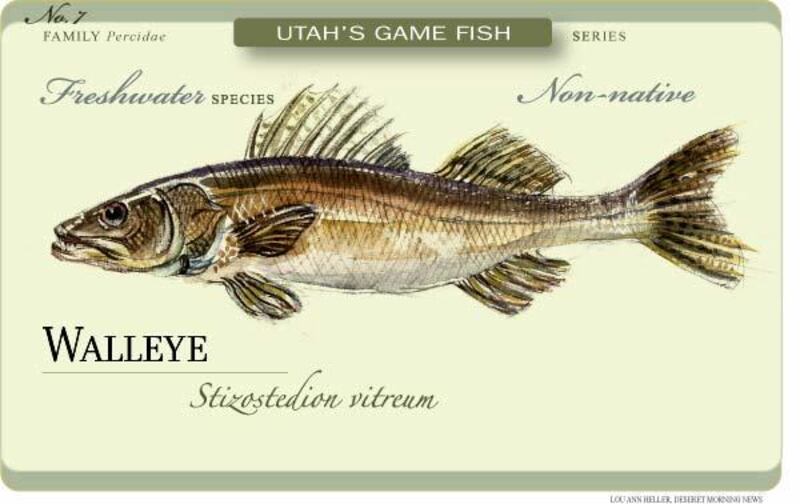
Description
Also called pike-perch, yellow pike and pickerel. It is the largest member of the perch family. The walleye has an elongated body and is best identified by the large, glassy eyes and intimidating canine teeth. The fish has a greenish or brown upper body with a few darker saddlelike markings or splotches on the back, which fade into a yellow or white belly. The tip of the anal fin and tail are sometimes tipped with white. The dorsal fin and anal fin have sharp spines that require careful handling.
Characteristics
The walleye is a very popular game fish in the Great Lakes region but has not gained the same recognition here in Utah, mainly because it is not an easy fish to catch by traditional Utah fishing methods. Best fishing is during the spring spawn or during low lighting conditions, i.e. early mornings and evenings and at night. Because of this characteristic, nature has given them large, glassy eyes that allow them to see better under dark and low-light conditions. They prefer cold-water lakes and rivers and head for deep water during bright daylight hours where they remain dormant but will feed if food is available. First planted in 1951 in Utah in Gunnison, Delta and Yuba reservoirs, and Utah Lake, it has expanded its range, sometimes through illegal planting by individuals. Walleye typically feed on crayfish, other fish, leeches, worms and insects and grow rapidly where forage allows.The world record fish weighed 25 pounds. The Utah record is 19 pounds, 9 ounces, and was pulled from the Provo River in 1991. Most walleye, however, range between 1 and 4 pounds. Many consider the walleye to be the best of the freshwater fish for eating as the flesh is white, flaky and has a mild flavor. When hooked, the walleye puts up a fair fight, but its endurance is short. It is found in most states in the United States except Alaska, Maine, Delaware, California and Florida.
Location
Nationally, walleye inhabit both lakes and rivers, but in Utah they are most common in lakes and reservoirs. Walleye are caught in rivers mostly in the spring when they run out of lakes in which to spawn. Rivers with walleye populations are the Provo, Sevier, Jordan, Bear and the lower reaches of rivers that run into lakes that have walleye populations. Walleye can tolerate a wide range of conditions and are found in fisheries ranging from Utah Lake's murky water to Deer Creek and Lake Powell's crystal water. Distribution of walleye has been controlled, because female walleye can lay hundreds of thousands of eggs and can severely impact other fish populations. Utah has significant populations of walleye in Yuba, Willard Bay, Starvation, Deer Creek, Lake Powell and Gunnison Bend reservoirs and Utah Lake.
Bait/lures
Generally, walleye stay close to structure, be it the bottom of a lake, along rocky shore lines or near weed beds. They will move about to find food, and anglers can often find walleye by locating forage. Trolling is an easy way to locate walleye, but the lure or bait must be presented slowly and just above the bottom. Best baits for walleye are night crawlers, leeches and minnows. Walleye can be caught by still fishing bait, especially minnows, but dragging a worm or leech along the bottom with a bottom-bouncer rig is more effective. From shore, lures are the best way to catch walleye. Fish from sunset to dawn and concentrate on rocky, wind-blown shorelines. Best lures from shore are plastic grubs or leeches fished on lightweight jig heads so they can be fished slowly. Best hard baits from shore are suspending lures like Lucky Craft Pointers, Rapala Husky Jerk and Shad Rap. Fish lures parallel to shore and use a stop-and-go technique. Fly fishers do well from shore casting black, red, white or yellow streamers with a sink-tip fly line.
Note: Because of its voracious appetite and rapid reproduction, a 12-pound female can produce more than 380,000 eggs. This has resulted in the walleye being a problem in some water.
— Byron Gunderson, Fish Tech Outfitters, contributed to this story