

Description
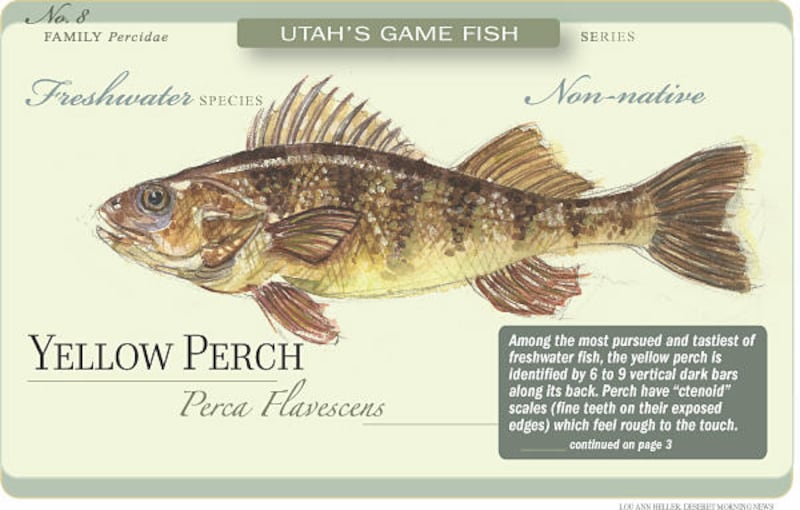
This popular game fish is also known as the American perch, striped perch, lake perch and ringed perch. This is a midsize model in the perch clan, characterized by dark vertical bars on its side, an olive-green back and yellow or golden sides. The belly is lightly colored. It has two dorsal fins. The first or frontal dorsal fin has sharp spines that can inflict a painful jab. The tail is slightly forked and it has no canine teeth.
Characteristics
The yellow perch is a popular game fish. When not overrun by predators, it is plentiful, easy to catch and is a good fish for younger anglers because the catch rate can be fairly high. It is widely distributed across the country and in much of lower Canada, and is among the better known warm-water game fish. It has a love/hate relationship with many Utah anglers. Those fishing for trout can get annoyed at catching nothing but perch, but those who enjoy a good fish dinner love nothing better than to hook perch. Yellow perch can also overpopulate a water, causing stunting and destroying food sources for other fish. Perch spend most of their lives in large schools, which means that once one fish is caught the likelihood of more fish being in the same area is excellent. This is not a particularly large fish. Most of those caught weigh less than a pound. A 2-pound perch is a good catch, and anything larger is rare. The world record is 4 pounds, 3 ounces and was caught in 1865. The Utah record is 2 pounds, 11 ounces and was caught in 1984. The yellow perch is not native to Utah. It was brought into the state in 1890 and first planted in the Weber River.
Location
Yellow perch can tolerate a wide range of water quality from low and murky to high-elevation and clear. In Utah, perch have found their way into many of the midelevation reservoirs and lakes. Deer Creek Reservoir is perhaps Utah's best-known perch fishery. Early in Deer Creek's history, perch numbers were so high that catches numbering in the hundreds were common. The perch was referred to as a trash fish at the time, and there was no harvest limit. Eventually, anglers began to recognize the table quality of perch and large numbers of anglers came to harvest perch, especially through the ice in the winter. Today, perch numbers at Deer Creek are low and a limit of 10 perch is in place. As perch numbers fell at Deer Creek, anglers began to look for other waters with perch populations and discovered huge perch at Yuba, and large number at Pineview and Fish Lake. Other waters include Rockport, Starvation, Hyrum, Echo and Jordanelle reservoirs. Other fisheries with good perch populations are Newton, Gunnison Bend and Mantua reservoirs and Utah Lake.
Bait/lures
Yellow perch are most often thought of as bait eaters, but they can be caught on lures and flies as well, and many are caught incidentally while lure fishing for other fish. Perch eat insects, minnows, plankton, worms, crayfish, leeches and just about anything they can get in their mouths. In the spring, perch spawn in shallow water, and at this time are easy to catch from shore by sinking a worm in traditional fashion or from a boat by tipping a jig or lure with a piece of worm and lowering it to the bottom. After the spawn, perch move into schools and move near the bottom looking for food. As the water warms, they move deeper and may be as deep as 60 feet. Schools of perch are easy to spot with a fish finder and vertical jigging with a 1/4-ounce Kastmaster or Deadly Dick or Drop Shotting with a small tube or grub will catch fish. Best jig colors are silver, chartreuse, olive or pumpkin. Perch are a favorite target of ice anglers because they remain active during winter months and readily take lures. Early ice season finds perch at moderate depth, from 25 to 40 feet, and hits are usually fast. Use 1/8-ounce lures tipped with wax worms, perch meat or perch eye. Late season finds perch deeper and bites get light and harder to detect. Drop an ice fly below a 1/8- to 1/4-ounce lure and fish it just inches off the bottom. A bobber or wire strike detector makes spotting bites easier. Best ice flies are Genz Worm, Ratso and Ratfinkee in chartreuse, green, orange and glow. Best ice flies are Flyer and Slim Jim in glow green and chartreuse. Perch brought to the surface from depth greater than 30 feet will be unable to swim away when released because their air bladder expands and paralyzes them.
— Bryon Gunderson, Fish Tech Outfitters, contributed to this story.