

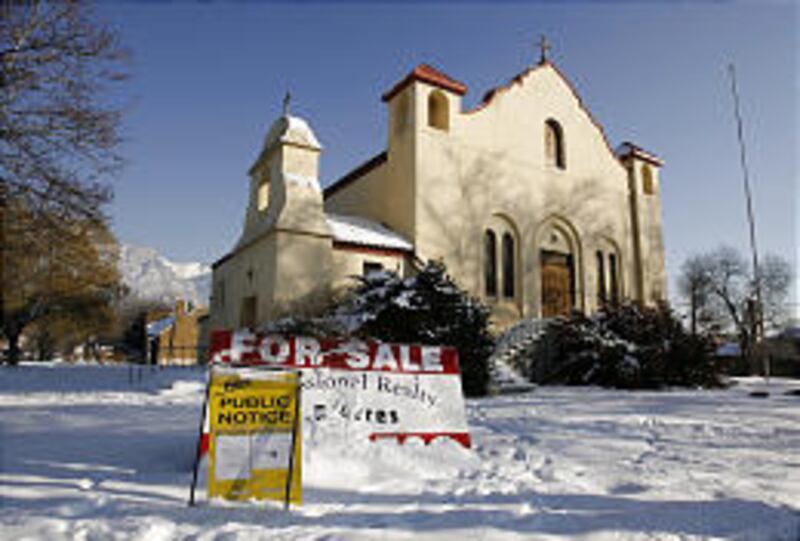

PROVO — In April 1997, exasperated Brigham Young University professor Juliana Boerio-Goates knelt to ask God why a third attempt to renovate her church's historic Provo building had been blocked by city planners.
The answer, she recalled this week, went something like this: "You knuckleheads, how many road blocks do I need to put up so you realize you're not supposed to be here anymore?"
Her Roman Catholic congregation got the message, pulled up Provo roots that date to the 1870s and sought greener pastures in Orem.
Those pastures don't yet include a large chapel, which the parish can't afford because it can't sell the old Provo church property. Prospective buyers balk when they learn the Spanish mission-style building erected in 1923 is preserved on Provo's Landmarks Register, a designation the St. Francis of Assisi Parish didn't seek and doesn't want.
Once again, the church has lined up a buyer who wants the property — if its uses aren't restricted by the landmark listing. The sale could bring $1.2 million, enough to start work on the Orem chapel, but the Provo Landmarks Commission refused this week to delist the building at 172 N. 500 West for fear it might be bulldozed.
The impasse has left the abandoned Provo church grounds to drug dealers and vandals while the parish's skyrocketing membership celebrates six cramped Masses each weekend in a gymnasium built adjacent to the planned site of its new worship sanctuary at 65 E. 500 North in Orem.
Despite the hardship, Boerio-Goates said hindsight proves the move was inspired. When the parish left Provo in 2000 after its last application for renovating the church to hold 300 seats was denied, it planned to build the future Orem sanctuary with 600 seats. Now the parish envisions a need for 1,200.
For now, worshippers sit in folding chairs and kneel on the gym floor. Every weekend, the three Spanish-language Masses are standing-room only.
"We had no vision then of what we'd need," Boerio-Goates said. "Our needs now far outstrip what we could have done with that site in Provo. In retrospect, I'm grateful Provo denied our application."
She wasn't feeling grateful Wednesday when a renewedly exasperated Boerio-Gates and the parish priest, the Rev. Mike Sciumbato, stood before the Provo Landmarks Commission to request that the church be removed from the register.
The commissioners voted 4-1 against delisting, even though city staff recommended it.
If the City Council also rejects the request, Sciumbato said, it will appear the city will do for Brigham Young University, owned by The Church of Jesus Christ of Latter-day Saints, something it won't do for the Catholic Church.
In 2002, BYU asked the Landmarks Commission to delist Amanda Knight Hall, which accidentally found its way onto the register in 1996 after a student nominated it as part of a class project. The nomination was accompanied by BYU's request that it not be accepted, but somehow the building was listed anyway.
Landmarks Commission Chairman Stephen A. Hales expressed sympathy and said religion wasn't an issue. The vote, he said, was consistent with the commission's actions in 2002, when it also refused BYU's 2002 request. The Provo City Council then reversed the commission and removed Amanda Knight Hall from the register.
Sciumbato, an attorney affectionately known as Father Mike to parishioners, now hopes the council will follow the BYU precedent.
That appears likely, although Hales and other commissioners don't want to see Provo's only Spanish Mission-style building torn down and said the city ordinance doesn't allow the City Council to delist a landmark unless it loses its historic value.
Of the 2002 decision by council members to release the BYU building, Hales said, "It seems to me they did that extralegally."
Sciumbato said Provo didn't follow its ordinance when it listed the St. Francis site in 1996. The city has been unable to show that it provided required notices to the Catholic Church of meetings where the Landmarks Commission and City Council voted on the matter.
The Salt Lake Diocese received one letter for a meeting that wasn't held, and replied with a letter saying it didn't want the landmark designation if it would limit use of the property in any way.
None of the councilmembers who voted in 1996 to put the St. Francis property on the register are still on the council. Only two remain from the council that voted in 2002 to remove the BYU property — Cindy Richards and Barbara Sandstrom.
Richards wants to research the case, but Sandstrom told the Deseret Morning News she will vote to remove the St. Francis property from the register. So will City Council Chairman George Stewart.
"It would seem we would be somewhat prejudiced toward the predominant religion if we didn't," Stewart said. "I'm sympathetic to their plight and so are others on the council."
The matter probably will reach the council in March. In the meantime, those who want to save and restore the building — and restoration alone could cost nearly $1 million — hope to find a buyer who will preserve it.
"The Catholic Church desperately needs $1 million. Why don't we come up with it?" Provo preservationist and activist Shirley Paxman said during Wednesday's Landmarks Commission meeting. "I'm challenging everyone interested in historic preservation to step forward. They need $1 million for a sanctuary so they can worship according to the dictates of their own conscience."
E-mail: twalch@desnews.com