

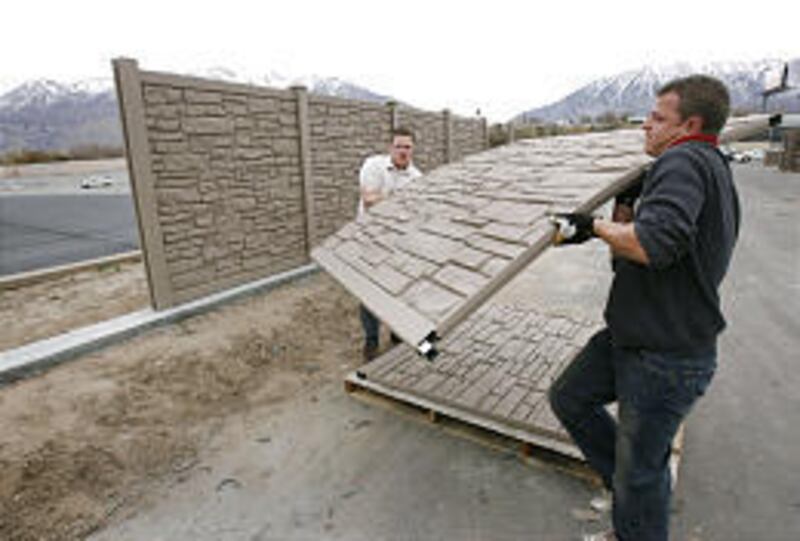
OREM — Try marking your territory on this fencing material made in Orem. The paint won't stick.
Similar to Teflon, paint won't adhere to Mity Fence Systems' stone-like panels if it's cleaned off early with a citrus-based cleaner.
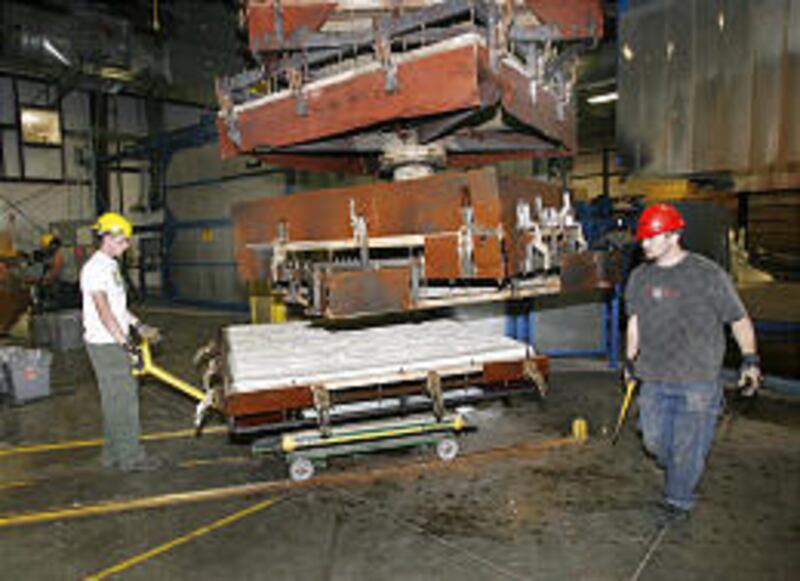
For the past year Mity Fence Systems has been manufacturing the simulated stone fencing in west Orem. It's fascinating to watch — transforming a bucketful of polyethylene polymer powder into a fence panel that looks and feels like stone.
"Though a polymer, this material is much different than vinyl. All of the manufacturing, market testing and product testing is being done at our manufacturing facility here in Orem," company president John Johnson said.
The panels, which have steel embedded in the top and bottom rails for added stability, are slipped into grooves in fence posts. The panels can be turned upside down to create variety in the stone pattern. Installing the fence takes more attention than vinyl or wood, said dealer Alex Hunt.
Mity Fence is currently installing a simulated stone fence between its property and Orem's public works. With Mity Lite sharing the cost the price is about the same as if the city had gone with chain link, Johnson said.
The fencing material starts as a polymer powder in a variety of colors from gray to brown to white. The molds and even the software that runs the rotation molding process — called rotomolding — were created on site, said Dru Laws, engineering director. The molds cook the polymer at 700 degrees Fahrenheit while rotating.
To test the fence panels Mity Fence researchers set up a popular white vinyl fence panel alongside their own simulated stone panel, then took aim with a softball pitching machine. The softball went through the white vinyl fence on the first pitch but it took more than 70 pitches to produce the first crack in the simulated stone fence.
Not surprisingly, some vinyl fence companies have started to stock the new fence panels.
Mity Fence sales manager Rich Smith is busy setting up distribution points with the farthest east in Denver so far. There are three Utah County dealers, two in Salt Lake County. The company has also received inquiries from the Eastern Seaboard and sells through its Web site: www.mityfence.com.
The company foresees building more manufacturing plants across the country to cut shipping costs as the market for the maintenance-free product grows. Thus far, sales have topped just $250,000, but the plant has the capacity to create $10 million a year in sales, Smith said.
Among the newest customers is The Church of Jesus Christ of Latter-day Saints, which used the panels to block the view of unsightly roof equipment outside the temple matron's window on Temple Square in Salt Lake City.
"We get people stopping and asking what it is at our installs," Hunt said.
The price deters some, he said. Pricing at about $40 a foot installed is more than white vinyl or wood but less than precast concrete.
Hunt has 10-year-old white vinyl at his own home he plans on replacing with the new product. White vinyl gets brittle in Utah's cold winters and cracks, he said.
E-mail: rodger@desnews.com