
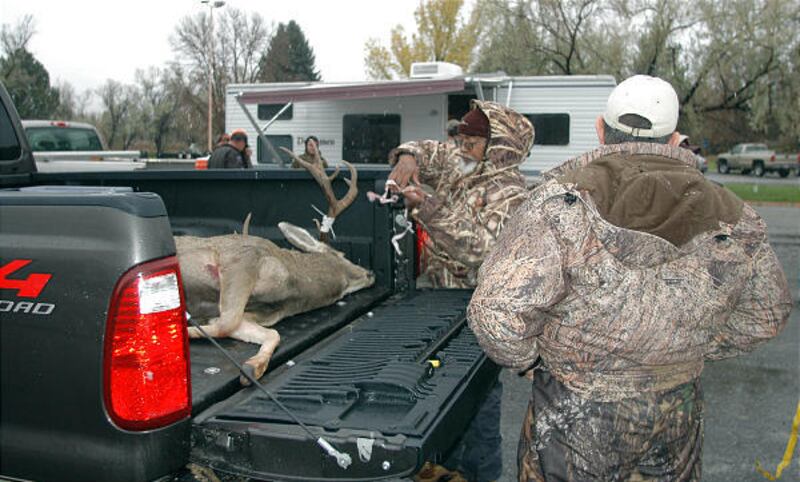

The opening day of the Utah general deer hunt was, as to be expected, slow. In some areas of the state, it was significantly slower then past opening days.
Bad weather, which included heavy snow, high winds and fog, hit the northern two-thirds of the state on Saturday.
Even in the southern reaches, brisk winds and cold temperatures kept deer in protected areas, which made them difficult to spot.
In areas of bad weather, wildlife officers reported that visibility was very poor and roads were muddy, so many hunters either chose to return home or parked on paved roads and hoped luck would follow them into accessible areas.
The pre-hunt forecast was that hunters could expect to see more yearling bucks this year, and early counts from check stations would support that prediction.
In the northern region, Scott McFarlane, big game manager for the Utah Division of Wildlife Resources, felt that most of the deer taken were shot in the first couple of hours, before the bad weather hit.
He also expected deer to start moving to lower elevations because of the poor weather conditions.
In the northeastern region, Ron Stewart, outreach coordinator, said bad weather wasn't a factor until about 2 p.m. in the afternoon.
"We saw a lot of hunters starting to pull up camps on Saturday and several who didn't even bother to set up camps, but parked and waited," he said.
"At the check stations, a lot of hunters chose to head home early. It was a very different hunting pattern than we usually see in the region."
At the Strawberry station, for example, overall success the opening weekend was at the lower end of the long-term average.
Stewart said the fall deer count showed that the number of bucks was rebounding.
"Back in 2004, it snowed the night before the hunt and pushed a lot of the bucks down. A much higher percentage of bucks were taken that year. Because of it, our buck-to-doe ratios were below objectives in 2005 and 2006, and for the first time were above objectives this year," he said. The management objective is around 15 bucks per 100 does.
He said he expected success to improve, especially for those willing to hunt during the week when the weather improved.
In the central region, Scott Root, outreach coordinator, said there were a lot of trucks and trailers coming off the mountains early on Saturday.
Conditions Sunday were much better, but the overall deer count in the region was down. And, most of the deer checked opening weekend were yearling bucks.
Dewayne Mower, big game biologist, said the check station at Salt Creek Canyon checked only about a third the number of deer as last year. Only five prime or three-and-a-half-year-old deer or older were checked over Saturday and Sunday.
He also noted that he heard more shooting early Tuesday in the area than he did on Saturday.
Dennis Southerland, big game biologist, said the three-day count at the Santaquin check station showed there were 75 fewer than were counted a year ago.
About half of the deer checked were yearling bucks.
Lynn Chamberlain, outreach coordinator, said the weather in Iron, Washington and Kane counties was dry, but was windy and cold.
"I heard of some pretty good hunting around Paragonah and Monroe Mountain, "but other than that, hunting was slow on Saturday, but improved on Sunday, Monday and Tuesday," he said.
Those hunters venturing out for the second weekend can expect good weather, but roads into the backcountry will likely be muddy.
Consensus was, too, that the bad weather opening day got some of the deer moving down to lower elevations.
Those hunters planning to hunt the final weekend will likely find hunting easier and more successful.
The hunt ended in the southern and southeastern regions on Wednesday. It will close at dusk on Sunday in the other three regions.
E-mail: grass@desnews.com