

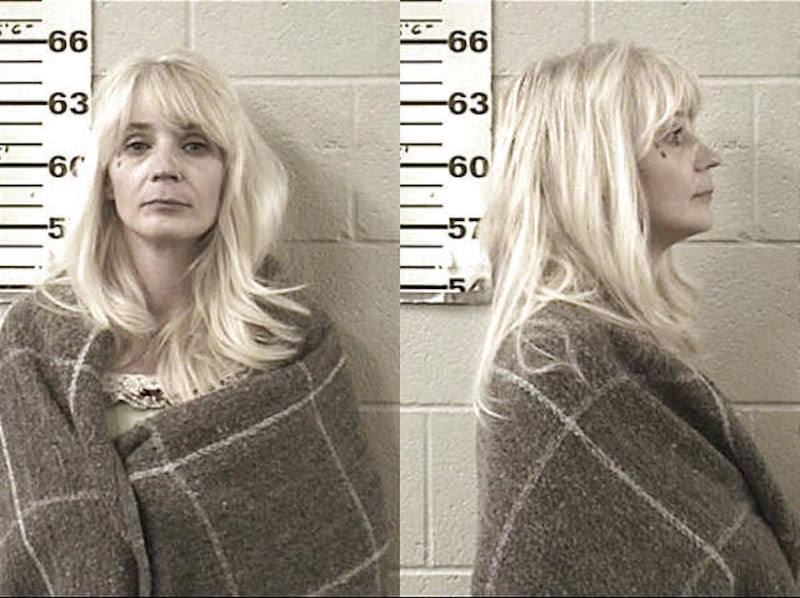
WENDOVER — Sylvia Tripp needed another pair of shoes. So, on a Wednesday night in mid-August, Wendover Police Chief Vaughn Tripp, 50, headed across town to the club where his 39-year-old wife performed as an exotic dancer.
Vaughn had been raised as a Mormon, and while no longer attending services every Sunday, remained a teetotaler. Sylvia was a German immigrant with blond hair and a slender figure. She battled an addiction to pain pills in the aftermath of a car wreck. The Tripps had been married 16 years. Each brought one child to the union. Vaughn's friends and relatives were ambivalent about the match.
"My son has a problem picking wives," said Tripp's mother, Gertrude, 78, the town's unofficial historian and a City Council member. "But he always kept his troubles to himself."
The trouble began six years earlier.
A dancer missed her shift at Southern Xposure, a "cabaret" located in a strip mall just across the Utah state line in West Wendover, Nev.
Co-workers coaxed Sylvia, who was working behind the bar, to step in.
Sylvia quickly discovered there was more money to be made swinging from a stripper's pole in pasties and G-string than pouring beer at the bar.
"I didn't know what I was doing, but at the end of the night it was like, 'Wow. This is really good money,"' she said.
Vaughn was not pleased, but he made peace with Sylvia's new job, reasoning: "She's got her life, and I have got my life."
But as he pulled into the parking lot at Southern Xposure with his wife's shoes, Tripp could see something was amiss.
Several West Wendover police officers, along with state narcotics officers, were near the entrance. Tripp rolled up to Ron Supp, chief of the West Wendover Police Department and his Nevada-side counterpart.
"Should I not be here?" asked Tripp.
"I wouldn't be," Supp replied, "if I were you."
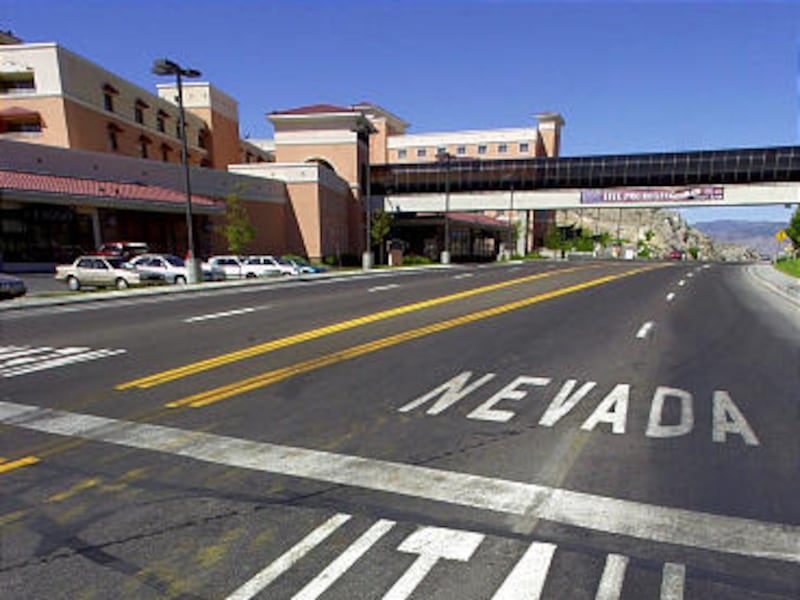
Wendover, Utah, celebrating its centennial in 2007, is located where Utah bumps into Nevada. What is striking is the disparity created by the border — represented by a white stripe painted across Wendover Boulevard.
On the Utah side, Wendover is a struggling town of 1,000 people. Blight coexists with the occasional well-kept residence and the brick edifice of the Wendover Ward of The Church of Jesus Christ of Latter-day Saints.
Across the line rises West Wendover, Nev., a neon oasis of hotel-casinos that melds into tidy neighborhoods. Incorporated 15 years ago, the town has a population of 5,000.
Fattened on tax revenue and payroll from the hotel-casinos, West Wendover has a community pool, library, fine schools, golf course and an equestrian center, with a new city hall complex to come.
One eyesore remains. At the western edge of town, a strip mall greets motorists on Interstate 80 with giant banners: "Smokes. Liquor. Showgirls." It's a come-on for the mall's anchor, the Southern Xposure.
For years, West Wendover officials have pressured the owner to relocate. With allegations of intimate lap dancing, the Xposure didn't fit West Wendover's image of what it aims to become — a gamblers' mecca, yes, but one that is modern, modest and wholesome.
Earlier in 2007, an undercover investigation into alleged drug activity was initiated by a state task force at West Wendover's request.
The probe narrowed its aim: "In June of 2007," according to a task force leader's sworn affidavit, "I was informed by a West Wendover police officer that he/she had reason to believe that one Sylvia Tripp ... was selling controlled substances at a commercial enterprise known as the 'Southern Exposure' (sic) ...."
That Sylvia was married to the police chief from the other Wendover was known to investigators, according to Supp.
Still, no professional courtesy was extended by Nevada investigators to their Utah colleague. Nobody whispered to Tripp that now might be the time for Sylvia to take up another line of work, even though Tripp early on had briefed the investigators on drug activity in both Wendovers.
"They just can't do that," Tripp insisted. "The guys who worked the case, I know them. They are good guys."
On Aug. 17, officers burst into the club. A general search of the place for narcotics came up empty, although suspicious pain pills turned up in Sylvia's purse.
Two suspects were led away in handcuffs: a bouncer accused of selling marijuana earlier that day, and Sylvia, who allegedly had been involved in the sale of two bottles of pain pills and muscle relaxants to undercover officers three weeks earlier.
As bad as it must have seemed, within days matters worsened. The story of the police chief's "wayward wife" soon hit the Salt Lake newspapers and local television. It ricocheted across the Internet and national talk radio, subjecting the Tripps to the easy cruelties of chat rooms.
In less than a week, Tripp was driven from the post he had held most of his adult life — "on grounds of embarrassment," said the mayor.
Tripp also was accused by two of his own officers of indifference to narcotics investigations. He denied this last allegation, which seems to have stemmed from a difference of opinion about how to police a small, isolated town. Still, the damage was done.
"It sucks," Tripp said.
He sat near the back door of his stucco house. Sylvia was holed up inside. A week had passed since her arrest.
"I'm going to get the worst of this deal out of everybody," he said. "She'll end up getting a slap on the hand, no jail time. In the meantime, I've already got my reputation scarred and I lost my job, and now I doubt I'll be able to get another job in law enforcement."
Vaughn and Sylvia met across the state line, where he was moonlighting as a card dealer and she worked as a cocktail waitress. Both were regrouping after failed marriages. Their marriage had been difficult. Twice Sylvia entered rehab, trying to snap her pain-pill addiction. Her enthusiasm for gambling, Vaughn said, also needed attention.
In hindsight, the peril created by Sylvia's job seemed obvious. A police chief husband and an exotic dancer wife simply presented an irresistible target for law-enforcement investigators and political foes, some said.
"Any time they can target a high-profile person," Tripp said, "they want to go after them."
Supporters of Vaughn Tripp saw his dismissal in a different context. In their telling, a lifetime of small-town police work had produced a minefield of grudges and political slights.
"I'm not saying Sylvia didn't do this," said Gertrude, Vaughn's mother. "But they are using her to bring him down. It's politics."
Like Gertrude, there were those who believed that political opponents seized an opportunity that Sylvia had dropped in their laps. Others suspected the Tripps were "collateral damage," caught up in a bid by West Wendover to rid itself of the Southern Xposure.
Complicating matters were the complaints that Tripp's officers brought to a union local in Salt Lake City — just as the Southern Xposure investigation ended. When a rival council member rushed to install the lead complainant as Tripp's replacement — a move stalled by Gertrude Tripp and others — suspicions among Tripp backers were heightened.
Finally, Chris Melville, West Wendover's city manager who grew up in Wendover, recalled how people who moved from there to the new town were branded "traitors." At the same time, Wendover residents detect condescension from across the border.
"They think we are a bunch of illiterates," said Gertrude.
Several years ago, a much-publicized push to merge the two towns by redrawing the border, moving this Utah town into Nevada, failed. When Tripp pondered who might have brought Sylvia's arrest to the attention of Salt Lake media, he tended to name politicians on the Nevada side.
Wendover Mayor Brett Shelton, who ordered Tripp to resign or be dismissed, cited what he considered a relevant precedent: The chief who served before Tripp had been caught, along with his officer wife, selling narcotics evidence from the trunk of a squad car. Tripp's charge had been to clean up the department.
"So now Chief Tripp finds himself in a similar situation," Shelton said. "And so it was embarrassing for him, and it was embarrassing for the community as a whole."
To those who defended Tripp, the saga was inflated with hyperbole. For example, a Nevada narcotics agent described Sylvia as "a drugstore," but facts laid out in court documents did not support the characterization.
Similarly, law-enforcement officials told reporters that Vaughn Tripp was not a suspect "at this time," even though Tripp said investigators had assured him he was never a target.
Sylvia's account of the affair, offered outside court following her first appearance on her felony case, was that two men — dressed like "construction workers" but later identified as undercover officers — had been coming into the club for months, pestering her for drugs.
"'Where can I get pot? Where can I get meth? Where can I get coke?"' she said they asked her. "I said, 'I don't know.' They were definitely pushing me, but I kept saying no."
Sylvia said she pointed out other bar employees, but the men insisted that they wanted to deal only with her.
Finally, in July, three weeks before the raid, with the two men again present, a woman customer burst in and told Sylvia a story about being beaten by her husband and needing money for a bus ticket.
The woman said she had medicine to sell, and asked Sylvia to help. Sylvia told the would-be drug buyers it appeared their ship had come in, and indicated the woman with the pills.
"They said, 'You get them. We don't know her. But we know you. You go get them."'
So Sylvia — in "a stupid decision," she conceded — ducked into the bathroom with the woman and emerged with a bottle of oxycodone — known on the street as "hillbilly heroin " and used to ease pain in cancer patients.
The men paid $200, which Sylvia claimed to have delivered to the woman. Later the same night, they returned and purchased the second bottle, containing morphine capsules.
"It was the first time I had ever done that," Sylvia said. "I'm definitely not a dealer. I thought I was helping a friend. Now it seems like a complete set-up. But none of it went into my pocket, none of it, nothing. I didn't get a dime."
After the raid, Sylvia found it impossible to leave the house.
"You can't go anywhere without people looking at you," she said.
She applied for work, but abandoned the pursuit when she reached the line in applications that asked: "Have you ever been arrested?"
In October, the West Wendover City Council rebuffed Supp's attempt to shutter the Xposure for good. Lawyers for the club's owner, threatening legal action, persuaded council members that there was no evidence their client knew of drug dealing by Sylvia Tripp or anybody else on the premises.
Early talk of circulating a petition to reinstate Vaughn died after a few weeks, but Gertrude Tripp looks forward to exacting political vengeance on those she deemed responsible for her son's downfall.
"What goes around comes around," she said. "Their time will come."
As for Vaughn, in September he went to work as a security officer at the county-run Wendover airfield. After a week, he was fired.
"The county commissioner says it doesn't look good," Tripp said. "He said that if I'm not good enough for the city, I'm not good enough for the county."
Weeks after the night he headed out to bring Sylvia her shoes, Tripp was in his driveway, changing the oil in his Chevy. For the first time in his life, he had filed for unemployment. He missed his old job.
"There was a lot of self-pride in the fact a boy from town could grow up and become the police chief," he said.
As for his relationship with Sylvia, Tripp does not discuss it. "I don't know what you'd call it now," he said, "but it's not a marriage."
Tripp repeats the rationale that once helped him deal with his wife's job.
"I guess you could say," he said, "she's got her life, and I got mine."