





Who are these people, and what are they doing in your kitchen?
ORVILLE REDENBACHER: He passed away in 1995, but this popcorn king's folksy persona has such staying power that last week he was named "favorite icon" for 2007 on the Madison Avenue Advertising Walk of Fame. He and the Chick-fil-A cows won a public online vote over other well-known icons such as Geico's caveman, said Genevieve Mazzeo, product publicity manager for Con-Agra Foods, which owns Orville Redenbacher Gourmet Popping Corn.
"He was a real human being, and very much involved in the creation of his product," Mazzeo said in a telephone interview.
He was born as Orville Clarence Redenbacher in 1907 near Brazil, Ind. A graduate of Purdue University, he spent most of his life in the agriculture industry.
At age 12, he began growing his own popping corn as a 4-H project, and his hobby of raising the perfect popcorn became a lifelong obsession. By 1965, he and his business partner Charles Bowman perfected their popcorn hybrid, which they initially named RedBow.
When the first Orville Redenbacher commercial aired in 1976, his folksy persona immediately made him a cult favorite.
Long after selling the company, he continued to appear in TV commercials (including later ads with his grandson Gary Redenbacher). Con-Agra's Web site, www.orville.com, gives the impression that Redenbacher is still alive.
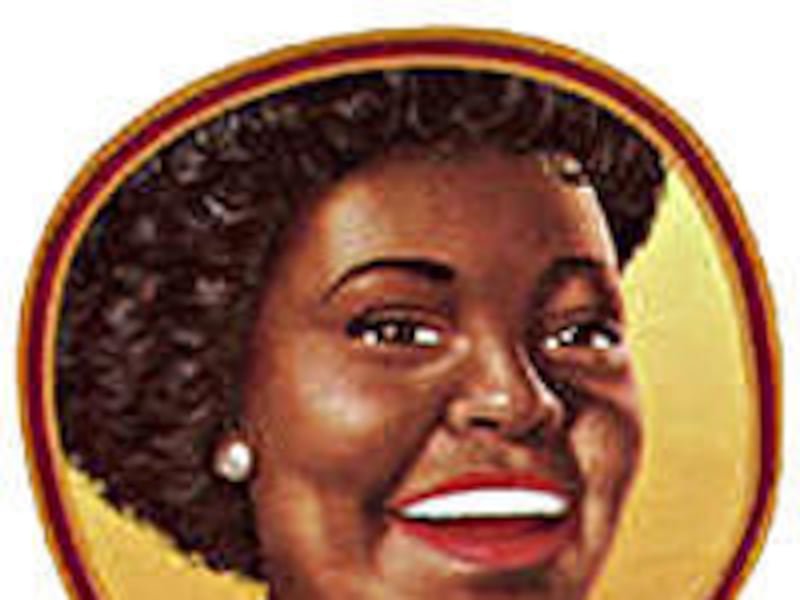
AUNT JEMIMA: The image of the smiling black woman first appeared on thousands of boxes of pancake mix in the early 1890s.
It was the first pancake ready-mix, developed by the Pearl Milling Co. in 1889, according to the Web site of Pinnacle Foods, which owns the brand today.
The "Aunt Jemima" idea was conceived by entrepreneur Chris Rutt after he watched a vaudeville performance of a song by that same name, according to Advertising Age, an industry magazine that named Aunt Jemima the seventh most-recognized advertising icon in the 20th century.
Rutt sold the business to Davis Milling, and the company hired Nancy Green, a 59-year-old former slave, as spokesperson. The trademark was updated over the years after drawing criticism that the image of a black "Mammy" in a kerchief was a negative portrayal of black women. In 1989, the headband was removed, and she was given pearl earrings and a lace collar.
CHEF BOYARDEE: He started out as Hector Boiardi, born in 1898 in Northern Italy, according to a biography from Con-Agra Foods, which now owns the Chef Boyardee line of canned pasta dinners. In 1915 he moved to New York where his cooking reputation grew at the Plaza and the Ritz-Carlton hotels. In 1922, he catered President Woodrow Wilson's wedding.
In 1924, he opened his own Italian restaurant in Cleveland, called Il Giardi. When patrons asked for his spaghetti sauce, he began selling it in milk bottles. Then he added dry pasta and packets of cheese to go with the sauce. When he outgrew his restaurant location, he opened a food-processing plant and eventually changed the spelling. For many Americans, Chef Boyardee was their first introduction to Italian food.
Although he sold his company in 1946, he continued as a consultant until his death in 1985.
COLONEL HARLAN SANDERS: He really did create Kentucky Fried Chicken, coated and seasoned with 11 herbs and spices, and it was a Salt Lake restaurateur, Leon "Pete" Harman, who opened the first franchise. The two met each other at a restaurant convention in Chicago.
Sanders, born in southern Indiana in 1890, ran a truck stop/restaurant in Corbin, Ky. At one time, the restaurant was so popular that Gov. Ruby Laffoon named Sanders an honorary Kentucky colonel to recognize his contribution to the state's cuisine. After that, Sanders cultivated his image of a proper Southern "Colonel" — white linen suit, string tie and goatee, writes Robert Darden in "Secret Recipe," (Tapestry Press, $24.95).
At the time KFC started, Sanders was 65, and living on his $105-a-month Social Security checks, according to his biography. In 1964, at the age of 73, he sold the company for $2 million. He remained the corporate spokesperson until his death in 1980, at age 90.
MRS. PAUL: Mrs. Paul was the mother of John Paul, a Philadelphia bread salesman, according to the Web site of Pinnacle Foods, which owns the brand today. In 1946, Paul's friend, Edward Piszek, started selling deviled crabs at a local bar. The crabs were a hit, and Piszek and Paul each put up $350 to start a frozen-seafood business.
Early on, the two debated taking the name Mrs. Piszek's Kitchens in honor of Edward's mother, in whose kitchen those first crab cakes were made. But to keep the company name simple, they chose to name it after John's mother instead — and Mrs. Paul's Kitchens was officially born.
DUNCAN HINES: He was well-respected food critic-turned-cake-mix-king. While traveling cross-country as a salesman, he kept track of the roadside restaurants where he ate, according to the company Web site, duncanhines.com. In 1935, Duncan and his wife, Florence, compiled a list of 167 recommended establishments and sent it out to friends as a Christmas present.
This was the forerunner to his self-published "Adventures in Good Eating," which he followed up with a hotel guide called "Lodging for a Night." In 1939 he came out with a recipe collection called "Adventures in Good Cooking."
In 1948, he was approached by North Carolina businessman Roy Park to lend his name to a line of premium-packaged foods. Initially, there were hundreds of products under the Hines-Park name. In 1956 Procter & Gamble bought the brand, which was eventually pared down to baking mixes
MARY SEE: When Charles A. See founded his candy company in 1921, he didn't need to invent a figurehead, as many companies did at the time. (That same year, General Mills came up with the fictional Betty Crocker.) Charles turned to his mother, Mary See, whose principles inspired his business ethics, and whose recipes for candies such as Chocolate Walnut Fudge and Victoria Toffee were the cornerstone of his success, according to a company press kit.
Mary See was born Mary Wiseman in 1894, in Ontario, Canada. She and her husband Alexander ran a resort there until his death in 1919. At age 64, the widow moved to Pasadena, Calif., with her son, Charles, and his family.
Charles's first candy shop had a kitchen where Mary See's home recipes were made by hand. More than 85 years and 200 shops later, Mary See's picture is still on every box of chocolates.
UNCLE BEN: The real "Uncle Ben" was a rice farmer from Houston, Texas, whose rice crop continually won awards for its high quality, according to information from the The Museum of Public Relations. In the 1940s, Gordon L. Harwell decided to name his rice company after the farmer, who had passed away. Hardwell used the maitre d' of a Chicago restaurant, Frank Brown, to represent the image of "Uncle Ben."
For many years, the brand drew criticism for racist overtones, because in the days of Southern slavery the term "uncle" was given by white Southerners to elderly male slaves. Earlier this year, owner Masterfoods USA gave Uncle Ben a "chairman-of-the-board" persona, which can be seen on the Web site, www.Unclebens.com.
MARIE CALLENDER: Yes, there was a real Marie Callender, who lived in Southern California. In the early 1940s, she began selling pies to friends and restaurants as a way to make extra money, according to the company Web site, www.mariepies.com. By 1948, to meet customer demand, the Callender family opened a wholesale bakery, selling the family car to finance the new company, according to a timeline from Con-Agra Foods, which now owns the Marie Callender frozen foods line (but not the restaurants or pie business.)
Marie's son, Don Callender, opened the first Marie Callender's restaurant in Southern California in 1964. In 1986, the restaurant chain was sold to the Ramada Inn, and in 1990, to Wilshire Restaurant Group Inc.
MRS. BUTTERWORTH: There's no real talking syrup bottle. Inquiries to Pinnacle Foods' advertising agency got this e-mailed response: "Mrs. Butterworth's happens to be a fictitious character that was made up by the marketing team and has been used in commercials and part of the marketing plans for over 40 years."
TV commercials have portrayed Mrs. Butterworth as an elderly woman who comes to life at the breakfast table, and her character has shown up in various TV shows and movies, such as "40 Days and 40 Nights."
Currently, the company is sponsoring a "Talk to Mrs. Butterworth's" contest, with the grand-prize winner getting a family trip to a local amusement park. Kids ages 3-10 can send a statement of up to 50 words on how Mrs. Butterworth's makes their breakfast fun and delicious, by Oct. 31 to: "Talk to Mrs. Butterworth's", c/o BHGPR, 546 Valley Road, Upper Montclair, NJ 07043.
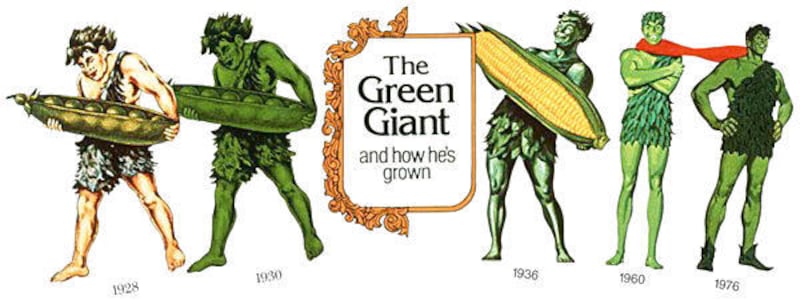
THE GREEN GIANT: He didn't start out very jolly or even green; in fact, early pictures from the 1920s were based on an ogre from Aesop's fables, according to Suzy Goodsell, the archivist for General Mills, which owns the Green Giant label today. The Minnesota Valley Canning Co. used the term "Green Giant" to publicize a new pea that was unusually large, sweet and tender. The original giant appeared in advertising for the first time in 1928.
Leo Burnett, the legendary adman behind other icons such as the Marlboro Man, improved the Giant's hunched posture, turned his scary scowl into a sunny smile and clothed him in a light, leafy outfit.
But the Giant didn't transition well to early TV, said Goodsell. "They had a man painted entirely green, and they couldn't get him to walk in a friendly way. That's why they went to an agency and asked for an animated character."
The addition of "Jolly" and "ho, ho, ho," further lightened the giant's image. Green Giant was named No. 3 in Advertising Age's list of most-recognized advertising icons of the 20th century.
Advertising Age's list of the Top 10 ad icons of the 20th century recognizes those images that have had the most powerful resonance in the marketplace. The criteria include effectiveness, longevity, recognizability and cultural impact.
1.The Marlboro Man - Marlboro cigarettes
2. Ronald McDonald - McDonald's restaurants
3. The Green Giant - Green Giant vegetables
4. Betty Crocker - Betty Crocker food products
5. The Energizer Bunny - Eveready Energizer batteries
6. The Pillsbury Doughboy - Assorted Pillsbury foods
7. Aunt Jemima - Aunt Jemima pancake mixes and syrup
8. The Michelin Man - Michelin tires
9. Tony the Tiger - Kellogg's Sugar Frosted Flakes
10. Elsie - Borden dairy products
E-mail: vphillips@desnews.com