


America was on the move in the early 1920s, and the Deseret News was moving along with it.
The Great War was over and a new optimism was wafting through the country — there were places to go, things to do, newfangled notions to test, new technologies to try.
Under the progressive leadership of general manager Elias S. Woodruff and editor John Q. Cannon, the Deseret News planned on being right at the forefront of this new era.
In 1920, for example, the News announced it was branching into radio.
And in order to promote tourism in the state, the Deseret News sent out a "Tourfinder" to cover 25,000 miles "of the roads that lead to the National parks and the great scenic attractions of the intermountain west."
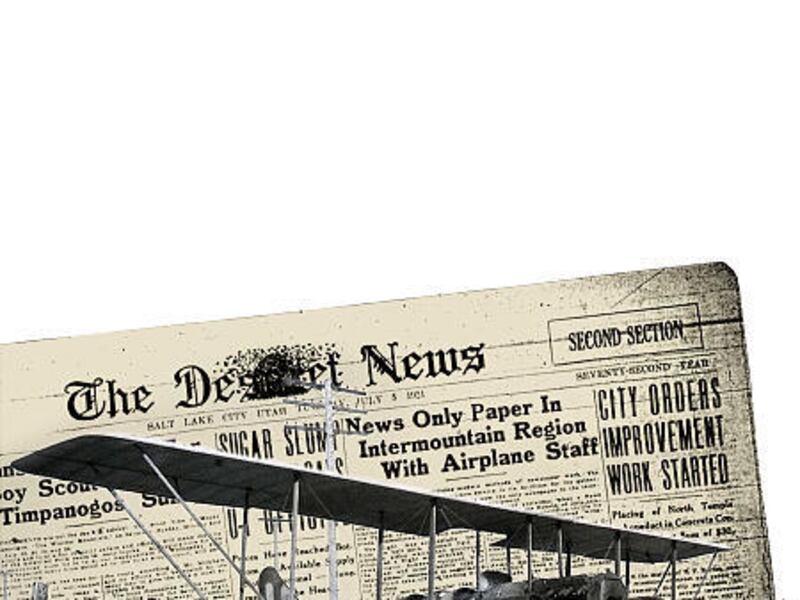
Then, on July 5, 1921, came even bigger news: "News Only Paper In Intermountain Region With Airplane Staff," read the headline. "Leading the way in utilizing modern methods of newspaper work, The Deseret News has added airplane service to its facilities for the gathering and dissemination of news. ...
"The Deseret News service was first introduced yesterday, when a News staff airplane gave an exhibition as a feature of the Fourth of July celebration at Payson. The aviator devoted half an hour to providing thrills for the Payson
celebrants. Several times he looped the loops, performed 'swing-overs,' Immelmann turns and numerous other death-defying maneuvers."
And that wasn't all: "Possibly more spectacular than the flying at Payson, was the appearance of The Deseret News staff airplane at Lagoon, where two flights were made by Rex Smith, daring staff aviator. In the afternoon he stayed in the air 34 minutes. Following that flight, it was necessary for the plane to return to the airdome at Woodward field, Salt Lake City, because no landing field was available at Lagoon."
That was not the end, however: "At 10:35 p.m., the plane left for the return to Lagoon, where it presented an inspiring sight in a difficult night flight. The wings of the great mechanical bird were illuminated with a diffused lighting system and despite the fact that considerable altitude was acquired, every movement was plainly outlined for the thousands who cheered the work of Aviator Smith.The return to Woodward field, where a successful landing was made, was accomplished without mishap."
The story went on to note that "Aviator Rex Smith will continue in the employ of The News and his speedy plane will be continuously at the disposal of The News, ready to go out on a moment's notice, whenever its services may be required for the work on an important happening of the day. When not flying for The News Aviator Smith is prepared to accept special commissions for firms and individuals and he will also keep his plane ready at Woodward Field to give rides to any citizens who care to taste the sensation of flying."
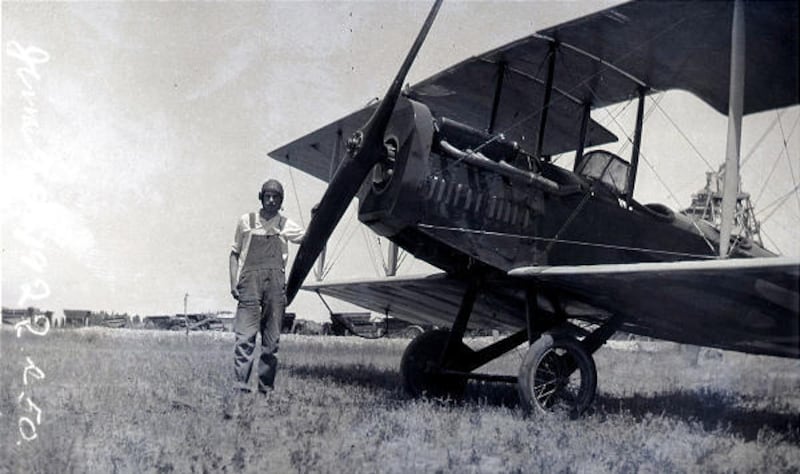
Two days later, Deseret News readers got a sense of how the plane would be used: "Upper picture is a near view of The Deseret News staff airplane. The picture was taken at Woodward field, where the 'ship' is ready for instant service in case its services are required for the gathering or dissemination of news. Insert, a close-up of Rex Smith, The Deseret News aviator, and Frank Dorbrandt, the manager of The News aviation department. Mr. Dorbrandt is also a pilot and can substitute for Aviator Smith in case of emergency."
The story accompanying the photo told of a flight the plane had made the day before: "Citizens of Salt Lake received their introduction to The Deseret News airplane yesterday afternoon when two flights were made over the city by the plane, piloted by Aviator Rex Smith and carrying a staff photographer and a staff writer. The 'hops' were made for the purpose of obtaining birdeyes views of various sections of the city, to be used in The News pictorial section."
The unnamed staff photographer had apparently flown before, but the also unnamed staff writer was "taking his feet off the ground for the first time. He was greatly surprised to learn that the real 'sensation of flying is that there is no sensation.' A man sitting in the window of his club watching pedestrians on the sidewalk below feels as much 'shock' as does the airplane passenger speeding along at approximately 100 miles an hour."
The pictures the photographer took appeared in the Rotary Gravure section of the Deseret News on July 30, and included shots of the University of Utah, the State Capitol, East High School, the City-County Building and views of Main Street.
Over the next several months, other photo spreads appeared, which were probably taken by a photographer in the paper's plane, although no mention of that was made. On Oct. 8, 1921, for example, aerial views of Bear Lake and several Intermountain power plants accompanied a story on the manufacture of power, but nothing indicated how the pictures were obtained.
More frequent mention was made — in the Deseret News and in other regional papers — of aviation shows given by Rex Smith at fairs and celebrations around the state. September was a particularly busy month:
• "Rex Smith with the Deseret News airplane was in Tooele giving flights yesterday," Tooele Transcript, Sept. 2
• "During the past week the Fair Association contracted with Rex Smith, the daring aviator, for his 'Flying Circus' for the three days of the fair. Cache County was anxious for this attraction and this county is very fortunate in securing it," Park Record, Sept. 2
• "Provo — Labor Day was celebrated here yesterday in a manner which reflects great credit on those who worked so earnestly for the success of the day. ... One of the distinct features of the celebration was the aerial exhibition given by Rex Smith in The Deseret News airplane. After having given a number of citizens joy rides over the city ... Mr. Smith and his mechanic gave the most thrilling exhibition of its kind ever seen in this city. Those who watched the aviator sail through air, with his mechanic cutting all kinds of capers on the wings of the machine, were thrilled at their daring. Altogether, Mr. Smith's exhibition was highly satisfactory and those who had not seen aerial exhibitions before were enthused with what they saw, " Deseret News, Sept. 6
• "The Emery county fair this year promises to surpass records. ... Rex Smith the aviator who did a lot of stunts over Price on a recent Sunday, will do all the new dare devil stunts in the air. Comedy will be intermingled and everybody will find much to his liking. The dates are September 14,15,16," News Advocate, Sept. 8
• "A principal feature of (the Peach Days celebration in Brigham City) was furnished by Rex Smith, Deseret News aviator, who thrilled the crowds with daring airplane stunts. He flew back and forth over the city and did dips, spurs and angles that amazed and thrilled the visitors," Deseret News, Sept. 14
• At the State Fair in October, the News had an exhibit "showing how the news is handled from the time it is taken from the different news carrying agencies, including the telegraph, wireless telegraph, airplane and city reporters until the paper is delivered at the home."
• On Oct. 6, the paper ran a picture "of Rex Smith, Deseret News aviator and Frank Dorbrandt, mechanic and wing walker, who have been giving some remarkable exhibitions of stunt flying at the Utah State fair. Dorbrandt's aerobatics on the flying ship and Smith's loops, tail spins and nose dives, have proved one of the biggest of the fair's attractions."
It is not surprising that these stunt shows attracted so much attention. It's not surprising that reporters could not find enough adjectives to describe them. Aviation was still very new and was proving very popular.
Although the Wright Brothers took their first flight in 1903, flying machines did not become commercially viable for several years. In "Flying Machines Over Zion," a book written by Anthony Martini while he was at Hill Air Force Base, the author details aviation in Utah between 1910 and 1919.
He writes: "The flying machine was still a novelty before the Great War, and the only way to make a living by flying was to perform for paying customers who gathered around race tracks, fairgrounds and open fields to watch the birdman fly — or crash. Two such exhibitions of the 'sport of dare-devils' took place in Utah in 1912 and 1913."
Martini further notes: "Although the cities of northern Utah would see several local flying exhibitions over the next few years, aviation would not 'take off' until World War I had ended, when where would be a surplus of both men and flying machines."
After the war, two things contributed to the continued success of airplanes — air-mail contracts and the so-called barnstormers. Both found a place in Utah.
In May of 1920, the Deseret News printed an announcement that "First class mail service between Salt Lake and New York in 21 hours will be established in September. Salt Lake will be required to establish a flying field and hangar and the government will spend fully $26,000 in improvements."
On Dec. 21, 1920, Woodward Field was dedicated at 22nd West and North Temple, named after an air-mail pilot who was killed in November of that year when his plane crashed in a snowstorm. Woodward Field eventually became the Salt Lake International Airport.
Passenger flights would not come along until mid-decade. The first passengers were on air-mail flights, and were allowed on only if there was room (and weight allowance) after the mail cargo was loaded. Western Air Express' first passenger flight was on May 23, 1926. Passenger service expanded rapidly toward the end of the decade.
In the meantime, people were becoming more and more enthralled with the idea of flying. According to the U.S. Centennial of Flight Commission, "stunt pilots and aerialists — or barnstormers as they became known — performed almost any trick or feat with an airplane that people could imagine. During the 1920s, barnstorming became one of the most popular forms of entertainment."
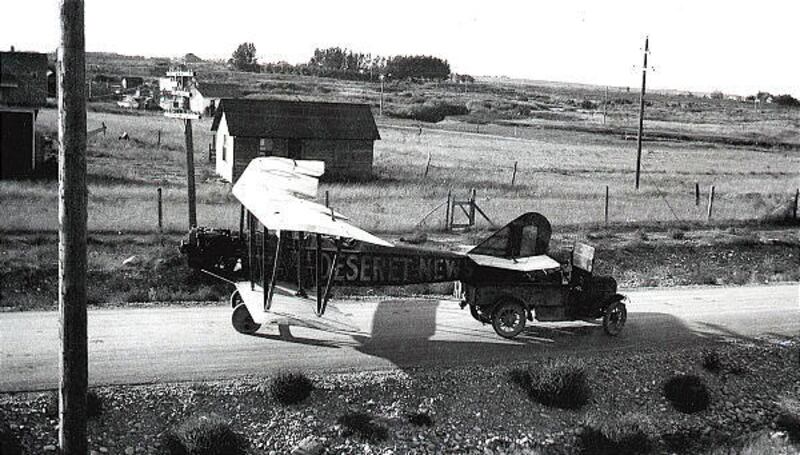
Capitalizing on that interest was a natural for the Deseret News, and the newspaper's plane was also apparently a favorite subject of local amateur photographer Bill Winther, who took numerous pictures of it.
The intriguing questions are: How long did the paper maintain a plane, what became of it, and what happened to Rex Smith and Frank Dorbrandt?
When and if the Deseret Morning News becomes digitized, research on these questions will be made easier, no doubt. Microfilm provides spotty evidence that 1921 was a busy year, and news of the plane fades in 1922. On July 4, 1922, a pilot named Clyde Pangborn was scheduled to do an air show at Lagoon, and no mention is made of Rex Smith or the Deseret News plane.
The last accounts of Smith we could find had him appearing in Manti, Millard Country and Richfield in September 1922. On Sept. 7, the Richfield Reaper wrote that "Rex Smith, the well-known Salt Lake aviator who gave some flying exhibitions here about a year ago, arrived in Richfield again and will remain here during the racing carnival." Mr. Smith purchased the Lincoln Standard airplane that was left here last year by Aviator Walter T. Varney of San Francisco and stored with C.M. Heppler. The plane was now assembled again by Mr. Smith and thoroughly overhauled, whereupon the young aviator made a test trip over Richfield Wednesday noon."
On Sept. 9, the Reaper further noted that Rex Smith was on his way to Mexico: "Rex Smith is one of the best known stunt fliers on the state. Last summer he spent most of his time flying for the advertising department of the Deseret News and making exhibition flights at county fairs in Utah, Idaho and Wyoming, finally up at the State Fair in Salt Lake City. His stunt flying at the fair was most remarkable and provided thrills for the spectators as well as for the aviator and his mechanic. ...
"Mr. Smith will stay in Mexico over the winter in the state of Chihuahua attending to business in connection with the reclaiming of 62,000 acres of land which were given his uncle under a Spanish grant."
Did Smith stay in Mexico? Did he return to Utah? Did he go off somewhere else? Hard to say.
The Utah State Division of History has no record of an obituary for Smith. In fact, the only mention the division has of him at all is one sentence in a Utah Historical Quarterly article on a celebration in Lehi where the "Deseret News birdman" appeared.
The Smithsonian Air and Space Museum has information on a Rexford Smith, who lived and built planes in Virginia and Maryland. But since he died in 1923 at age 60, this is clearly not the Rex Smith who was flying in Utah.
As for Frank Dorbrandt, he may have gone off to Alaska. The official history of the Katami National Monument in Alaska tells of a flight into the bowl of a volcano made by a Frank Dorbrandt. An Aircraft Maintenance Technology Web site on Alaska's bush pilots of the 1930s also mentions a Frank Dorbrandt.
However, articles in the New York Times saved by the Smithsonian say the flight into the "smoke and steam enveloped heart of the volcanically active Valley of Ten Thousand Smokes ... believed to be the first time that an airplane had ever landed in a centre of active craters" was made by a Frank Dorbandt — spelled without the second r.
The Memorial Park Cemetery in Anchorage lists a Frank Dorbandt (again, no second r) among its notables, calling him "one of the best known of Alaska's aviators, a man of daring and enterprise was an important factor in introducing aviation to Alaska."
And an Aviation Foundation of America Web site discussing veterans of national air tours and races mentions a Frank Dorbandt (no second r) who "left the Woodson clan some time after 1926, made his way to Alaska. ... Alaskan veterans there remember him as a man not well thought of, and not successful as a flyer-businessman, who went to his reward in about 1936 following an injury from an airplane propeller. But it wasn't the prop that did it; Frank got over that, walked out of the hospital to celebrate his recovery, celebrated for several days, and died of pneumonia."
It is possible there was both a Frank Dorbrandt and a Frank Dorbandt. It is possible that neither one came from Salt Lake City. There was no story in the Deseret News of the volcano feat; no "former-staffer-makes-good" headlines. But the picture of Frank Dorbandt on the cemetery Web site does look an awful lot like the fuzzy Deseret News pictures of Frank Dorbrandt.
The Deseret Morning News no longer has personnel records from the 1920s, so there's no way to tell how long either man was on the payroll. Overall, it appears that the Deseret News plane was a very brief experiment that seems to have been quickly forgotten.
Former Deseret News staffer Parry Sorensen recalls that his first contact with the Deseret News was in the 1930s. "At that time they chartered a plane for me to take pictures of Antelope Island."
By the time the paper celebrated its centennial in 1950, no mention of the plane was made in the many special sections dealing with the paper's history. Wendell Ashton's "Voice in the West" book on the history of the Deseret News has a one-sentence mention of the plane.
Still, the fact that there was a Deseret News airplane in 1921 says a lot about early journalism in the state and the beginnings of the aviation age that we now take for granted.
E-mail: carma@desnews.com