

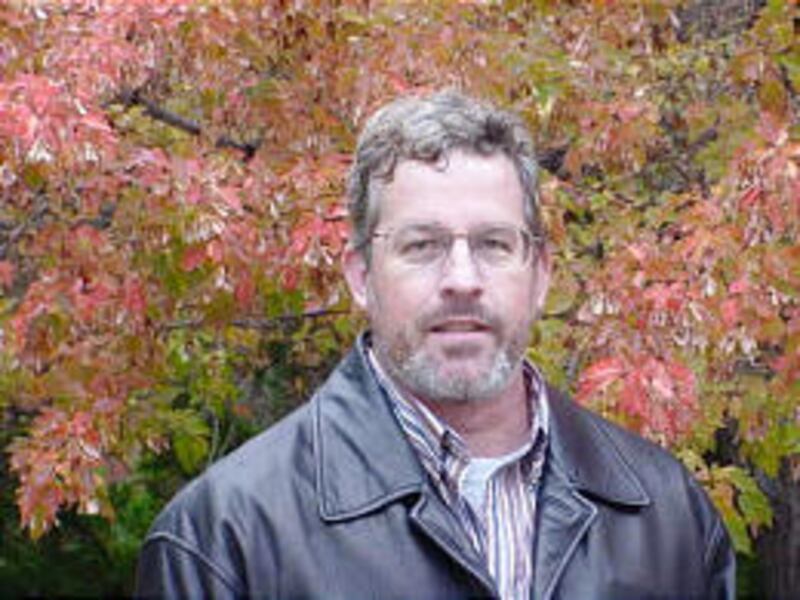
Like many young people, Kevin Holdsworth, who grew up in the 1970s, couldn't wait to get out of Utah, which he felt was "a cemetery with lights."
For him, part of it was geography — he felt trapped in the valley. And in his beautifully designed and well-written new book, "Big Wonderful: Notes From Wyoming," Holdsworth — who now lives in Wyoming — wrote that he was "embarrassed" about growing up in Utah.
Longing to leave everything provincial behind, he moved to the Big Apple, which quickly overpowered him. So he moved back to Utah — to the deep south this time: Torrey.
"That was too much of a contrast," Holdsworth said by phone from his office in Rock Springs. "I'd come to the edge of the Earth!
"Actually, I still have a cabin in Torrey — I love it. And I still go back to Utah all the time. But for me, it's ideal to have access to Utah but not live too close."
Now 46, Holdsworth enjoys living with his family in Rock Springs. He and his wife, Jennifer Sorensen (a native of Logan), are English professors and co-directors of the Western American Studies Program at Western Wyoming Community College.
He said he finds the students, most of them first-generation college students from a blue-collar community, "very rewarding and satisfying." Often, he and his wife do team teaching. "It's fun. Jennifer and I don't always agree on the issues, and when that happens, the students' mouths drop."
The most influential person and mentor in Holdsworth's life is Ken Brewer, formerly Utah poet laureate and Utah State University English professor, who died last year. "I went to USU because of Tom Lyon (also an English professor), then I met Ken — and later, he became my father-in-law. (Brewer's widow, Bobbie Stearman, is also a USU professor.)
Holdsworth also has "a long-distance mentor" in the renowned, also deceased author Wallace Stegner, who grew up in Utah and became a prolific novelist and Stanford professor.
But Holdsworth said he harbors no illusions that his career might parallel Stegner's. "I started way too late to do things like Stegner," he said with a chuckle. "Any writer would aspire to be like him. In fact, his greatest books didn't come out until he was in his 60s.
"I write whenever I can, balancing it with teaching and my family. It took me 15 years to write the piece 'Money for Nothing."'
His book is an artful combination of essays and poetry (mostly essays) on a variety of topics that are usually very personal, very human and always thought-provoking. There is room for disagreement with the author on some issues, but that just makes the reading stimulating.
Holdsworth's essays and poetry, both impressive, are indicative of his hard work and care. They are the kind of pieces people love to either read or listen to the words read aloud — because they sound beautiful.
If he would just lessen his anger about the history of Martin's Cove and leave out his occasionally jarring expletives such as "Amen, Brother Wally!" after quoting Stegner, his writing would be almost flawless.
Just listing the essay titles — "The Glaciers are Dying," "To the Bears of the Greater Yellowstone Ecosystem," "At a Cemetery in Salt Lake City," "Crossing the Three Sisters" — illustrates the interest the author generates.
Holdsworth has lost his father and his father-in-law, survived a difficult birth of a beloved son, Christopher, and wrenchingly left both the state and the church of his birth (Mormonism). He downplays the difficulties, saying his life has been "easy as compared to a lot of people."
"It's hard to write about one's upbringing and be honest about it," said Holdsworth. "After attending a conference on Western literature, I found myself asking about my own heritage. Then a lot of things came together for me. I revise a whole lot. I finished the draft of the first essay, 'Theme from an Imaginary Western,' the same day my father passed away. I got the call that night."
Inspired by the outdoors, both in Utah and Wyoming, Holdsworth gracefully pays tribute to his surroundings, which have become his "church." He feels "a spiritual connection" when he and his 8-year-old son are hiking together.
As for Wyoming, he relates to it more and more after nine years of residency. But he'll never be completely accepted by the people there, he said. "People from Wyoming hate Utah, but it's a transient place. Even in the ranching communities, people are often from somewhere else.
"People are friendly here, but the community sense in Utah is a little stronger."
E-mail: dennis@desnews.com