

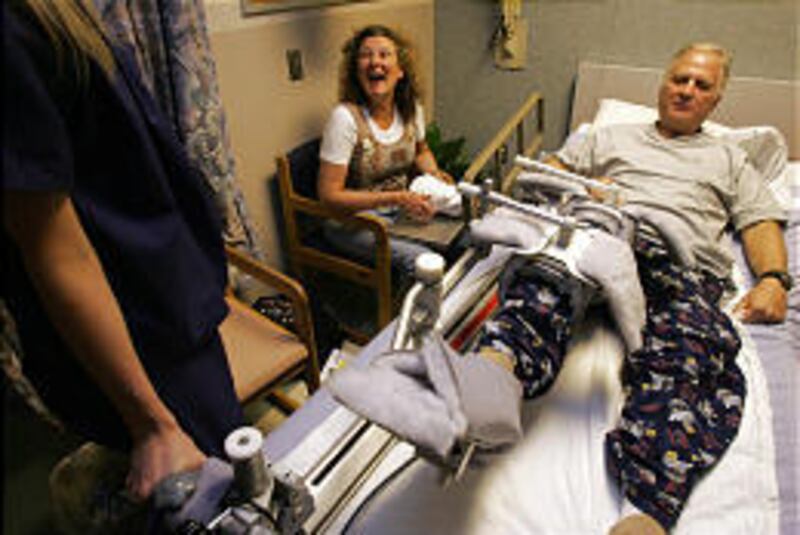
His leg bone was snapped in two by a whale, the ride back to shore took nine hours in rough seas, and he nearly died in a Dominican Republic hospital. Still, says Randy Thornton, the whole experience was a highlight of his life.
Thornton, who owns a dive shop in Draper called Dive Addicts, is recovering now at HealthSouth Rehabilitation Hospital in Sandy. His encounter with the North Atlantic humpback whale took place March 1 in a series of shallow reefs known as the Silver Banks.
That's one of the few places in the world where divers are allowed to swim with humpback whales. Expeditions there take place during the 10 weeks each year when the whales breed and give birth. The whales, says Thornton, "slow down and let you catch up with them," are playful and seem to enjoy their encounters with humans.
His own mishap was just a freak accident, says the 50-year-old Thornton. "I was just in the wrong place at the wrong time." Did we mention that a grown humpback whale weighs 40 tons and has a mouth that's 20 feet wide?
Thornton and 17 other Utah divers were on the last dive of the last day of their weeklong trip to the reefs when they swam near a mother whale who was dozing, with her baby riding on top. The problem started when the surface current picked up, pulling a few of the divers closer to the sleeping mom and baby. At that point the mother started to bring the calf to the surface for a breath of air, right under the divers.
"The calf woke up and got spooked, and that startled the mother, who swished her big tail twice," Thornton recalls. The first swish sent several divers, including his wife, Gwen, 20 feet through the water. The second swish of the tail whacked Thornton in the leg, breaking his femur "like a twig."
Whales are highly intelligent and definitely big. But they don't make a habit of attacking humans, he says. Occasionally there are accidents, like the one that killed a fisherman in Japan earlier this week as he tried to help rescue a sperm whale. The whale apparently panicked and struck the boat, a story that Thornton watched on TV in his room at the rehab hospital.
After his own thrashing, Thornton's buddies splinted the broken femur with fins and a weight belt, then he was taken by boat for a nine-hour ride to shore in choppy waves that slammed his body repeatedly onto the deck. Twenty-six hours after the initial break, Thornton was in surgery in what he calls a "quite prehistoric" hospital in the Dominican Republic. "That's where the real adventure began," he says.
The epidural blocked the pain but left him awake while surgeons cut through his bone with a hack saw and used a sledge hammer to pound a steel rod into his leg. Later he developed a complication and was "almost dead" from a respiratory problem, he says.
To those who argue that humans shouldn't be swimming with whales — that humans are keeping the animals from getting to their food supply — he argues that the whales don't eat during this birthing cycle and that diving trips like his "help educate the public about the endangered status of these animals."
To those who scratch their heads when he says he'd love to go back and swim with the whales again, Thornton remembers how peaceful and playful the animals are. He remembers when another member of his diving group began pirouetting in the water, and then the whale danced in a circle too. "They call that a valentine," he says. "It's just a magical, unbelievable experience."
E-mail: jarvik@desnews.com