


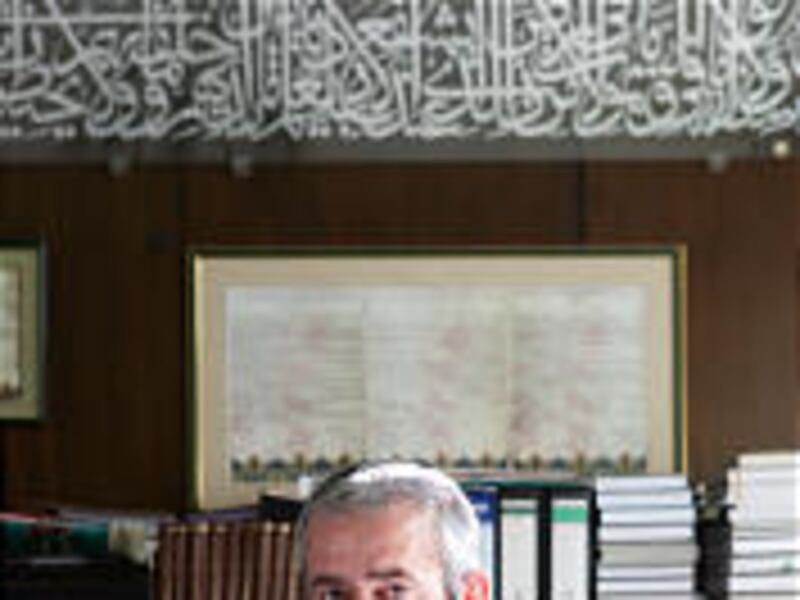


SARAJEVO — Nezim Halilovic, the main imam of the Bosnian Islamic Organization and arguably the most influential religious leader in Bosnia, does not believe the Trolley Square shooter was motivated by his Muslim religion.
The shooter, Sulejman Talovic, moved from eastern Bosnia to America at an early age, Halilovic said. "He was a child then. The motive that brought him to do that, the crime, should be investigated.
"I think that here, in this case, it wasn't a religious motive, because Islam doesn't embrace terrorism or violence. It's something Islam just doesn't preach."
However, Muslims are allowed to fight for self-protection under prescribed rules, according to the imam.
A Deseret Morning News reporter interviewed Halilovic Monday in his offices at the Islamic Center in Sarajevo. Adi Sokolija, a university student who has been working as a guide for the newspaper, translated.
Besides directing the society, every Friday Halilovic teaches at the King Fahd mosque in Sarajevo, which he notes is the largest mosque in the Balkans. It was built through donations of King Fahd, the late ruler of Saudi Arabia.
The imam is a distinguished-looking man of middle age, who was wearing a dark suit and a tie with a clip. His gray hair was offset by a short, dark beard. On his desk were a small, decoratively carved wooden chest; a jar of honey; a cup holding many pens; a tiny replica of a mosque; and several copies of the Quran. The screen saver on the computer beside him showed religious buildings.
Ethnic cleansing
He said that when Western countries encourage Muslims from Bosnia to leave their country and work in the West as poorly paid workers, they help the vicious practice of ethnic cleansing.
So, many Bosnian Muslims have gone to other countries, Halilovic said, and after a few decades, they will not have any connection with their country of birth. "They'll just be French, German or some other group.
"The possibility is that they will have children, and those children will be taught that way," he said. "In that way, the whole world is helping in the ethnic cleansing of Bosnia."
Ethnic cleansing was the genocidal war launched by some Serbs against Bosnia's Muslims, which continued from 1992 to 1995. It ended with a peace agreement drafted in Dayton, Ohio, the Dayton Accords. When the fighting was over, ethnic Serbs had carved out a new entity, the Republika Srpska, from part of what was once Bosnia, but the enclave is not the same as the country Serbia.
In 10 years, when American and European Union peacekeepers have left Bosnia, "the Serbs can just vote themselves to take the whole country," said Halilovic, who was commandant of the 4th Muslim Brigade defending against the Serb invasion.
"But Bosnia will not get deleted," he added. "It's just up to the whole world, and up to us a little, to be very hard, and try and try."
Multinational Bosnia
Bosnians who fought the invasion, both Muslims and non-Muslims, made a lot of compromises with the Serbs in the hopes of having their own territory, Halilovic said.
"We want a multinational and multicultural Bosnia and Herzegovina (the country's formal name), a place that every citizen will have all the rights he deserves. And because of that, we share this country and law.
"Unfortunately, we're used to getting bullied, so they attack us the most. The world should do everything to help Bosnia and to delete Republika Srpska, because it was formed on a genocide."
It's hard to get a functioning parliament or law in Bosnia, because the government is based on the Dayton agreement "and it's wrong," he said.
He recalled a comment by a former president of Bosnia, the resistance hero Alija Izetbegovic, that a divided Bosnia "looks like a man that just suffered a hard car accident, and he's in the hospital covered up with bandages."
Metaphorically, half of the accident victim is missing. People think he should be whole, he added, "he should be normal."
Conservative Islamists
King Fahd Mosque has attracted a number of what the press terms Wahhabi, a name its members generally dislike. They are adherents of a strict interpretation of Islam. Immediately in front of the huge mosque, some of its members have erected a small market. Members of the group walked about the vicinity, men with long beards and trousers shorter than most Bosnian men's, women wearing black burqas.
Some Muslims interviewed were wary of the Wahhabi, saying they were attempting to win moderate people to their beliefs.
"All things that go about in that mosque are done the right way, the traditional way we have here in Bosnia," Halilovic said. "The mosque is open from the first prayer to the last prayer.
"Anybody can come there and do their prayer, it's an open mosque. Concerning the place in front of the mosque, the little marketplace: that is public property and doesn't belong to the mosque."
The government owns that property in front, and it is up to the government to regulate it, he said. "For a long time we've been talking to the people in government to put on that location ... a normal kiosk."
He added, "People that pass by just think that's a part of the mosque."
Halilovic said it's important to protect the integrity of the Bosnian Islamic community from the Wahhabi.
"But still, the Islamic community and the government cannot forbid these people to practice Islam in their own way, just the same way that here the law says you can dress like you want. Nobody can tell you you can't dress that way."
E-mail: bau@desnews.com