
Someday, people along the Wasatch Front may need to dial 10 digits instead of the traditional seven to make a local phone call.
But telecommunications company representatives said that approach may actually be less confusing and less costly than another option when the new 385 area code is needed.
On the plus side, they said, existing customers would not have to change their phone numbers.
At a technical conference Thursday of the Utah Public Service Commission, the telecom representatives said an "overlay" of the 385 area code over the existing 801 code would cause fewer hassles for both customers and the companies than a split in which Salt Lake County would retain 801 while people in four other counties would have to switch to 385.
"Customers in the state stand to benefit far more so from an overlay than a split," attorney Stephen Mecham, representing AT&T, said during the conference. "None of the customers in the state with an overlay will have to give up their telephone numbers, whereas with a split, customers in four of the five counties along the Wasatch Front will have to use a new area code, which will change their number."
The move to the 385 area code is being forced by the depletion of numbers with the 801 code, which is expected to be exhausted in the second quarter of 2009. The commission in 2000 ordered the split, but it has not been implemented because phone number conservation techniques enabled a delay.
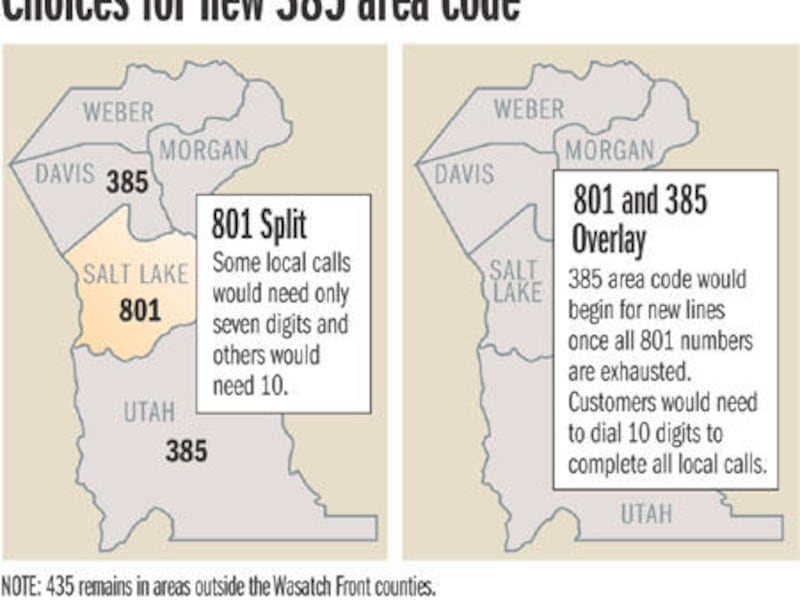
That 2000 order called for Salt Lake County to retain 801, but Weber, Morgan, Davis and Utah counties would switch to 385. An overlay option would retain 801 in all five counties, with the 385 code being added to new phone numbers when the 801 numbers are exhausted.
Telecom companies preferred the overlay method in 2000, but the commission found it "unacceptable," citing several reasons but saying it was "primarily concerned with minimizing the impact on the general populace." People attending four public hearings that year voiced support for the split.
But telecom representatives Thursday said customer habits and preferences have changed since 2000 and that a split would be confusing and costly to customers having to switch to the 385 code. In particular, small businesses with a new area code could be hurt as customers try to call them with the old area code, they said.
While an overlay would require all local calls to include an area code, a split would result in some local calls needing only seven digits and others requiring 10.
Mecham noted that a local call from Salt Lake County to elsewhere in the county under the split format would need seven digits, a call to Davis County would require 10 and a call to Ogden, 11. Overlays require 10 for local calls and 11 for long distance.
"So nobody gets thrown under the bus, which, in my opinion, is exactly what happens in Davis County if you stay with a split," Mecham said.
The telecoms cited several other reasons for favoring an overlay, which has been implemented in several other states. One of its few downsides is losing seven-digit local calling, they said.
"And we don't think that's such a downside, because the way things are going today, there is so much 10-digital dialing going on now, particularly with wireless devices," Mecham said. "No matter where you're calling in the country, you're using 10 digits, and you can use 10 digits within the state. We think that people have grown accustomed to 10-digit dialing, for the most part."
Another possible disadvantage would be that homes or businesses adding new lines in the future could end up with two area codes in the same building.
But telecoms said phone number "churn" likely would keep that to a minimum, and several stressed that enabling existing customers to keep their current phone numbers was a way to keep customers happy.
"Honestly, I don't think that the public really knows what impact one has over the other. They're only going to know it when you implement it. The experience around the country has been that it's been quite easy to implement an overlay versus a split, (with) probably fewer complaints and fewer difficulties," Mecham said.
Customers could be educated about the changes through various announcements, bill inserts, presentations to local groups, news releases, Web site information and appearances on radio and TV, the telecoms said. During a "permissive" period, they could dial either seven or 10 digits for local calls. A "mandatory" period would follow, and callers trying to use only seven digits for a local call would get a recording reminding them to dial the area code first.
Burglar and fire alarm companies would need early notification if an overlay is used because some still program systems using seven-digit numbers. Telephone directory companies also need to be informed early, but they likely would begin listing 10-digit numbers.
The Utah Division of Public Utilities does not oppose the overlay, while the Utah Committee of Consumer Services has not taken a stance on the matter.
The commission might schedule public hearings on the issue, but commissioners did not say Thursday what their next steps will be. "Stay tuned," PSC Chairman Ric Campbell said at the end of the conference.
The PSC's 2000 split order and accompanying news release can be accessed at www.psc.utah.gov/misc/00orders/Apr/9999905o.htm. The recently filed telecom petition and the division's comments about it are at www.psc.utah.gov/misc/Indexes/0799901INDX.htm.