

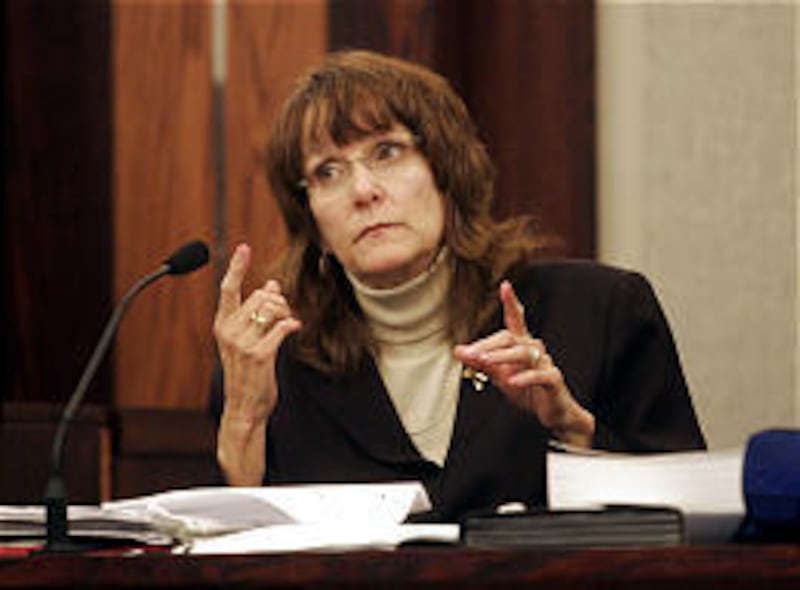
BOUNTIFUL — Linda Gummow, an expert witness for the defense in the case of confessed killer Robert Cameron Houston, testified Thursday that no one had ever properly diagnosed or treated the young man's obsessive compulsive disorder, which included uncontrolled thoughts of sexual violence.
A jury this week has been hearing testimony regarding Houston, 18, who admitted raping and brutally killing 22-year-old Raechale Elton, a youth counselor, after she gave him a ride to an independent living center for troubled teens on a snowy night last year. Since the crime was committed when Houston was 17, the death penalty is not an option, but a jury still must decide the sentence: life in prison with no parole or 20-years-to-life with the possibility of parole.
Houston spent two years in either a group home or independent living center run by Youth Heath Associates, a private firm that rehabilitates juvenile offenders where Houston was sent after being convicted of sex offenses.
Gummow testified, in essence, that everything YHA offered was completely wrong for Houston's psychological problems.
Among other things:
Houston needs a highly structured environment, but Gummow said the center's supervision was so lax no one noticed when the teen skipped school for months or that he was sexually active with a girlfriend.
Most people with OCD need medication specifically for that disorder, and many patients fare best when taking medication combined with a regimen of treatment also designed especially for OCD. But Houston had individual sessions with a female therapist and also took part in group therapy with other sex offenders — both things Gummow said could exacerbate his obsession with sexual violence.
A male YHA supervisor sometimes brought his own girlfriend to spend the night, and boys at the center could hear their sexual activity — something that Gummow said was highly inappropriate for Houston.
No effort was made to "build a bridge" between Houston and his estranged mother, nor was she brought in for discussion when the mother challenged Youth Health Associates and wanted to know more about her son's progress. "The saddest part for me is that the family issues were not resolved," Gummow said.
Gummow is a neuropsychologist who studies brain function. She testified she has been treating people with OCD for years and also has dealt with approximately 40-50 homicide cases.
She characterized OCD as a genetic disorder that can be influenced by other factors, such as a dysfunctional family or childhood abuse and molestation, all of which were present in Houston's youth.
But the illness also can show up in people who come from happy and functional families, she said. Although it is a difficult disorder to live with — both for the individual and those around him — there are treatments available that help people corral uncontrolled thoughts and the rituals they create to relieve extreme anxiety.
Prosecutors later called Brian Garlock, co-owner and clinical director of YHA, who disagreed with Gummow's diagnosis of OCD for Houston. Garlock said he had observed the young man daily at the agency's group home and three times a week at its independent living center for two years and did not observe signs of OCD. He said if staffers noticed such symptoms, these would have been reported to him.
Closing arguments are expected today, and then the case will be turned over to the jury for deliberations and a sentencing verdict.
E-mail: lindat@desnews.com