

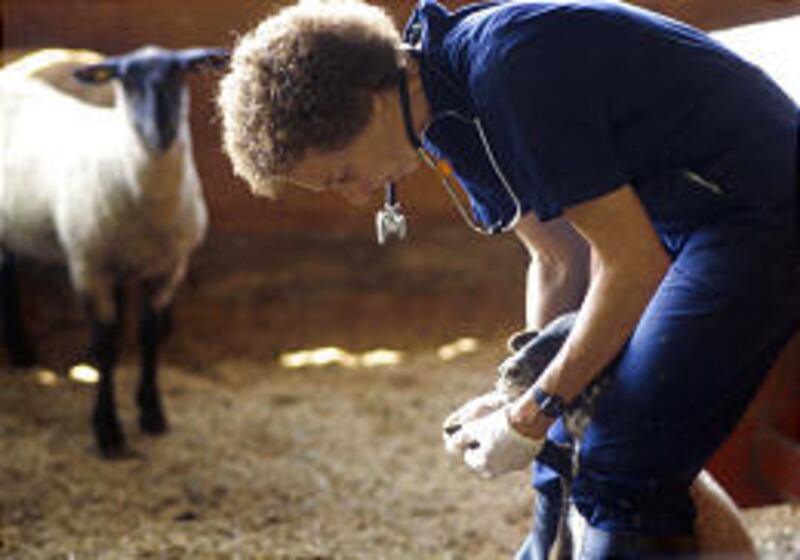
CHEYENNE, Wyo. — Somewhere near Moorcroft, in an unincorporated area of northeastern Wyoming, a livestock owner will hand over his entire flock of sheep next week to the federal government for a mass execution. The rancher knows what will happen: his herd of roughly 300 sheep will be transported live out of state and taken to a slaughter plant where they will be euthanized, their brains and lymph node tissue harvested for testing.
He'll lose his herd because he owned the first U.S. sheep to test positive for a rare strain of scrapie — a disease found in sheep and goats that's similar to mad cow disease in cattle and chronic wasting disease in deer and elk.
Still, state statute prohibits officials from releasing the rancher's identity, and attempts by The Associated Press to reach him were unsuccessful.
Scrapie itself is rare in the United States. Out of more than 115,000 animals tested since 2003, only 300 have tested positive; federal officials hope to eliminate scrapie from U.S. herds by the end of 2010.
But the Wyoming rancher's case is even more rare: Fewer than 300 cases worldwide have been recorded of the "Nor98-like" strain of scrapie, so-named because it was first diagnosed in Norway in 1998.
"This is very unusual," Larry Cooper, regional spokesman in Fort Collins, Colo., for Animal Plant Health Inspection Service, or APHIS, said of the first discovery of a Nor98-like strain of scrapie in the United States.
"It doesn't indicate that we're going to have mass outbreaks of this particular strain, it just indicates that one of these animals from Europe ended up in our system."
APHIS headquarters spokeswoman Karen Eggert later added there is no evidence suggesting it was an infected animal from Europe that brought the disease to the United States.
There are no known human health risks associated with scrapie. Cooper and Bryce Reece, executive vice president of the Wyoming Wool Growers Association, say consumers and livestock owners have nothing to fear from the diagnosis.
"From an industry standpoint, we're not at all concerned or alarmed by it," Reece said. "It's more of an interest to the researchers or the scientists than it is to the industry. I'm sure they're all questioning themselves as to how it got here."
Dr. Mark Hall, head of the special pathology section of the National Veterinary Services Laboratories in Ames, Iowa, agreed.
"It is something of interest and something I think we want to continue to look at," Hall said. "But this is certainly not a shocking revelation or anything like that. At this point, I don't think there's any evidence that there's any great need for concern."
Scrapie experts and Animal Plant Health Inspection Service officials say it's discovery is actually something to brag about.
"It means our surveillance system is working," Dr. Diane Sutton, National Scrapie Program coordinator, said. "We found it utilizing our current technologies to find scrapie cases in the United States."
APHIS notified the state last month that the sheep rancher's ewe tested positive for a form of scrapie consistent with the Nor98 strain. The ewe was slaughtered in Michigan last fall as part of the USDA's regular scrapie slaughter surveillance program and traced back to the Wyoming flock.
Dr. Walt Cook, acting state veterinarian, said the government would pay the livestock owner an indemnity fee based on fair market value for the sheep, before "depopulating" the herd.
"It's the best and the simplest thing to do," Cook said. "It's unfortunate to put down all those sheep, but it will allow us to test them and make sure no other animals are infected."
Cook and Sutton said the infected ewe's owner had one other option: to quarantine his flock, during which time he couldn't sell breeding animals for several years while the flock was monitored to ensure no other cases of the disease appeared.
"Economically it doesn't make much difference one way or the other," Cook said of the rancher's options. "Obviously, by depopulating, he has to go through the loss of his animals, which can be distressful."
Reece said when traditional scrapie is found in a flock, typically up to 10 percent of the rest of that herd can be infected with the disease. But with Nor98, when one case is found, to date it has been the only one found in the flock.
"I would bet we're not gonna see another one of these in Wyoming, and maybe not even in the United States, but who knows?" Reece said. "With 300 cases worldwide, it's not something out there that's highly transmittable."
He said that if an animal becomes infected with scrapie, it will die from it: "It's 100 percent fatal, and because it's 100 percent fatal it's a self-limiting disease."
"From a practical standpoint, scrapie is nothing," Reece said. "Pneumonia probably kills more sheep than anything else out there, but because of scrapie's similarities to mad cow disease, from a marketing and consumer standpoint it is important for the U.S. to eradicate the disease from the U.S."
Cooper said the effects of Nor98 are basically the same as those seen in classic scrapie — the disease attacks the central nervous system of infected animals, causing behavioral changes such as tremors of the head and neck.
Classical scrapie is believed to be primarily transmitted through exposure to placenta and birth fluids from infected animals or from facilities in which infected animals have lambed.
The lamb and wool production business is a $50 million-a-year industry in Wyoming, according to Reece, and a $500 million-a-year industry nationally. According to Cooper, many sheep-importing countries require that the U.S. be free of scrapie for seven years before they'll import U.S. breeding sheep.