

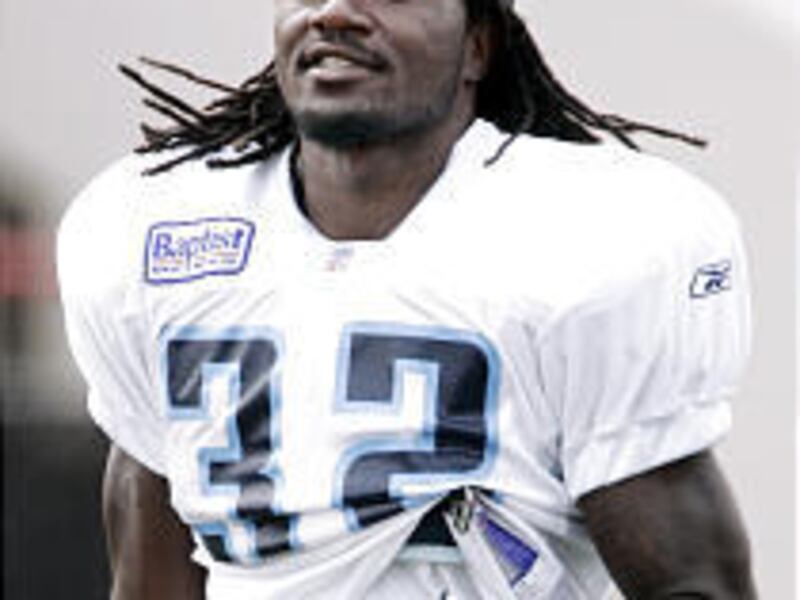
PHILADELPHIA — Adam "Pacman" Jones and Chris Henry met with NFL commissioner Roger Goodell on Tuesday, and shortly thereafter, Gene Upshaw delivered a minor bombshell.
The NFL Players Association executive director told the Washington Post that Goodell is considering adding a lifetime ban to his forthcoming player-conduct policy for players who repeatedly get into serious legal trouble.
Those were the strongest words yet linked to Goodell, who has made policing the league — and protecting, as he called it, "the shield" — an early mandate during his first year in office. And while a lifetime ban might seem a drastic measure, just about everyone agrees that the commissioner needs to have the ability to levy harsh penalties in order to discourage deviant behavior.
Then, on Friday, the NFL announced that Goodell had established a six-member council of veteran players to advise him on player conduct.
Fines haven't worked. Neither have short-term suspensions. Increased education into the pitfalls of wealth and success sounds good on paper. But stripping a player of his ability to perform on a season's worth, or even a lifetime, of Sundays? That just might work.
"You take away his stage," Cincinnati coach Marvin Lewis said last week during the league's annual meeting in Arizona, "and you show the other guys."
For the last several months, Goodell has been acting like a politician on the campaign trail. He floated his platform at the Super Bowl in Miami and then met with a group of active players, including NFLPA president Troy Vincent, at the scouting combine in Indianapolis.
Two weeks ago, a league spokesman said that Goodell would announce his new policy at the league meetings, but that event came and went without a set-in-stone policy. There were strong words and even the threat of a season-long ban, but nothing solid, only a promise of a policy by the draft, which will be held on the final weekend of this month in New York.
One AFC general manager said that the holdup is caused by the league's need to hammer out legal issues related to the policy. Goodell wants to levy fines or suspensions before a player has gone through the legal system, the source said, and that could open up the league to other issues.
For instance, why can Goodell act as judge and jury before a real judge and jury acts?
Almost no one inside the league — with the possible exception of the players who already are in trouble — disputes that the commissioner needs a tougher policy in dealing with bad behavior. During an hour-long media session last week at the league meetings, Tennessee coach Jeff Fisher answered numerous questions about Jones, the Titans' cornerback who since 2005 has been involved in at least 10 incidents that required police attention. Fisher pleaded with people to understand that there is more going on with the Titans than just Jones, even though Jones' legal entanglements have dominated recent headlines.
It's sad and unfair, but Jones, who was involved in an incident at Las Vegas strip club during the NBA's all-star weekend, has become the new face of the NFL. At least 50 players reportedly have been arrested since the start of 2006. Goodell wants it to stop.
"People are tired of getting up in the morning and picking up the paper and reading about somebody in trouble," Washington coach Joe Gibbs said last week. "I don't think anybody likes it because it casts everybody in a bad light. And to have a few guys, which is just what it is, causing real problems, I think the mind-set right now is to do something about it."
Eagles cornerback Sheldon Brown said last week that it isn't that difficult to stay out of trouble. He said that, in his opinion, players who surround themselves with friends who aren't their teammates or their family are the ones who open themselves up to trouble.
Brown, like a lot of players, doesn't like the reputations of a few so seriously impacting the reputations of many.
"There are a lot of good guys who do the right thing in the National Football League," Brown said. "It's not that hard to do ... Especially when you're young, you have to learn from your mistakes, but something has to be done."
That is what Goodell plans to do. He met with Jones and Henry, a Cincinnati Bengals wide receiver, at an undisclosed location in Manhattan on Tuesday to hear their explanations for repeated incidents. At the league meetings last week, Goodell said he would rule on the Jones and Henry cases within 10 days of meeting with the players.
Goodell also met Tuesday with Upshaw and Vincent, neither of whom could be reached for comment on Saturday.
"None of these cases we're talking about will be a permanent ban," Upshaw told the Washington Post. "I don't think we're at that point yet with these cases. We understand there will be some type of suspension, but not that ... One thing was clear: Once a player has gotten himself into this fix, it's going to be up to him to get himself out."