


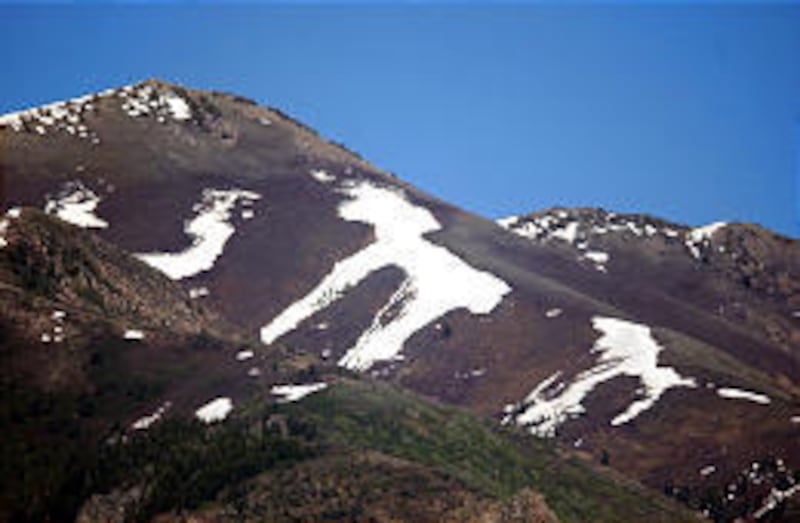

LAYTON — The legendary snow horse galloped into the history books this spring by becoming the namesake of a new Kaysville elementary school. However, the horselike figure trotted off the mountainside so quickly this year that it was only visible for two or three days.
The horse shape's longevity is dependent on weather and this year fell victim to shallow snowpack and extra warm temperatures. It is usually visible for several weeks or more.
"It was not well-formed this year," Forest Barker, 78, a Fruit Heights historian, said of the snow horse.
He saw the shape about May 8 or May 9, but by May 11 and 12 it was gone.
"I never fail to see the snow horse," he stressed.
Barker said this was one of its shortest visits.
"It does this every 11 years or so in a drought," Barker said.
The arrival of this seasonal landmark, a shape resembling a horse formed by the melting snow, signals a variety of pioneer and modern legends. Located on the the upper reaches of Snow Horse Ridge — just north of Webb Canyon at the Layton-Kaysville border — at an elevation of about 8,500 feet above sea level, the horse is reputed to forecast water supplies and temperatures.
The Davis Board of Education has named the district's 55th elementary school (now under construction) in west Kaysville Snow Horse Elementary, 1095 W. Smith Lane. This title recognizes the seasonal figure and should help perpetuate the legend of the snow horse.
However, Barker said the school district's decision to name the school after the snow horse was a poor one.
"You can't see it from there," he said, noting the school is too far south to allow a view of the shape. The shape faces northward.
Barker also said there are a lot of different versions of the pioneer beliefs about the snow horse. He said the true one is that if the early Kaysville-Layton area settlers could still see the shape by June 1, there would be enough water crossing Main Street that summer to mature a crop of grain.
Since pioneers had no reservoirs, they had to haul water from larger creeks farther away if smaller ones dried up.
Kent Day, a former director of the Layton Heritage Museum, found evidence that early valley residents believed they should never plant their tender crops until the snow horse appeared. Only then would the valley be frost-free the rest of the spring and summer.
In a present-day variation, some Layton-Kaysville area parents tell their children they can't wear shorts or play in the hose until they spot the snow horse on the mountainside.
The fact that the snow horse was a phantom this year is not good news. Some Layton residents noticed they had the driest garden dirt this spring they've had in more than two decades. That obviously ties into the absence of the snow horse and moisture.
The lack of a deep snowfall this past winter, combined with three periods of extra warm temperatures — one each in March, April and May — likely led to the quick demise of the snow horse. The area where the shape appears was covered in snow the weekend of May 5 and 6. However, by May 12, the snow had almost completely melted in that area and left mostly dry ground behind.
Barker said Snow Horse Ridge was also a prime deer hunting region some years ago, and some blue grouse have even been known to make their home in that area, some 3,500 feet above the benches.
"That's one of the most beautiful places around," he said.
How large is the snow horse? It's probably about 200 feet wide, and its legs are 50 feet in length.
The hiking trail from Francis Peak, north to Weber Canyon, passes just above the snow horse area.
The open ridge, some deep gullies and native plants in the area help create the horse design. Some residents also believe they can see the shape of another figure chasing the snow horse. To some it is a bat, others a little bear. The snow horse's legs usually fade away first and how long it lasts depends on the temperatures. Memorial Day to early June is usually the prime viewing period for the shape. Although the snow horse can be seen from as far away as northern Weber County, there are some other variations of this spring symbol along portions of the Wasatch Mountains.
Barker said the snow horse remains obscure in north Davis County today. He said he gave a historical presentation to an audience of about 50 people earlier this month and only three of them had ever heard of the snow horse.
He said some can see a 7 shape on the north face of the mouth of Farmington Canyon. Again, because of the weather, that shape was also not very clear this year.
A banjo shape can sometimes be spotted in the spring from the Hooper-Clinton area near the mouth of Weber Canyon. Also, some claim to see a Scotsman's smiling face on Ben Lomond Peak, north of Ogden, each spring.
Spotting some of the other symbols takes a little imagination, but the snow horse doesn't — you just need to know where to look on the mountain — at least in years when it actually shows itself for a few weeks.
Perhaps the best location to see the critter is from Layton Commons Park on Wasatch Drive. Standing near Wasatch Drive, look east toward the high school, find the L symbol on the building and then look straight up to see a long ridge that bears the snow horse. Fairfield Junior High or Layton's Ellison Park are two other good viewing areas.
Barker said the Fort Lane shopping area is also a good viewing area, as is Bowman's Market in Kaysville.
If you have trouble seeing the shape in the future, count two major peaks going north (left) from the Francis Peak radar towers. Then, on that second peak, look down a long slope and there's the snow horse. Or count two canyons north from Francis Peak and then follow the ridge down from the north side of Webb Canyon to spot the shape.
E-mail: lynn@desnews.com