




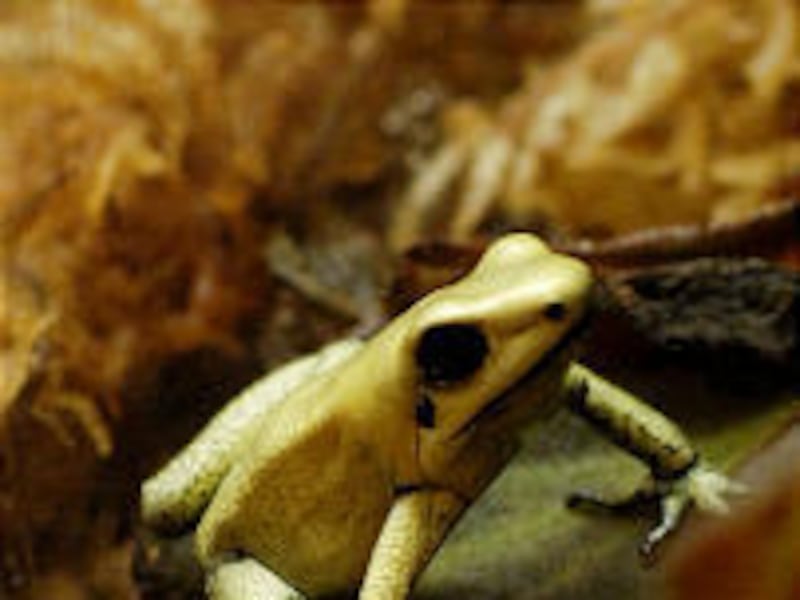


A few days before the "Toadally Frogs" exhibit was set to open, some 6 year olds were invited in for a preview. The children were enrolled in the Utah Museum of Natural History's "Animal Detective" class — so they may have been naturally sleuthful. At any rate, they showed impressive investigative powers as they studied one terrarium after another, peering under leaves and among ferns, searching until they spotted even the tiniest of toads.
Alex Baughman watched a toad that looked like a piece of bark lying motionless at the bottom of a pond. His voice boomed with excitement as he described how it suddenly swam "up to here."
In another part of the exhibit, Henna Inoway-Yim laughed as she listened to the recordings of various frogs calling. "This one sounds like a bird chirping," she squealed. "And this one sounds like a barking dog, a small dog." She punched the button labeled "Eastern Narrow Mouthed Toad." "And this one sounds like a scream."
"Toadally Frogs" is a traveling exhibit, featuring about 70 live frogs and toads, from 20 different species. "Toadally Frogs" belongs to the Audubon Nature Institute in New Orleans. The Institute's director of touring exhibits, Ian Hiler, described to the Deseret Morning News how he drove the live parts of the exhibit to Utah, bringing the frogs into his hotel room at night, only to have them start calling to each other as he tried to go to sleep.
Hiler hopes the exhibit will help people appreciate the beauty, the natural history, the diversity and the importance of frogs. The exhibit features frogs from Africa, Surinam, Australia — and local varieties, as well, such as the Colorado River Toad.
(Hiler is one of many scientists who is currently hosting wild frogs in a desperate bid to save them from extinction. Even now, he says, scientists are scouring the mountains of Central and South America, staying about one range ahead of a frog-killing fungus. Hiler has in his possession dozens of species, including a solitary representative of one species, a sweet little orange guy who breaks Hiler's heart by calling and calling without ever hearing a response.)
Tim Lee, UMNH exhibit designer, explained that "Toadally Frogs" will be augmented with displays of frog-related objects from the museum's permanent collection — Native American fetishes, drums and a totem pole.
Rachel Zurer, gallery programs coordinator, explained that with this exhibit visitors will see the first fruits of a 2-year-grant the UMNH has been given to sponsor events. Every Saturday will be a special day at "Toadally Frogs," featuring performances of a 15-minute play, which was written by University of Utah theater professor Margo Andrews.
The exhibit will also feature research done by Ben Chan, who is working on his Ph.D. in biology at the U. One of Chan's projects has to do with the parenting skills of poison dart frogs.
While most species abandon their eggs, Chan explained, the dart frogs hang around. The eggs are laid on the ground, and when the tadpoles emerge they wiggle up their father's back. Then the father frog carefully transports them, one at a time, to a nearby pond or puddle. Because poison dart frog tadpoles tend to be cannibalistic, the father frog places each tadpole in a separate puddle.
Chan added, "One cool thing is: they choose the temperature of pond." If a body of water is too hot or too cold, the father will hop away, in search of a better place for his baby.
If people take one impression away from this exhibit, Chan hopes it is that they care more than they did before about amphibians. "Everybody, everywhere, should know that one-third of the species are threatened with extinction," Chan said.
Also on this sneak preview day, the Fredenberg family, grandparents and grandsons, were touring the museum and stopped in at the frog exhibit. The three boys went quickly to the dart frogs, seemed entranced by the shininess of both the blue dart frog and the terrible dart frog.
Sue Fredenberg told her grandsons that she used to collect tadpoles when she was a girl in Wisconsin, in the summertime. She would keep them and watch them turn into frogs, she said. She sounded impressed, still, by the miracle.
'Nature of Things' lecture features Texas zoologist
If you could just turn part of your back yard into habitat, and if just a couple of frogs or toads could live there, well that might help. When Stan Mays, curator of herpetology at the Houston Zoo, comes to Salt Lake City tomorrow, he'll ask Utahns to help. He'll ask them to do something about the fact that one-third of the world's amphibians are disappearing at an unprecedented rate. He'll talk about what the loss of insect-eating amphibians might mean to the food chain.
Mays will speak at the final lecture in the Nature Conservancy and Utah Museum of Natural History series "The Nature of Things." He talked to the Deseret Morning News by phone last week, giving a sample of what he'll say when he's in Utah.
Mays described a certain fungus, named batrachochytrium dendrobatidis, that can wipe out an entire species in a week. The chytrid fungus is killing frogs in the Americas, Europe, New Zealand, Australia and Africa.
In January, a group of Japanese scientific organizations announced "a state of emergency," according to the Kyodo News, when the fungus was discovered to have killed several pet frogs in Tokyo. "Invasion by the chytrid fungus could irreparably affect our country's biodiversity," the scientists said. They are trying to figure out how to keep the fungus from spreading to Japan's wild amphibians, including a type of salamander found no where else on Earth.
If the world's amphibian populations had been in good shape when the fungus first hit, then more species would survive, Mays said. But, in fact, habitat has been shrinking, global warming has weakened many species, and the world's waters are already full of agricultural pesticides and herbicides.
And so, of the 5,743 known species of amphibians, 1,896 are endangered, Mays explained. That's about 32 percent of all amphibians. In comparison, he said, 23 percent of mammals and 12 percent of birds are endangered.
The fungus is present in spotted frogs in Utah, but it is not killing them, according to Krissy Wilson, native aquatic species program coordinator with the Utah State Division of Wildlife Resources. Chytrid was found in frogs along the Provo River in 2001, and biologists braced themselves to lose 90 percent, even 100 percent, of the population. But the population is as healthy as ever. Wilson said scientists are concerned about spotted frog populations in other parts of the Wasatch Front, where habitat is disappearing and the populations have become too small and isolated.
(Wilson seconds Mays' idea that it would great if Utahns added habitat to their yards. She said homeowners along the Wasatch Front might expect to attract Woodhouse's toads, spadefoot toads and chorus frogs.)
When Mays comes to Utah, he'll talk about the crisis in Central and South America and how conservation biologists are trying to fight it.
Under a program called the Amphibian Ark, U.S. zoos take responsibility for helping to protect these small creatures in their native countries. The Houston Zoo has been trying to protect the frogs in Panama, and, in 2006, had just about finished building a "survival assurance facility" there, when the fungus was discovered to have started killing Panamanian frogs. Mays described walking through the forest one week and seeing 15 or 20 different species — and then coming back a week later and seeing nothing, not one living frog, just the occasional small body.
Working frantically, the U.S. scientists began gathering every live frog and toad they could find. Until the facility could be finished, they quarantined the frogs in tanks in a hotel — desperate to keep them away from the soil, the streams, all the places the spores of the fungus might be living.
The Houston Zoo's main project had been with the Panamanian golden frog, Mays said. But now they rescue "basically anything we can find."
Someday they hope to reintroduce into the wild every species they are saving. And reintroduction will be difficult, Mays added. He explains that when frogs and toads are eating off the land, they develop a toxicity and a coloration that warns off snakes and other predators. Something about their diet in captivity must be slightly off. In captivity, they don't get so toxic.
If you tried to re-establish a captive-raised colony, Mays said, it would be like setting out a buffet for the snakes. He sighed as he said this.
About the fungus with the funny name and the frogs in a hotel and the hand-raised snake hors d'oeuvres, Mays said, all of these are fascinating facts. Or, he corrected himself, all of these details would be something he would enjoy talking about more if the overall story weren't so sad.
If you go. . .
What: The Science of Frogs: Frogs as an Indicator Species, lecture by Stan Mays
Where: Salt Lake City Main Library, 210 E. 400 South
When: Tuesday, June 12, 6:30 p.m.
Cost: free
Phone: 581-6927
Web: www.umnh.utah.edu
Also: The exhibit "Toadally Frogs!" through Sept. 3 at the Utah Museum of Natural History, 1390 E. President's Circle, University of Utah
E-mail: susan@desnews.com