

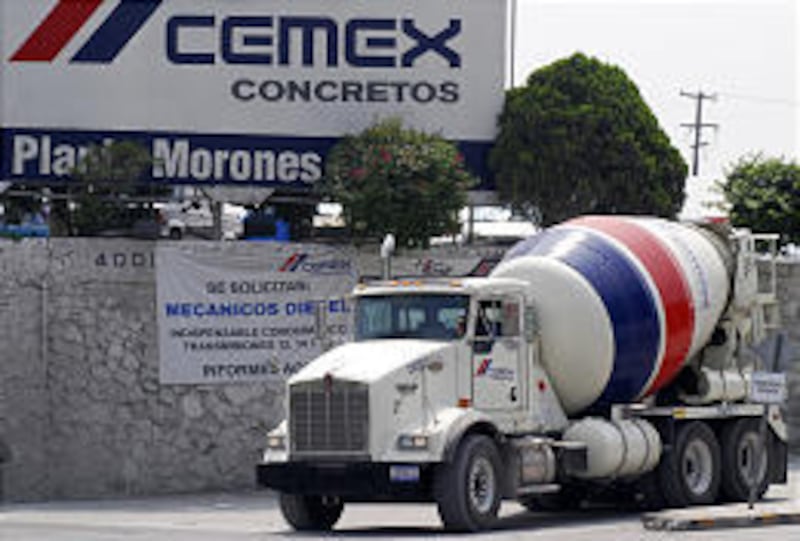
MEXICO CITY — Cemex of Mexico became the world's largest supplier of building materials on Thursday after it won a majority stake in Australia's Rinker Group Ltd., overcoming concerns of potential market dominance in some U.S. markets.
Cemex announced it had won acceptance of its $14.25 billion takeover bid from shareholders representing 50.34 percent of Rinker stock.
The buyout — which comes as Mittal Steel completes its acquisition of Arcelor to create the world's biggest steelmaker — marks the latest in a wave of rising business conglomerates with roots in the developing world.
Cemex and other third-world conglomerates like Mittal, Brazil's Companhia Vale do Rio Doce, or India's Tata Group started in protected markets as former state monopolies or dominant companies. But they are now turning the tables, snapping up companies in the developed world.
Analysts say Cemex and its cohorts have proved that management ability and access to capital are now spread much more equally across the globe than in the last century, when American and European firms were the only real transnationals.
But they also caution that management teams accustomed to being big fish in small ponds must still prove they can assimilate the big acquisitions and face tough global competition and potential market downturns that humbled many of their first-world counterparts.
"I don't think they can just transfer strategies, and that's the challenge, because in some measure they have all grown up in protected markets," said Raul Feliz, of Mexico's Center for Economic Research and Teaching, an academic think-tank. "Their monopolistic power has allowed them to generate cash flows they're using now."
Rinker has already warned its fiscal 2008 earnings may drop by 10 percent because of a housing slump in the United States, where it makes 80 percent of its profit.
The acquisition of Rinker will boost Cemex's annual sales of about $18.2 billion by some $5 billion, putting it ahead of France's LaFarge SA, generally considered the largest building materials company with $21.4 billion a year in sales.
Some say Cemex — and businessmen in the developing world — have already proven themselves.
"I think Cemex has already demonstrated it can compete with any company on a global level," said analyst Gonzalo Fernandez of the Santander Mexico financial group. "It's an important lesson, that Mexican companies can be efficient."
"Before, it was hard to believe that a firm like Cemex could go to the United States, buy a company there, and make it more efficient, or to England and make them more efficient. Before that was hard to believe, but that has been exactly what they have done," Fernandez said.
The combined Cemex and Rinker will have 41 percent of its business concentrated in the United States and 24 percent in Mexico.
The size of the combined company has raised concern among regulators, with the U.S. Justice Department saying it would allow the deal to proceed only if Cemex sells 39 concrete and aggregate facilities in Arizona and Florida to avoid market dominance.