


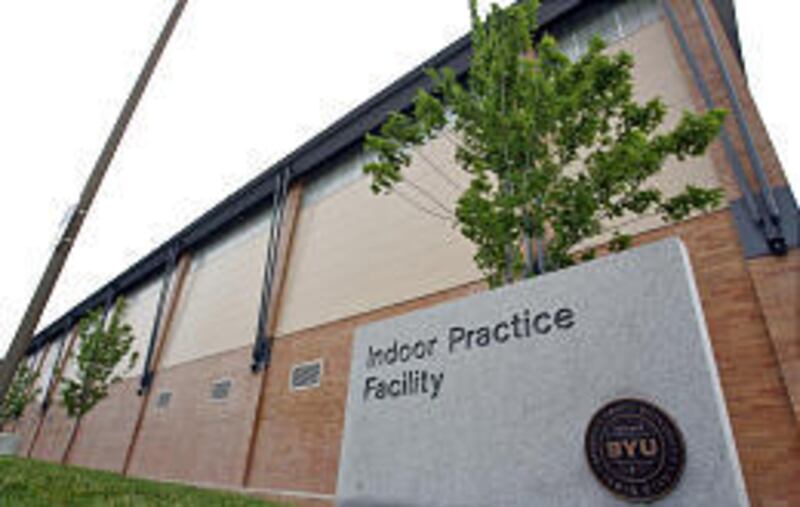


PROVO — On any given day at Brigham Young University's Indoor Practice Facility, a spectator could see a perfectly spiraled football pass, a well-placed goal kick or, on the rarest occasion, a model airplane soaring near the rafters.
While many students and fans view the facility as a haven meant exclusively for the Cougar football team, the truth is that a number of athletes with varying skills and specialties keep the indoor field busy year round.
"Football makes up just a small percentage of what takes place in there," said Matt Nix, athletic events coordinator at BYU. "We've got classes in there, extramurals and athletic teams ... It's been a great facility, and it has given a lot of our teams, not just football, an opportunity to play in a larger field environment during (bad weather)."
Currently, the Indoor Practice Facility (IPF) plays home to a number of different on-campus groups, meaning the building is booked solid from 6 a.m. to 10 p.m. daily. The Cougar football team, however, is only guaranteed a three-hour block each day. The rest of the schedule is filled out by extramural sports, physical education classes, university athletic teams and BYU's extensive intramurals program.
"It originally was a building that, primarily during the winter, could be used by several different entities on campus, without having to worry about the weather," Nix said.
The IPF has fulfilled that original purpose and then some. The construction of the building fulfilled what many in the athletic department — including former BYU football coach LaVell Edwards — viewed as a long-standing need for the school as a whole.
"LaVell was very interested in seeing something like this happen in the early '80s," said Duff Tittle, associate athletic director at BYU. "We were basically the last Division-I football program in cold weather that didn't have an indoor facility."
Tittle said that the athletic department primarily had two overriding goals in constructing the IPF. First, to provide the university's athletic teams a chance to prepare to compete, even in case of inclement weather. Second, they felt an indoor facility would help with recruiting efforts by providing the types of facilities that would attract the best athletes.
"Being successful in athletics takes a commitment to facilities, along with great coaching and great athletes," Tittle said. "Those things are all represented in (the IPF and the new Student Athlete Building)."
From the beginning, the building was designed to accommodate multiple athletic teams, along with providing an additional venue for limited university functions. The 222-by-422-foot playing field is equipped with a series of nets to divide the field, allowing multiple teams to practice at once. The field allows for full scrimmages for the softball team, while the baseball squad works with a slightly misshapen outfield.
The men's and women's golf teams are able to practice through the winter indoors, with a range of nearly 85 yards readily available.
The ceiling's highest point reaches 93 feet, providing ample space for pop flies and spiraling punts. And perhaps the best news for the groundskeepers, the artificial-turf playing surface stands up to beatings that grass never would.
In addition to the school's athletics, the IPF does rarely play host to off-campus groups. The building can be rented, similar to other on-campus facilities, as long as the renter is equipped with a hefty insurance policy and can foot the $400-per-hour bill.
"Someone interested in renting it would just have to contact the athletic department and talk to me about what they're trying to do," Nix said. "As long as there would be no damage to the facility and no high-risk activity, they'll probably be OK. They would just contact me, and I would check on the availability of the facility."
The key word, however, is availability. Because the facility is so often booked solid by the university's programs, Nix said he can only remember a handful of times the IPF has been rented to an outside group. The first was when a local indoor football team held tryouts in the building. A later instance involved a BYU professor in need of a wind-controlled environment in which to fly his group's model airplanes.
To say nothing of off-campus groups who find the IPF unavailable, the packed schedule doesn't even allow for some of BYU's own programs to use the facility at the most favorable times. The Cougar lacrosse team, for example, does not have a set time to use the facility, partly because it does not fall under the umbrella of NCAA-sanctioned sports at the university.
"Lacrosse was not one of the teams that got a scheduled time in there," Nix said. "Because it's booked so solid, the only time available would be late in the evening, when intramurals is finished."
Because of the team's club status, BYU's lacrosse team, winner of the 2007 MCLA Division A national championship, was not guaranteed a time slot. After the men's soccer team snatched the 6-8 a.m. slot, lacrosse coach Jason Lamb took what was left: the 10 p.m. to midnight opening.
"A lot of people have had their slices of pie; by the time we came around, we definitely only got crumbs," Lamb said. "At the same time, it's kind of like being the last kid in the family. There's nothing you can do about it. If you're the last of five brothers, so is your life."
Although frustrations are inherent with scheduling difficulties, Lamb said his squad has still benefited greatly from the indoor practice facility. Throughout the summer and fall months, when the football and soccer teams are outside, the Cougar lacrosse team can take the field indoors.
"In September and October, we're in here more than any other team because everyone else is outside," Lamb said. "It's been a tremendous help because, even when we can't be in it, other teams are in it, and then that frees up the space outside for us."
E-mail: davidr@desnews.com