




Psst. Heard the rumors about how schools on the rich east side of Salt Lake County have smaller classes, better programs, more experienced teachers, more exotic student trips, fewer behavior problems and fewer minorities than schools west of the Jordan River?
Everyone has. Many view such sometimes unseemly rumors as the real-but-unspoken fuel for current moves to consider splitting both the Granite and Jordan school districts and separate the problems of one side of the valley from the advantages of the other.
But how many of those rumors are really true?
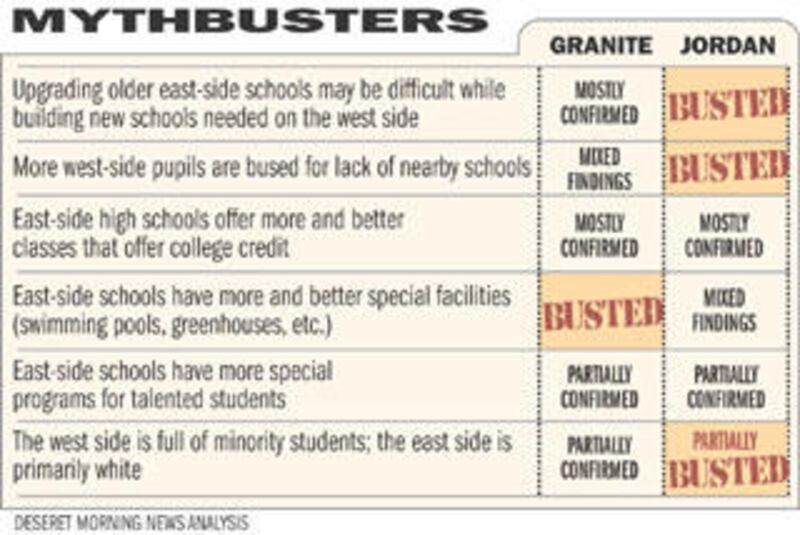
In the spirit of the popular TV series "Mythbusters," which uses experiments to "bust" or confirm common beliefs, which may or may not be "myths," the Deseret Morning News used state open records laws to compile data about programs and facilities on both sides of each district.
The gleanings bust some common myths, such as which side of the valley really has the better teacher-to-pupil ratio. But they confirm other impressions, such as which side has the better college preparation classes and which has teachers with more experience and advanced degrees.
Analysis of several of the myths helps show what each side of the valley is receiving for its tax money — and the result may help focus ongoing debates about splitting or improving the districts.
The Morning News looked only at equality of programs and facilities, not test scores. Most experts say scores often depend more on such factors as parents' education and income. That is out of the control of school districts, but they do control the programs and facilities they offer. The analysis looks mostly at regular schools, not at special or alternative education centers.
West-side schools are more crowded than those on the east side and have more portable classrooms.
Jordan and Granite: Confirmed.
In Jordan, the average used capacity of schools, based on a traditional school year without portables, is 84 percent on the east side and 112 percent on the west.
Of course, schools sometimes increase capacity by adding portables, going to year-round calendars or using split sessions.
In Jordan District, the average number of portables is 1 per school on the east side of the valley but 2.6 per school on the west side.
In Granite, the average capacity used is 97 percent on the east and 109 percent on the west. The average number of portables per school is 1.3 on the east, and 3.4 on the west.
In both districts, the east side tends to be long settled, while construction of new homes continues at high rates toward the west, and districts are struggling to keep up.
Portable classrooms are a cheaper way to address growth than adding onto schools. Granite District learned this after brick and mortar add-ons to east-side schools went empty as neighborhoods aged, former longtime Granite Board of Education member Lynn Davidson said.
"People look at them as, 'They're bringing a bunch of trailers to our campuses ... and the east side doesn't have any trailers,"' said Davidson, a former east-side board representative and, before that, district real estate consultant. "My perception is, that's because the east-side expansion came first."
Jordan used year-round scheduling and put sixth-graders into middle schools and ninth-graders into high school instead of adding to buildings in past growth times, Jordan Superintendent Barry Newbold said. But it also built a bunch of schools in the same east-side area — five elementaries within a 1.5 mile radius. The Board of Education closed two in 2005.
East-side schools are older than on the growing west side. So upgrading them may be difficult while building all the new schools that the growing west side will need.
Jordan: Busted;
Granite: Mostly confirmed.
East-side schools indeed are older in both districts, so the myth may appear true at first glance. But differences disappear in Jordan (and are diminished in Granite) when one looks at the dates of the most recent major renovations or remodelings of schools.
The average time since construction or major renovation of a school in Jordan is 7.8 years on the east side and 7.0 on the west, or less than a year. In Granite, it is 7.6 years on the east and 4.4 years on the west side — a difference of 3.2 years.
For the record, the average overall age of schools in Granite is 42.9 years on the east side and 34.8 years on the west. In Jordan, it is 37 years old on the east side and 18 on the west.
"Most new school construction is believed to be in the west, and that's true, because that's where the growth is. But look at where the majority of remodeling and renovation is occurring," Newbold said of the Jordan District.
"I don't know if (people) have short memories or what. There are new schools that have been constructed (on the east) and schools that have undergone major remodeling and renovation. Now, there are always unmet needs; I think that's been a major challenge," he said.
Granite also has its share of angst, such as the controversy over where to put insurance money after Wasatch Junior High burned down in 2005. Some west-siders argued that nearby, undercapacity Churchill Junior High could absorb Wasatch students (they're there now temporarily, a school within a school), and insurance money should go to build needed west-side schools. However, the Granite Board of Education decided to rebuild Wasatch with the money.
East-side schools have better student-to-teacher ratios.
Jordan and Granite: Busted
In Jordan, both sides of the valley have class sizes that are virtually equal. In Granite, the west side actually has a slightly better overall student-to-teacher ratio.
In Granite, the west side has one teacher for every 23.1 students while the east has one for every 24.0 — a difference of about one student per teacher. The difference is fairly consistent among elementary, junior and senior high schools.
District officials say that, by design, they use local tax money to fund equal numbers of teachers per students in all schools. However, some schools receive extra money from grants or programs such as Title I funding for low-income-neighborhood schools. Most of that extra money went to Granite's west side, resulting in the somewhat smaller classes there.
In Jordan, the east side has a teacher for every 25.5 students, and the west has one for every 25.8, virtually equal. Ratios are also about equal among elementary schools. But east-side middle schools have about one less student per teacher than on the west side. And east-side high schools have about a half a student fewer than on the west.
That is according to Jordan data for the past school year. However, the district initially directed the Morning News to older data on state and federal Web sites. That older data showed significantly better ratios on the west side — one teacher for every 19 students there compared to 26 on the east, a whopping difference of seven students per teacher.
When Newbold saw those results he was surprised and, after learning the source, indicated those reports don't reflect all district hirings, so the district provided newer data.
East-side schools offer more and better advanced high school classes that can bring college credit.
Jordan and Granite: Mostly confirmed.
The myth is especially confirmed for advanced placement and international baccalaureate programs but less so for "concurrent enrollment" classes.
In Jordan, east-side high schools offer an average of 19 AP courses each, compared with 15.8 for those on the west side. However, west-side Riverton High School offers the most: 22. But Riverton has the district's worst pass-fail percent among students who take AP tests, with only 54 percent passing.
Overall, east-side Jordan students pass 72 percent of the AP tests they take, compared to only 64 percent on the west side.
In Granite, east-side high schools offer an average of 18.3 different AP courses, compared to 14.2 on the west side. However, individual schools that offer fewer AP classes tend to offer more concurrent enrollment classes (where students co-register with a local college for both college and high school credit), and vice versa.
The number of concurrent enrollment classes offered in Granite high schools is virtually even on both sides of the valley: 31.0 in east-side schools and 30.8 in west.
Jordan provided data only about total credits earned through concurrent enrollment, rather than about courses offered at each school. It showed that three of the four high schools where students earned the most college credit were on the east side (but the one with the most was west-side Bingham, and east-side Hillcrest was in last place). Data showed west-siders were more likely to need to take such courses somewhere besides their home school, sometimes at east-side schools.
Jordan has set up distance programs to improve student access to classes. For instance, Jordan High has broadcast American Sign Language to many schools where interest is too low to justify hiring another teacher, Newbold said. Students also can attend classes in different schools, and those from all over the valley can attend an applied technology center, which the district has on both the east and west sides, for concurrent enrollment classes.
International baccalaureate programs, which can provide up to about 30 hours of college credit, appear to benefit east-side students more.
Jordan offers that program, open to any district student, at east-side Hillcrest High School. Granite offers one program on the east side, at Skyline High School, and one on the west, at Hunter High. However, nearly three-fourths of Granite students live on the west side, so a 50-50 split of programs may not necessarily be equal.
There also are far more kids finishing the IB program at Skyline than at Hunter, as shown by the class of 2006. At Skyline, 37 of the 41 IB students who enrolled as sophomores earned either an IB diploma or certificate. At Hunter, eight of 61 enrolled as sophomores received IB diplomas or certificates (two also are challenging to receive diplomas).
Bottom line: 90 percent finished the program at Skyline, and 13 percent finished at Hunter.
Mariotti wonders if the results illustrate the high schools' philosophy. Mainly, is it better for advanced programs to cast a wider net — capturing potentially first-generation college students who may or may not pass an AP test for college credit — or the more traditional lines to high-scoring kids practically guaranteed to be successful?
Skyline, for instance, has its own support system with advanced and gifted programs placed in feeder schools, better preparing students for the international baccalaureate program, Mariotti said. Hunter hasn't had that.
"I'm owning this," said Mariotti, who has worked in schools on both sides of the valley. "I need to address this, and I am."
West-side schools are full of minority students; the east side is "white bread."
Jordan: Partially busted.
Granite: Partially confirmed.
The number of minority students in Jordan is virtually equal on both sides of the valley. But Granite has much greater diversity on its west side.
In Jordan, minorities in its east-side schools account for 13.2 percent of enrollment, compared to 13.5 percent on the west side — virtually the same.
However, much of the east-side diversity appears to be concentrated in one big pocket around Midvale, an area with lower-cost housing that is more affordable to recent immigrants.
For example, Midvale Elementary has by far the highest percentage of minorities of any school in the district — 83 percent.
The rates for some other Midvale-area schools include: Copperview Elementary, 48 percent; East Midvale Elementary, 37 percent; and Midvale Middle School, 35 percent.
About half of all east-side Jordan schools could truly be considered "white bread," with fewer than 10 percent being minorities (the lowest is 2.7 percent at Granite Elementary in Sandy). But about half of west-side schools also have fewer than 10 percent minorities (the lowest is 3.9 percent at Foothills Elementary in Riverton).
In Granite, minorities on the west side account for 35.8 percent of enrollment, almost double the east side's 16.9 percent. Again, minorities tend to cluster in areas with the most affordable housing, which often tend to be in west-side areas in that district.
Affluent areas on both sides of the valley tend to have fewer minorities, while areas with lower-cost housing tend to have more.
The east side has more and better special facilities, such as swimming pools and greenhouses.
Granite: Busted
Jordan: Mixed data.
In Granite, especially, it appears the west has more such facilities.
All four greenhouses in the district are on the west side, as are six of nine TV studios (but that may reflect that three-quarters of Granite students live on the west side). All district high schools (except Kearns) have a swimming pool (and Kearns has a community pool across the street).
In Jordan, two of three junior high swimming pools are on the east side, as are two of three greenhouses. The district has one applied technology center on each side of the valley.
Jordan district schools often team with recreation centers or other agencies for swimming pools, which keeps costs down and offers more access on both sides of the valley, Newbold said.
More west-side students are bused for lack of nearby neighborhood schools. They sometimes even go long distances to east-side schools, which are so vacant that maybe they should never have been built in the first place.
Jordan: Busted;
Granite: Mixed findings.
Jordan reports that mostly east-side students are being bused. Only 1,322 students are bused to west-side schools and 14,032 are bused to east-side schools.
In Jordan, the busing is more south to north than east-west, although west-side Heartland Elementary students are being bused to the recently closed Cottonwood Heights Elementary while their school is rebuilt.
Four bus routes in east-side Draper have one-way trips that are longer than an hour to pick up and deliver students and are up to 19 miles long. One kindergarten bus route to Crescent Elementary in Sandy takes an average of 81 minutes to cover 15 miles. One for Draper Elementary takes an average of 79 minutes one way to cover 19 miles, data show.
Newbold said children living in the mountaintop Sun Crest neighborhood are bused north to Sunrise Elementary, Mount Jordan Middle and Jordan High, all in Sandy. "That's a long way," he said.
Draper residents don't like busing students outside city limits — there's no middle or high school there. Jordan Board of Education member Sherril Taylor has made that known as the board divvies up nearly $200 million in remaining building bond money. Locals feel they were promised a middle school, though the district says all proposals were tentative.
In Granite, about one of every seven east-siders are bused, versus about one of every eight west-siders.
But five east-side schools have significant numbers of west-side students bused to them. For example, 219 students within the boundaries of Arcadia Elementary School in Taylorsville are bused across the valley to Bonneville Junior High in Holladay. Another 196 from the same area are bused to the east-side Cottonwood High School.
The west-side Arcadia is considered a feeder school for both Cottonwood and Bonneville, despite the distance. The Granite School Board voted to keep that boundary a couple years ago, spokesman Randy Ripplinger said, because the community was used to it and wanted to keep it.
Many westsiders long argued that Cottonwood should not have been built, at least not when it was. At its completion, hundreds from west-side Taylorsville were bused there, and they argued that Taylorsville High School should have been built first. Cottonwood is now used at 92 percent capacity, including the bused west-side students and a charter high school that operates within it.
Numbers of other west-side students bused to east-side Granite schools include: Churchill Junior High, 94; Granite Park Junior High, 181; Moss Elementary, 30; and Skyline High, 22.
Busing isn't necessarily a bad thing, said Linda Mariotti, Granite assistant superintendent over instructional services.
"Busing smacks of ... integration and segregation. But busing also is about opportunity ... taking advantage of options we can't (offer) in every school," including programs offered at the centrally located Granite Technical Institute, Mariotti said. "More important is school choice.... As a district, we have really made a conscious effort ... to facilitate kids being mobile."
The east side has more special programs for talented students.
Granite and Jordan: Partially confirmed.
Gifted programs and accelerated classes are offered in every school in both districts. Both also have magnet programs for the cream of the crop.
Jordan has more accelerated or advanced learning programs on the east side than on the west. The only such middle school program is on the east side, as are four of seven such elementary school programs. However, its Itineris Early College program is on the west side.
The district last year expanded offerings, adding two magnet gifted programs on the east side and one on the west, due to a lack of space, Newbold said. The school board is looking for another west location for that and an IB program, he said. "This inequity you see right here, we know it, and we're working to mitigate that."
Granite has one dual-immersion foreign language program on each side of the valley — but that doesn't match the 3:1 ratio of students who live on the west side in that district. It also has gifted-and-talented elementary magnet schools on each side of the valley. More programs aimed at disadvantaged populations on the west side, including full-day kindergarten, are expected to help create more of a need for accelerated programs and "to balance what heretofore has been left to neighborhoods and socioeconomics," Granite's Linda Mariotti said.
Offerings of other special programs are a mixed bag. In Jordan, its alternative high school is on the east side, as are two of three special needs programs and the teen mother program. Also in that district, 40 percent of east-side schools offer school breakfast, while 45 percent of western schools do.
In Granite, 37 west-side schools offer school breakfast while only four east-side schools do.
Newbold said east-west comparisons on special education programs don't indicate inequity. He said those programs bus kids from all over the district, and another school is going up in west-side Riverton.
East-side schools have teachers with more experience and advanced degrees than in the west.
Granite and Jordan: Confirmed.
When it comes to experience, east-side Granite teachers average two years more experience than their west-side counterparts (14.3 years to 12.4). In Jordan, east-siders have about 1.4 years more experience (10.0 years to 8.6).
In Granite, 45 percent of east-side teachers have advanced college degrees, while only 36 percent of west-side teachers do.
In Jordan, 41 percent of east-side teachers have advanced degrees, compared to 37 percent on the west.
New growth brings new jobs, and new teachers are the most likely to fill them, Mariotti said, adding Granite gives experienced teachers stipends to work in year-round and Title I schools for balance.
Jordan limits the number of teachers a new school's principal can take from an existing school, leading to more new or transferring teachers on the growing west side, Newbold said. The district also recruits at colleges and universities rather than other schools with established teachers.
Nevertheless, the east-west differences in experience and education level are negligible, Newbold said. Rookies also don't mean kids will be shortchanged.
Indeed, Granite's Lynn Davidson recalls parents in an east-side school full of veterans complaining about young talent going west. "Nothing young and exciting was happening in their school."
The west side has more behavior- or crime-related problems at schools.
Jordan: Busted
Granite: Busted
The data used to measure that is a bit different in each district. In Granite, responses from its own police department to schools was used. In Jordan, which does not have its own police department, its record of actions taken to expel students was used.
In Jordan, the expulsion rate on the east side was about a third higher than on the west side. The east had about one expulsion for every 188 students. The west had one for about every 299 students. The expulsions came for actions from assault to bringing weapons to school, sexual misconduct, threats, drug or alcohol abuse and gang violence.
Jordan officials point out, however, that may just show that some schools are stricter than others, and some schools may initiate discipline less severe than expulsion.
In Granite, police responses to schools per 1,000 students is virtually the same: 35.6 per 1,000 on the east side and 34.8 on the west. That is according to data for January through June this year provided by the district.
Of note, however, Granite also has more "resource officers" stationed in west-side schools. While all district high schools have one officer, five of nine west-side junior high schools have one, but only one of six east-side junior high schools does. Jordan reports having the same number of resource officers in each type of its schools.
East-side high schools take students on more expensive trips and to more exotic locations.
Jordan and Granite: Confirmed.
While Jordan high schools on both sides of the valley have had about the same number of overnight trips over the past two years, the east side has had more that are out-of-state and that are more expensive.
On the east side, 54 percent of trips by Jordan school groups and teams in 2006 and 2007 were to out-of-state locations. On the west side, 41 percent were. The average cost of an overnight trip for a student on the east was about $372, compared to $321 on the west — a difference of $51 (hence trips cost 16 percent more on the east side on average).
The results for Granite are similar. The average number of trips per school in 2006 is roughly equal, east and west. But 46 percent of trips from east-side schools were to out-of-state locations, compared to 39 percent on the west side.
Also, the average cost per student per trip was $299 on the east, and $260 on the west — a difference of $39 (or 15 percent more on the east side — about the same as in Jordan District). Part of that may be subsidized by the school and fund-raisers, and fee waivers for low-income students apply if the school requires the trip. Breakouts for that, however, were not available for analysis.
"My gut feeling is this is not that big of a deal and is a huge red herring," Mariotti said. "If kids on the west raised $39 more, would they be going out of state? ... To me, the more significant detail is where they're going and to what event. Is the richer educational experience, and I'm being slightly facetious to make a point, going to San Diego for a cheer competition ... or driving 15 minutes to hear the Utah Symphony perform?"
Newbold said trips, which are optional, are not within his control. Communities come up with and raise funds for them, often with benefactors stepping in. And in those cases, what's the district supposed to do?
"I don't feel responsible to control how people give and whether they give or not," Newbold said. "I don't expend public dollars to send kids on trips. These are all extracurricular."
Myths may fuel district splits
The long-standing myths may fuel the movement to split the districts. In that vein, Granite's Linda Mariotti hopes the information contained in this report will better inform the public, move districts to act where needed and "quell some of the conversations that have steam without substance."
But the myths also are about equity, perceived or real. Probably every community has felt it has not been treated fairly at some point, regardless of location, Newbold said.
"Do we provide a quality education for every student in a safe, well-maintained environment? Absolutely," Jordan's Barry Newbold said.
"If defined based on programs and services, I think you would find that they are available — you have to have a certain number of kids to carry a course ... but can we help someone find that course? We absolutely can. Unless I have a neighborhood school my children can walk to and begins and ends at a time I like (for everyone) ... I don't know how to resolve those issues of inequity."
East-side cities join forces in effort to form 2 smaller school districts
Cities east of the Jordan River have joined forces in both Granite and Jordan school districts in an effort to form two new, smaller school districts.
In Jordan, Cottonwood Heights, Alta, Sandy, Draper, Midvale and some parts of unincorporated Salt Lake County together want to become their own entity. In Granite, South Salt Lake, Holladay, East Millcreek Township and Salt Lake County are considering smaller breakaway districts.
The groups have commissioned studies on the feasibility of a district split. They found a split would be tough, if not just temporarily, on the west side, particularly in Granite. That's because the east is where the tax base is and growing numbers of kids are not.
Lawmakers, meanwhile, are working to ensure tax-poor school districts can get their hands on more state aid for school buildings, which they hope could take the edge off for the remaining west-side districts.
East-side municipalities are voting now whether to put the school district split up for a public vote — the final hurdle in the movement. Cottonwood Heights, Midvale, Alta and Draper city councils gave the thumbs up this past week. This week, the Sandy City Council will vote, and South Salt Lake and Holladay will at least discuss it. The Salt Lake County Council is scheduled to vote on the matter July 31.
A "no" vote from one of the councils could delay, if not derail, the whole thing.
But if it's all green lights, then the people will vote on the idea in November — if they live in the proposed east-side districts. The west side would have no say. Mayors in Jordan's west-side cities and the Jordan Board of Education have questioned whether that violates the U.S. Constitution's one-man, one-vote guarantee in the 14th Amendment. There's also buzz of a lawsuit.
Also of note: Salt Lake County Mayor Peter Corroon has sought legal advice on the matter. Among them: what his veto powers are.
E-mail: lee@desnews.com; jtcook@desnews.com