

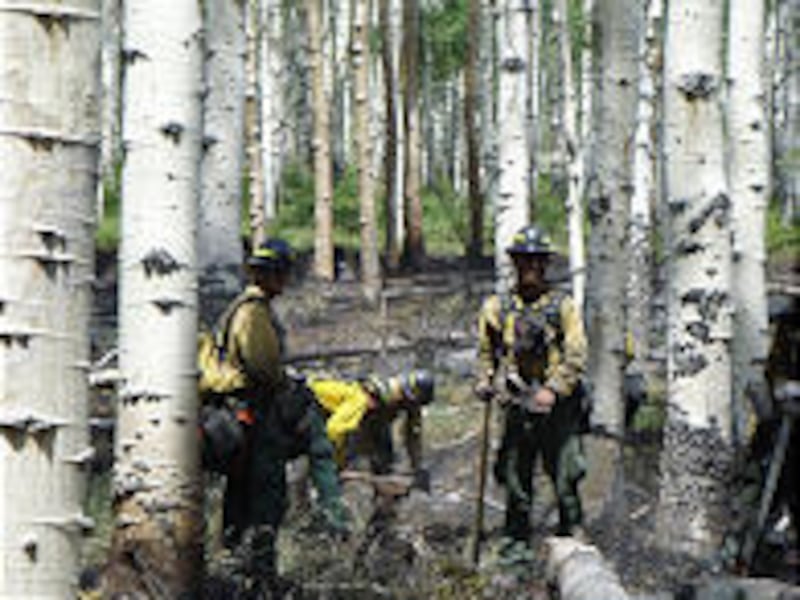
ASHLEY NATIONAL FOREST — Rob Ayres describes his job as "90 percent of the most boring thing you could ever do, and 10 percent of the most exciting thing you could ever do."
The firefighter is one of hundreds battling the Neola North Fire, which has burned more than 42,465 acres at a cost of $4.1 million so far.
"We're making progress," he told the Deseret Morning News as he worked his way through an aspen meadow, making sure the fire lines that firefighters put in will hold the wildfire back.
With the fire now 50 percent contained and staying away from homes for now, authorities have begun a series of "burnout" operations in which firefighters start a series of smaller fires to keep the Neola North Fire from spreading.
"It's going very, very slow," said Dave Sisk, the deputy incident commander for the Rocky Mountain Fire Incident Management team, in charge of the massive firefighting effort. "It's steeper. We can't use equipment, so the firefighters that are out there are working it by hand."
Thunderstorms moving across the Uinta Basin have kicked up strong winds, making it more difficult for firefighters to suppress this blaze.
"We got pretty erratic winds," said Richie Bare, an engine boss manning a water-tender truck here.
Lightning has also been spotted, making fire officials uneasy. And dry conditions in eastern Utah are fueling the fire.
"It's been incredibly dry — drier than I've seen in years," Ayres said. "With the wind and the fuel being so dry, the fire kind of does what it wants to do."
On Thursday, the crew was mopping up hotspots from the burnout operations. They waded into the burned-out areas, sticking their hands in black and gray ash, feeling downed trees to make sure they were cold to the touch.
"I need that hose!" a firefighter shouted in the distance.
A man raced up to the piece of wood churning out smoke and doused it. When they were done, they fell in a line and walked toward the road. The men then walked up the road to another area. They passed another squad putting out hotspots, calling it "leapfrogging."
Overhead, a helicopter moved back and forth to drop water and fire retardant.
At "Drop Point 9," just outside the forest boundary, a series of 2,000-pound pallets of fire retardant were stacked up in a clearing. The retardant was being mixed with water for use in supporting the burnout lines. If the fire jumps the lines, the retardant creates a backup.
Fire officials said conditions here are so dry that much of the water being dropped on the fires by helicopters evaporates before it hits the ground. That's why the helicopters were switching to the retardant.
"It hangs around a little longer than water and makes the fuel a little more resistant to the fire," said Nicholas Giger, who was managing some of the operations at Drop Point 9.
Enough progress had been made on this fire that the U.S. Forest Service planned to reopen some of the roads in the Ashley National Forest today. Taylor Mountain Road and Yellowstone Canyon Road are now open. Campgrounds on Uintah Canyon Road, which is now the western edge of the closure, remain closed.
"Because of the nature of the current and projected fire activity and with the successes of fire-suppression efforts, we are able to open more of the forest to recreation," Ashley National Forest supervisor Kevin Elliott said Thursday.
A fire ban remains in effect, prohibiting any open flame except in an approved designated campground.
The threat still remains for homes in nearby canyons, including Bacon Park and the U Bar Ranch resort area.
"We're watching it real close," Sisk said. "There's always the possibility we'll get new lightning starts."
By Thursday, the fire had destroyed a dozen homes, 24 outbuildings and 12 vehicles. The Red Cross has mobilized to provide disaster relief services to people who lost their homes in the fire.<
"We've identified most of the spaces that have been destroyed, but we haven't identified all of those who lived there," said Amanda Thomas, a Red Cross staffer.
Many homes had several generations of family members living there in a collection of trailers or other buildings. Food was being handed out at a Baptist church on the Ute reservation for those still displaced.
The cause of the fire remains under investigation. The FBI, Bureau of Indian Affairs and U.S. Forest Service continue to focus on an area around a power pole north of here, where the fire is believed to have originated. On Thursday, investigators were seen photographing the power lines, while a Moon Lake Electric Association truck worked on the power pole.
However, authorities have remained tight-lipped about any possible cause.
"As far as I know, no determination of what happened has been made," said FBI Special Agent Trent Pedersen.
The Moon Lake Electric Association's insurance carrier has hired its own investigator to try to determine the cause of the blaze. Electric cooperative officials said hiring an investigator is common when there is a loss or questions of liability.
Moon Lake Electric has estimated it lost 70 power poles in the fire. Early on, some blamed the power cooperative's electric lines for the fire. Moon Lake Electric has denied its lines started the wildfire.
"It doesn't appear that there was anything resulting from power lines," Moon Lake Electric staff assistant Diana Rasmussen said. "There's not a transformer on the pole where the fire started. We just don't see anything that could cause the fire."
Numerous power crews have been seen out in places charred by the wildfire, putting up new poles, stringing new lines and working for as long as they've had daylight. Rasmussen said most of the electricity has been restored to the area.
E-mail: bwinslow@desnews.com