

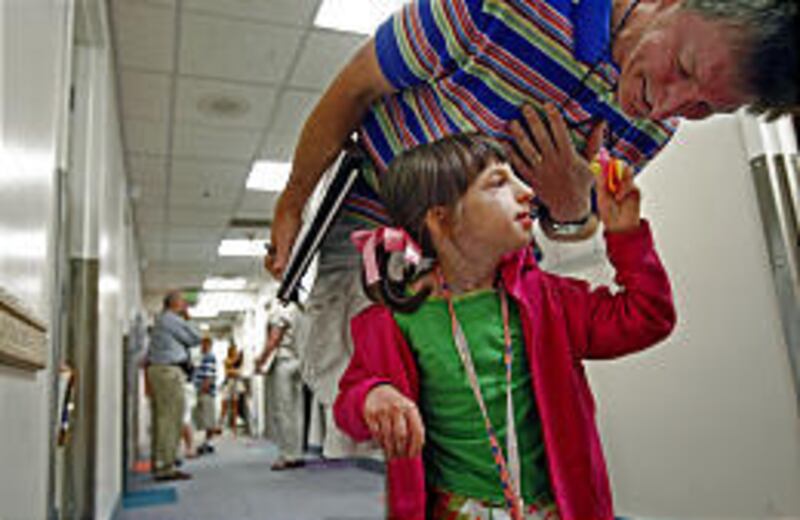
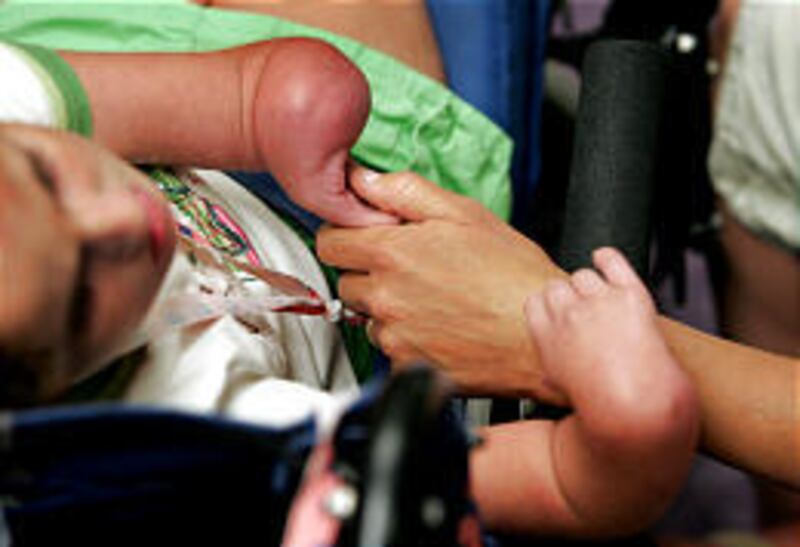

When Morghan Kubena was less than a week old, doctors told her parents, Faye Kaufman and Mark Kubena, not to get too attached. She wasn't going to survive a rare chromosome anomaly called trisomy 18. Her parents were given a do-not-resuscitate order, which they declined to sign.
Kaufman, from Houston, tells the story a decade later as she watches her husband and daughter walk hand-in-hand down the hall outside a special clinic at Primary Children's Medical Center. The two look just like each other, father slightly supporting his daughter as she moves on skinny little legs down the hall, a smile on her face visible behind the pacifier she likes to suck.
They have come, along with more than two dozen other families from around the country, to the annual gathering of SOFT — Support Organization for Trisomy 18, 13 and Related Disorders. Each year, they convene for group sessions, socializing, workshops and fun. But one of the highlights is the clinic, this year at Primary Children's, where parents check in with experts from various disciplines, including orthopedics, genetics, physical and occupational therapy, cardiology and ophthalmology.
This year's ophthalmologist, Dr. Steve Cantrell, made the trip from St. Louis to hold a clinic. His own son, Ryan, was born with trisomy 18 and died when he was just 8 months old. Cantrell understands the loss, the hope, the drive to do everything for such children. As many as half the families in SOFT are still involved although their own child has died.
They also embrace families with related conditions. "We are the home for conditions that have no home," says Dr. John C. Carey, medical director of SOFT and a pediatric geneticist at Primary Children's, which has hosted the clinic several times in the last few years.
He's also a leading authority on these trisomies — so named because a child with trisomy 18 has three No. 18 chromosomes, while one with trisomy 13 has an extra copy of No. 13.
They are very different but oddly similar syndromes, both affecting the mechanics of swallowing and eating, both often accompanied by heart defects and slow growth and poor muscle tone and neurological difficulties, among other challenges. A child with one of the trisomies may have spina bifida or hearing loss or vision problems. All have developmental retardation and most will not walk.
About 1 in 6,000 live births includes a child with trisomy 18, while the number is 1 in 10,000 for trisomy 13. Many babies with these severe chromosome abnormalities die before birth and Carey says 90 percent who make it to birth will die in the first year.
Those that don't, he says, "seem to be declaring themselves to be survivors."
The survivors being celebrated and examined in clinic include almost-4-year-old Elizabeth Hertig and 11-year-old Mary Donohue.
While Elizabeth's parents, Janice and John, ask occupational therapist Jackie Swan what they can do to help her feed herself, the little girl amuses herself by squeezing a water bottle to hear it crinkle and groan, then dropping it to see who will retrieve it. "She likes to play fetch, if you haven't noticed," John jokes.
She was born with trisomy 13, diagnosed when she was a week old. She had an extra finger and toe on the right side, which they had removed to help her walk and use her hand. But she doesn't have "a lot of physical issues," says her dad: a small atrial septal defect that may close on its own and some kidney reflux. She wears glasses and hearing aids and will likely never talk. But she communicates. Mom knows instantly when she wants out of her wheelchair to crawl around, which she does with alacrity. When she's hungry, she scoots into the kitchen and parks in front of the fridge.
Mary, from Stony Point, N.Y., has amazingly thick, curly hair and a pleasant disposition. Born with trisomy 18, she has polyvalvular heart disease and a condition called patent foramen ovale. She used to have a small hole in the lower chambers of her heart, but it closed on its own.
Mom Christine Donohue sounds like a doctor as she discusses issues with Carey. Like most of the parents, with time has come knowledge. Mary has had a lot of lung problems and they take extraordinary steps so a simple cold will not progress to something serious. But despite several oxygen treatments a day, her fingertips and toes are often blue.
Her vision challenge is tricky. She sees one eye at a time. But still, she plays, makes choices in school, supports her own weight and can take steps on her own. Although she can't walk down stairs, she walks up them. And she has "incredible abdominal muscles" and good hearing, although her ear canals are narrow.
She, too, has been basically healthy, hospitalized once in her life for sickness.
Mary's the middle child of five and her mom knew before she was born that she had the condition. But as too often happens, not much was provided in the way of information. She was referred to a support group for an entirely different chromosome defect, Down syndrome. They, in turn, told her about SOFT.
Lots of information about SOFT and the trisomies are online at www.trisomy.org.
E-mail: lois@desnews.com