

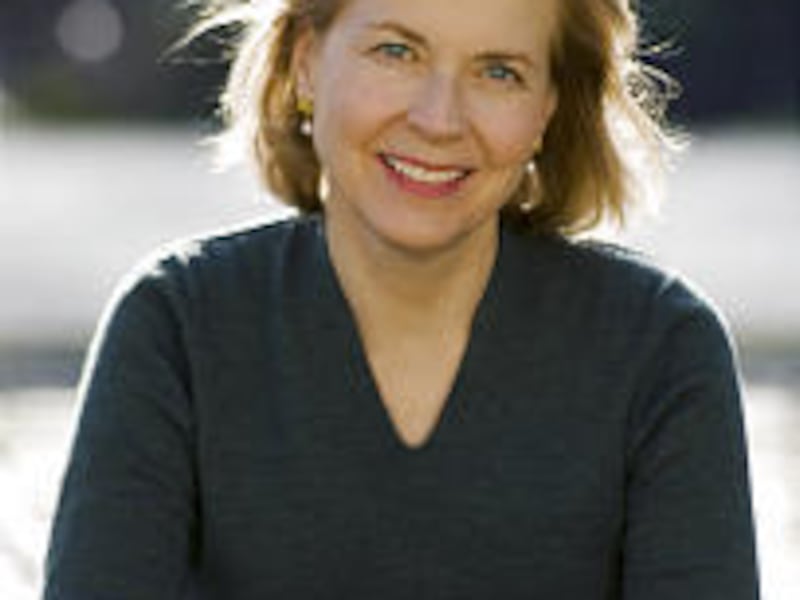
NEW YORK — The personal life of Frank Lloyd Wright, legendary American architect, is not nearly as well known as his 1,000 buildings. In an impressive, well-written debut novel that took seven years to research and write, Nancy Horan effectively fills that void.
"Loving Frank" is a historical novel about Wright's affair at the age of 40 with Mamah Borthwick Cheney, a client for whom he designed a home in Oak Park, Ill., the town where he also lived. They fell in love and left their spouses and children to run away together — an event that shocked the world.
Horan, a former journalist, grew up in Oak Park and lived there for 24 years, although she now resides on an island in Puget Sound.
"Anyone who lives in Oak Park has heard something about Frank Lloyd Wright," said Horan during a June interview at the American Booksellers' Convention in the Jacob Javits Convention Center in New York City.
His home and studio is there, and his prairie style of architecture is easily seen throughout the town, said Horan. "The house he designed in 1903 for Mamah is on East Avenue. I didn't realize that it was her house for many years, but I walked in front of it probably 100 times. It's a low-slung prairie house. When I learned it was her house, I became very curious about the relationship."
Horan stayed close to the historical record, even though she invented feelings and conversations in telling the story. Her research even brought her to the University of Utah to examine the papers of Taylor Woolley, an architect who worked under Wright — and to Boulder, Colo., where Mamah once lived.
"To follow the historical record for me was liberating," said Horan. "When you know what the record says, your job becomes understanding and interpreting why people did what they did. That's where fiction comes in. I didn't insert imaginary characters — I just followed the record from 1907 to 1914."
When the scandal broke, it was headline news across the country with a sensational twist. "Mamah was labeled a vampire," said Horan, "even though she was a feminist, well-educated and an intellectual. People were scandalized that a woman with a husband and two children would leave them while Wright left his wife and six children to go live in Germany. I tried to view it from her point of view and follow her journey — and I found someone more interesting and sympathetic than a vampire.
"Mamah had her own agenda," said Horan. "In Europe, she translated the written work of Ellen Key, a Swedish philosopher who espoused free love and thought a loveless marriage to be immoral. That meant that people who really love each other in spite of being married to others have a right to that love."
Ellen Key was also "a great proponent of women pursuing their own individual gifts and using them as mothers. Mamah's translation proved to be a window into the translator as well as the philosopher."
Horan discovered Mamah's personal letters to Key in the Ellen Key collection at the Swedish Royal Library in Stockholm.
Until Horan wrote her book, Mamah had "been treated as a footnote to Wright's story — and architectural scholars wanted to preserve his reputation. They thought dalliances along the way were damaging to him. Other scholars have become interested in Mamah's place in Wright's life, though. Anthony Ellison, for instance, wrote 'The Lost Years,' a great book I went to time and again."
Horan said Wright and his new love spent much time together in a villa in Italy — so when they returned, he built Taliesin (Welsh for "shining brow"), a kind of American villa, for her in Spring Green, Wis. "I can't help but think," said Horan, "that their history together is somehow recorded in that house."
Horan also believes that Mamah had a profound impact on Wright's later work, especially with the school of architects he founded. Horan is excited to have "discovered fiction writing late in life, but I had no idea my work would see the light of day. I wrote a horrible first draft, written from four points of view. I didn't understand then that I needed to write from Mamah's point of view. I joined a writing group started by Elizabeth Berg (prolific novelist), and when I finished the book, Elizabeth referred me to her agent, who took the manuscript — and Ballantine has been wonderful."
Horan learned that "you must kill your darlings — just as I had to kill Charlotte Perkins Gilman, a well-known feminist, who had historical context with Mamah, but had to go for space reasons. It was an exciting experience to write the book, but it was also lonely. I didn't really talk to anyone about it, because I didn't know if it would pan out. Now, I'm anxious to do another one."
E-mail: dennis@desnews.com