


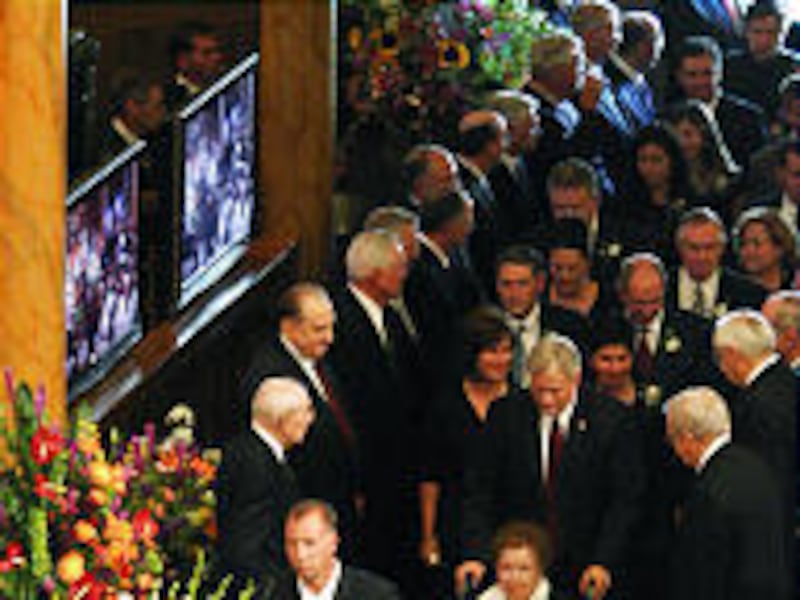

Tens of thousands of Latter-day Saints gathered on Temple Square and in chapels in various parts of the world Tuesday to say farewell to President James E. Faust.
The second counselor in the First Presidency of The Church of Jesus Christ of Latter-day Saints, who died Aug. 10 at the age of 87, was eulogized during funeral services in the Salt Lake Tabernacle as a man of deep and profound wisdom with "the mind of a lawyer and the compassion of a church leader."
Church President Gordon B. Hinckley said the goodbye was a challenge. "This is a time of deep emotion, and a difficult assignment for me. I've lost a close friend and a wise and able counselor." He said numerous messages of sympathy and love have come to church headquarters from all over the world since President Faust's death.
President Hinckley recalled his early association with President Faust, when they both worked as stake leaders in the same part of Salt Lake City. From that point, "I watched him as he progressed up the ladder of church administration. And in 1995, when I was called as president of the church, I knew I wanted him for a counselor."
In those days, President Faust was physically "sharp and bright. He was able to get about without difficulty. Then illness hit him. He had trouble with his back. One thing led to another. He had difficulty walking. He maneuvered that Jazzy (scooter) like a taxi driver," President Hinckley quipped to knowing laughter from the audience.
He recalled President Faust's early days as a farm boy, an athlete and a missionary in Brazil, a place that became so dear he "never got over his love for the people of that nation."
President Hinckley said President Faust was scheduled to participate in the Curitiba Brazil Temple dedication early next year, in the place where he baptized the first LDS family in that nation several decades earlier. "Now none of that is possible. It is all behind us. For him it will simply not be."
"His death was a terrible surprise. We miss him terribly. As we meet as a presidency I look to my right expecting to see him, and he is not there."
That fact was illustrated by President Faust's empty chair on the dais next to President Hinckley.
President Faust's faith was "unflagging. There was no doubt in his mind concerning the prophetic calling of Joseph Smith," President Hinckley said, calling his late counselor's most recent General Conference talk on forgiveness "a masterpiece, which will long be remembered."
He credited President Faust's wife, Ruth, and their children for being a "credit to his name."
"Peace be to his memory. All of us are the richer for our association with him. May his memory remain with us to comfort and guide us."
President Thomas S. Monson, first counselor in the First Presidency, said, "Jim knew the Lord, and the Lord knew Jim. I have a firm testimony of this truth."
While not born to worldly wealth, President Monson said, "(President Faust) came from a home where love prevailed."
When attending sessions of the Cottonwood Stake conference in May 1967, President Monson first met President Faust, who was serving as the stake president. "Thus began a close and cherished friendship.
"There was no chink in his armor; there was no guile in his soul; there was no flaw in his character," President Monson said. "President Faust loved the Lord with all his heart and soul and served Him with all his might to the very end of his mortal life."
A few hours before President Faust died, his wife was sitting beside him, his hand in hers, President Monson said.
"He was a man for all seasons. He was a teacher of truth. He left behind a heritage of honor and a legacy of love. God bless his memory."
Elder Jeffrey R. Holland, a member of the Quorum of the Twelve who had long worked with President Faust to help secure the construction of the Brigham Young University Jerusalem Center, lauded the relationship between President Faust and his wife.
"Surely his almost storybook romance is among the sweetest in the annals of the church. Ruth Faust adored James E. Faust — everything he did and said, every act or deed or gesture melted her. He felt the same way about her, and they were 'melted."'
President Faust's most troubling concern during the past few weeks of his life was leaving his wife, Elder Holland said. "As stillness finally settled over him the hardest thing for him was saying goodbye to Ruth."
He praised President Faust's compassion and caring for the individual, and the sensitivity with which he taught and counseled those who came into his sphere. While he was calm and quiet much of the time, President Faust had "a backbone of steel as resolute as those soft hands were gentle and soothing," Elder Holland said.
"The bigger the issue was, the better he was," he said, adding that pressured decision-making and difficult challenges were when President Faust was at his very best. During one conversation with President Faust, Elder Holland remembered, he strongly advocated a particular course of action.
Commenting on his fervor, President Faust responded, "Jeffrey, my boy, before this hair was gray, it was red. And from time to time a strand of that still shows through."
President Faust's son, Bishop Marcus Faust, told church members of his father's deep love and dedication to his wife and family, as well as to his faith. Through his leadership in their family, "church, gospel, missions and family are all one and the same; the interwoven fabric of our lives."
Bishop Faust recalled a General Conference address in which his father shared thoughts penned during a particularly trying time in Argentina. With emotion in his voice, he read from his father's talk, recalling a "fleeting feeling of being forsaken. Then being reinforced a hundred fold I have climbed a spiritual Mount Sinai dozens of times seeking to communicate and receive instructions.
"It has been as though I have struggled up an almost real Mount of Transfiguration and upon occasion felt great strength and power in the presence of the Divine. A special sacred feeling has been a sustaining influence and often a close companion."
Bishop Faust said serving with President Hinckley in the First Presidency had been "the greatest joy of (President Faust's) ministry," and thanked President Monson and the other General Authorities for their friendship and expressions of love.
The Mormon Tabernacle Choir provided music for the service and sang as a closing hymn and tribute "This is the Christ," which was written by President Faust. Beloved among Latter-day Saints, it describes Jesus Christ and the reality of His role as Redeemer of the world.
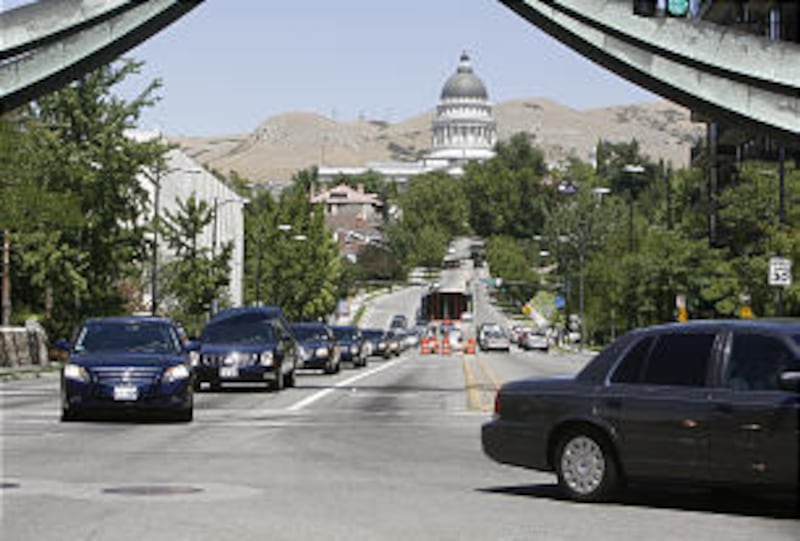
Security was tight on Temple Square, with church service missionaries operating metal detectors at the north and south gates and security personnel visible around the Tabernacle. Following the one-hour service, a hearse containing President Faust's flower-bedecked wooden casket made its way to Holladay Memorial Park with a full police escort.
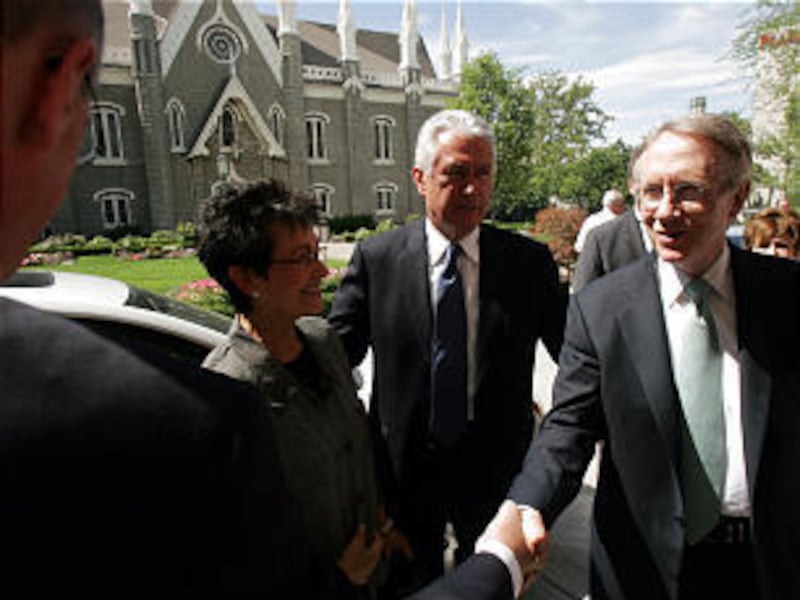
The remaining two members of the First Presidency, members of the Quorum of the Twelve and other General Authorities of the church and their wives joined the motorcade, which arrived at the cemetery just before 2 p.m. Hushed tones and whispers signaled the approach of President Hinckley and Sister Faust and her family.
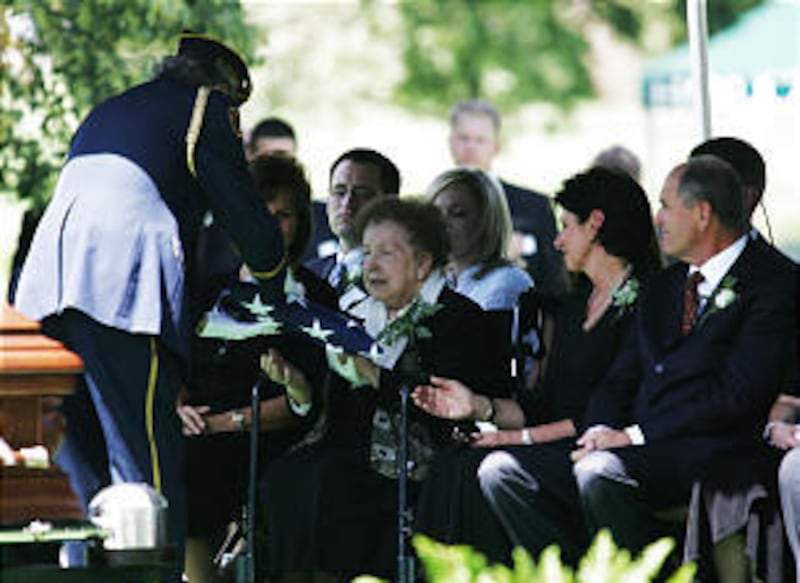
The Disabled American Veterans, Salt Lake Chapter 6, stood at attention as the pallbearers carried the flag-draped casket to its final resting place. President Hinckley stood and welcomed the mourners to the grave dedication of "our beloved James Esdras Faust."
Family members moved closer, comforting each other as a son, James H. Faust, gave a short prayer dedicating his father's grave. The military honor guard gave a three-volley salute in honor of President Faust's military service in the Army Air Corps during World War II.
The bugle played a slow and mournful rendition of "Taps," then the honor guard came forward and, with quiet precision, folded the flag covering the casket and presented it to Sister Faust.
The simple graveside service concluded as each of the pallbearers stood and came forward to place their white rose corsages on the casket. President Hinckley was the first to approach Sister Faust to offer his sympathies, remaining for a few minutes to comfort and visit with family members.
Funeral sprays in the form of a "U" and a "Y" were brought from the Tabernacle and placed near the grave site, honoring the role President Faust played as a graduate of the University of Utah law school and a member of the BYU Board of Trustees.
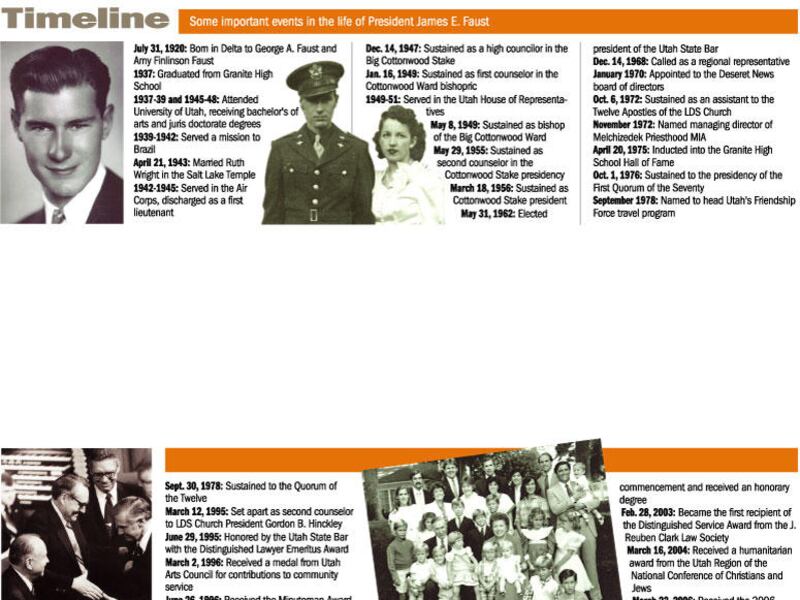
Set apart as second counselor to President Hinckley on March 12, 1995, President Faust served by his side for nearly 12 1/2 years. He was ordained an apostle on Oct. 1, 1978, at the age of 58, and served in the Quorum of the Twelve for 16 years.
During his years as a general authority, he was president of the church's international mission, general authority adviser for South America, executive director of the Church Curriculum Department, director of Welfare Services and editor of the church's three monthly magazines. He also had served as managing director for the Melchizedek Priesthood MIA.
President Faust was sustained as an Assistant to the Twelve on Oct. 6, 1972. He was called to the Presidency of the First Quorum of the Seventy in 1976.
Prior to his full-time church service, he practiced law in Salt Lake City from 1948 until his call to be a general authority in 1972. He had served as president of the Utah Bar Association from 1962-63 and as a Democratic representative in the Utah Legislature from 1949-51. While a legislator, he also served as chairman of the House liquor investigation committee.
President Faust met his wife, Ruth Wright, while attending Granite High. They were married in the Salt Lake Temple on April 21, 1943. He kept in regular contact with his five children and his grandchildren, who took individual flowers from the spray on his casket at the cemetery as a reminder of their grandfather.
For more about President James E. Faust: deseretnews.com/dn/view/1,5143,695200791,00.html
Contributing: Deborah Ramsay
E-mail: carrie@desnews.com