

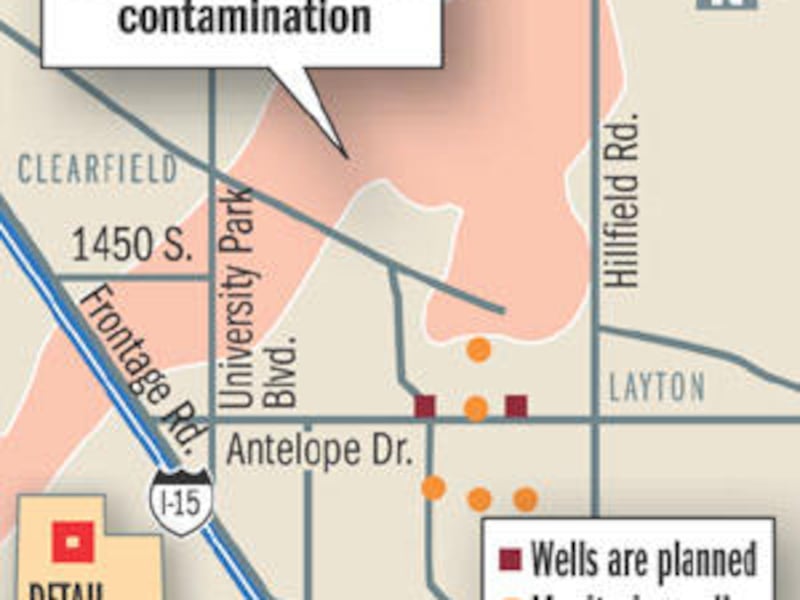
LAYTON — Hill Air Force Base is getting ready to redraw the map of a two-lobed plume of shallow groundwater contamination in Layton.
And though it may come as a surprise to some residents to find the plume is bigger than the current map shows, Hill officials want to reassure them the plume isn't moving.
"There's no evidence to suggest that," said Bob Elliott, the base's environmental restorations chief.
Over the past two years, base officials have been using new techniques to search for shallow groundwater contamination, and the Layton City Council recently got an update on those techniques.
But what started the investigation was the discovery of trichloroethylene, or TCE, vapors in homes outside of the plume's known area.
TCE is a potential carcinogen. The base was charged with cleaning up the contaminant from groundwater following Hill's designation as a Superfund site in 1987, when it was added to the U.S. Environmental Protection Agency's National Priorities List.
TCE first got into the shallow groundwater in Layton, South Weber, Riverdale, Roy, Sunset, Clinton and Clearfield when the chemical, an effective degreaser, was disposed of in unlined chemical pits from the 1940s to the 1970s.
Eventually, the practice was stopped when TCE was suspected as a carcinogen, but that didn't take contaminants out of the ground. Instead, they flowed in shallow groundwater onto the base and into the seven surrounding communities, where cleanup efforts now are under way.
Elliott stresses that TCE has not been found in drinking water and that drinking water supplies come from deep aquifers or from mountain reservoirs.
During fiscal year 2008, the U.S. Air Force is expected to spend $24 million on cleanup efforts, and from now until 2028, which is how far budgets are estimated, the Air Force is expected to shell out about $350 million.
Cleanup is expected to be completed sometime around 2070.
The process allows investigators to revisit contaminated areas to get a refined picture of where contaminants are.
During the past three weeks, residents south of Lincoln Elementary watched as the base installed monitoring wells in their neighborhood. The access plate to each well sits flush with the street and likely wouldn't cause much notice until a technician comes to take a groundwater sample.
Jarrod Case, who runs the base's air-sampling program, continues to test homes for vapor intrusion. As TCE moves through the ground, it sometimes volatilizes, or vaporizes, out of the groundwater and can surface underneath a home.
If levels of TCE are high enough, the base offers to outfit the home with a vapor-removal system, essentially a low-wattage fan installed in a basement floor that vents TCE vapors to the outside.
Testing is free, and if TCE is discovered in a home, the Air Force will pay to have a system installed and provide a stipend for the power it uses.
Barbara Hall, the project manager over the Layton plume, known as Operable Unit 8, said it's still too early to give the plume a new drawing. She doesn't plan to redraw the plume's map until she has at least two samples examined.
"Results of indoor air sampling don't necessarily correspond with the historically drawn groundwater plume," which was drawn in 2001, Hall said.
"We've gone back to relook so that we fully understand it," Elliott said.
The base also plans to install two more wells this fall or winter, one northwest of Lincoln Elementary and one directly north of the school.
Dewey Pearce, who lives south of the known boundary of the plume, said he's had his home tested twice and no TCE has been found.
John Burr, who lives up the street, said officials found TCE vapors the first time they tested, and have since come back to retest and found none.
Both men said base officials have been forthright about efforts to monitor and clean up contaminated groundwater, and Pearce added said that technicians are thorough and detailed about their work.
Residents who live near the plume and may be concerned about TCE vapors may request a test of the air in their homes by calling Barbara Fisher at 801-775-3652.
The base plans to hold an InfoFair at Lincoln Elementary, 591 W. 2000 North, on Sept. 18, 5 to 7:30 p.m., that will allow residents to talk to base officials and environmental experts.
If you go. . .
Hill Air Force Base officials will hold an InfoFair to update residents on the Layton plume, known as Operable Unit 8. Residents can talk to Hill representatives and environmental experts.
Where: Lincoln Elementary, 591 W. 2000 North
When: Sept. 18
Time: 5 to 7:30 p.m.
E-mail: jdougherty@desnews.com