

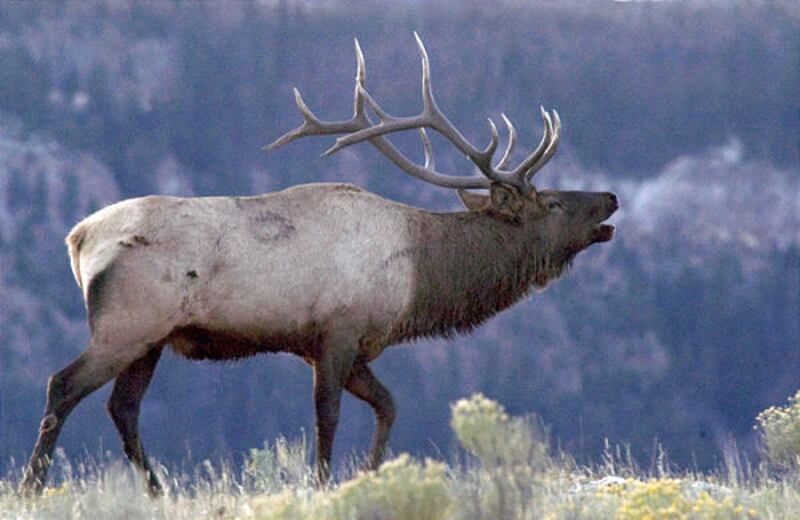
Utah's 2007 general rifle bull elk hunt opens Oct. 6. On Sept. 18, more than 3,800 any bull elk unit permits, and 3,900 spike bull only unit permits, were still available for the hunt. What hunters can expect to see this year are plenty of bull elk.
"The weather over the past four years has been excellent for elk," said Anis Aoude, big game coordinator for the Division of Wildlife Resources. "Most of the state's herds are doing great."
Based on surveys this past winter, DWR biologists estimate Utah's elk population at more than 63,800 animals. That's only 4,800 elk shy of a statewide goal of 68,600 animals.
Aoude said some of the largest elk herds are found on the central mountains near Manti and Wasatch Mountains units; the South Slope, Yellowstone unit in northeastern Utah; and the Plateau, Fish Lake/Thousand Lakes unit in south-central Utah.
He said there's also a lot of elk on the Morgan, South Rich unit in northern Utah. This unit is almost entirely private land, however, and hunters must obtain written permission from a landowner before hunting.
Most of Utah's elk hunting takes place on units that are called spike-only units. These are units where only spike bulls may be taken. And, while there are a large number of spike bulls on these units, once the hunt starts the animals can be tough to find.
"The success rate on spike only units averages about 18 percent," Aoude said.
"Fortunately, there are several things you can do to up your chances."
Unless it gets cold and snowy before the hunt, Aoude said elk will be scattered at higher elevations when the season opens. He added that the key to finding elk is to get off the roads and into the backcountry.
"Elk are smart, wary and sensitive to hunting pressure," he noted. "As soon as the shooting starts, they head into the thickest cover they can find. To find success, you've got to head into the backcountry and find them."
The rut or breeding period can also make it challenging to find spike bulls.
The rut occurs right before the general rifle hunt. During the rut, mature bulls gather groups of cow elk to breed. These large bulls will chase off any spike bull they see.
Being chased into the cover by the bigger bulls before the hunt makes the smaller spikes more apt to head back into the cover once the bullets start flying.
"The larger bulls probably scare the spike bulls as much as the hunters do," he noted. "Unless you get into the backcountry areas where the spikes are hiding, you're probably not going to see many.
"The good news is, if you do get into the backcountry, there's a good chance you'll be among the 18 percent who take a spike bull this year."
The most important reminder Aoude has for elk hunters is for those using off-highway vehicles to obtain an OHV riding map for the area they are going to hunt.
These maps are available from the DWR, the U.S. Forest Service or the Bureau of Land Management, which manages the land.
Aoude said the DWR is receiving more and more complaints every year about OHVs being taken into areas where it's not legal to take them.
"Taking OHVs into these areas damages the habitat that the elk rely on, disturbs and scatters the animals, and ruins the hunting experience for other hunters," he noted.
He also encourages hunters to do some preseason scouting and to check the boundary descriptions for the areas they will be hunting.
Boundary descriptions are found in the 2007 Utah Big Game Proclamation.
The proclamation is available at the DWR Web site — www.wildlife.utah.gov — and from DWR offices and hunting license agents across Utah.
For more information, call the nearest DWR office or the main office at 801-538-4700.