

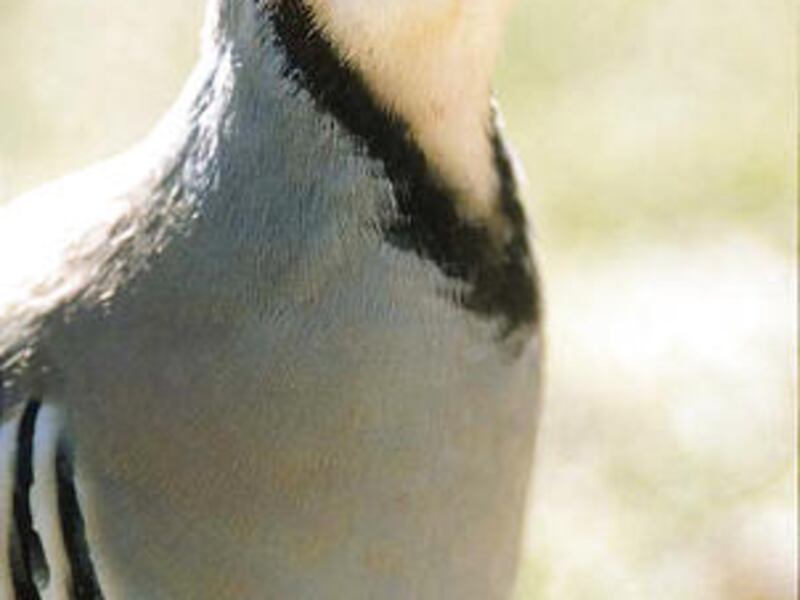
More than 3,000 chukar partridge were released across Utah for the upland game hunt that opened last Saturday.
The Division of Wildlife Resources released the adult, pen-reared birds to provide better hunting in certain areas of the state this season.
Pen-reared chukars were released in Box Elder, Cache, Summit, Kane, Utah, Iron, Millard, Sevier, Duchesne, Uintah, Carbon and Emery counties.
The DWR released many of the chukars in areas where biologists have constructed game bird water guzzlers. Chukars were also released in areas where populations have been affected by the dry conditions in Utah this year.
Because of the potential to overcrowd areas with hunters, and to protect the guzzler sites used by wildlife, the DWR will not provide maps of specific guzzler site locations or more specific information about where the birds were released.
A map that shows the distribution and density of guzzlers in Utah is available at www.wildlife.utah.gov/pdf/guzzlermap.pdf.
Some of the chukars that were released were banded with aluminum leg bands. Those hunters taking a banded bird are being asked to call the DWR at the telephone number printed on the band. They can also submit band information online at www.wildlife.utah.gov/uplandgame/index.html#bird_band.
The information will allow biologists to assess how many birds hunters took and how many of the birds survived and dispersed into habitats they prefer.
Hunters might also take wild birds that have been banded. Many of these wild birds have been banded with colored, plastic bandettes. These birds are part of a statewide research study that is being done to assess chukar populations and how they use guzzlers in the state.
To learn more about the research study by visiting www.wildlife.utah.gov/uplandgame/chukar/chukar_study.php on the Web.
Since the mid-1990s, the DWR has constructed hundreds of 350-gallon game bird and small mammal guzzlers. These guzzlers have been placed on many of the mountain ranges in the western desert, stretching from the Utah-Idaho border to the Mohave Desert in the southwestern corner of the state. The guzzler design the biologists are using allow the watering devices to be placed in Utah's roughest and rockiest habitats, which are ideal for the chukar partridge.
Biologists place the guzzlers in long, narrow canyons that have steep, rocky slopes. These areas provide good escape cover for chukars.
In each area, complexes of four to six guzzlers are built about one mile apart. Biologists then move down the mountain range a couple of miles and build another guzzler complex. The idea behind this guzzler construction scheme is to place water where birds would normally look. Biologists also want to provide water in areas that provide good forage for chukars.
Chukars are an exotic bird that are native to places like India and Afghanistan in the Middle East. They are about 15 inches long and weigh 20 ounces.
Chukar partridge live in some of the most inhospitable habitat in Utah.
They're found mostly on steep, rocky slopes in the barren desert areas of the state. They seem to like areas that have low-growing shrubs, such as the sagebrush, saltbush and cheatgrass vegetative zones, above and below the juniper tree belt. Talus and rocky slopes help the chukars hide, and they give them a place to escape.
Chukars eat mostly grass seeds, weed seeds, buds and flowers. In the winter, they also eat cheatgrass that's just starting to grow.
Male and female chukars look almost identical.
The season runs until Jan. 31 in some areas of the state. Both males and females can be hunted. The daily bag limit is five birds, and the possession limit is 10.