

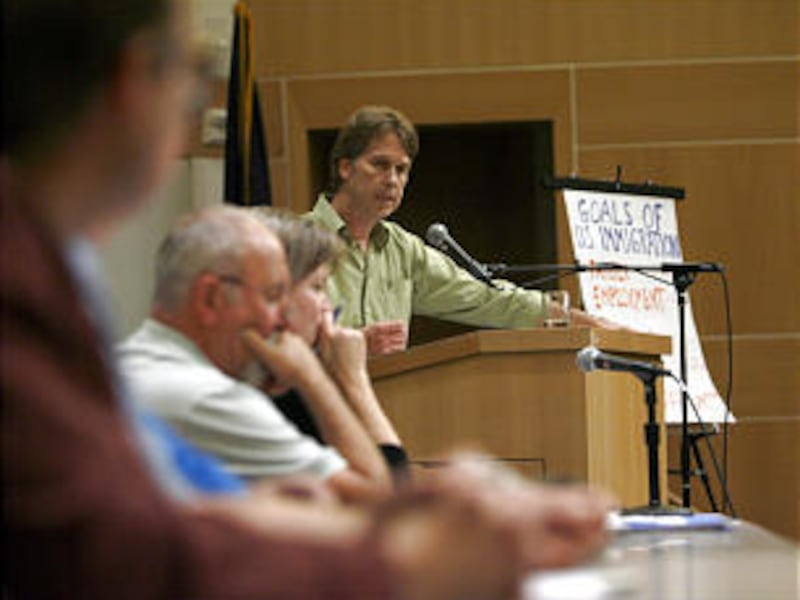
At first blush it might be tempting to dismiss Jeff Nielsen's idea as simply a civics lesson. (And could there be a duller word in the English language?)
But Nielsen, despite his Utah County guy-next-door demeanor, is something of a revolutionary. He doesn't just want to teach about democracy, he wants you to actually help govern America. He wants you to not just vote but to serve on randomly chosen citizens councils that help make policy. He wants the Legislature to mandate those councils and wants citizens to be paid to participate. He believes that democracy means that our elected representatives are not our leaders but our employees.
Nielsen teaches philosophy at Westminster College and Utah Valley State College. He also used to teach at Brigham Young University, but his contract was not renewed after he wrote an op-ed piece last year supporting gay marriage. Clearly he does not recoil from controversial topics (much to his wife's dismay, he says). He can also take a topic as routine as democracy and bring to it a radical spin.
Last year, Nielsen started what he calls the Democracy House Project, going into people's living rooms to encourage them to really think about what democracy requires. This summer he helped Salt Lake City's Office of Diversity run a Citizens Council on Immigration, an experiment he hoped would bring people with opposing ideas together to respectfully discuss immigration, a topic so divisive that some days it seems to be tearing America apart.
And Sunday, along with Mayor Rocky Anderson, he helped launch Democracy Week. Like Anderson, Nielsen comes from a place of earnest belief in the desire of ordinary people to get fired up about abstract ideas and their own role as citizens.
The agenda for Democracy Week includes these enthusiastic suggestions:
Monday, Sept. 3: Residents are encouraged to walk around their neighborhood and talk to five people they don't know, then "share with these people their thoughts on democracy and citizen involvement."
Wednesday, Sept. 5: "Residents are encouraged to research a public policy topic of importance from objective, nonpartisan sources. Then write down three legitimate reasons that support their opinion and three reasons that support the opposing position."
When a reporter wonders if, um, people will actually do any of this, Nielsen laughs his easy, pleasant laugh. "I don't know why I'm so optimistic," he says. "I have no reason to be. I think it's a character defect."
Maybe he's naive, he acknowledges, but for him the nitty-gritty of democracy is that ordinary people "are smart enough and morally decent enough for self government." So what we need are not more blue-ribbon panels of well-connected people or more advocates pushing their side of an issue or talk radio blaring raw emotion. What we need, he says, is not debate but dialogue among regular folks.
"Too often we just speak from our emotions. We all have good intentions, but there are all these unquestioned myths and assumptions, and we need a safe place to bring them out and examine them," he says.
So, for Nielsen, political literacy is not just about being able to name the three branches of government but about learning to talk — and listen — to people who have different views, and then to deliberate with them, coming up with solutions based on shared values.
This was the democratic ideal of the ancient Greeks. But America's history reflects a continuing struggle with the idea of pure democracy, from the Founding Fathers' uneasiness with the concept, to President George Bush's desire to export democracy to the Middle East, and then his unhappiness when democratic elections produce victory for a group like Hamas.
The Founding Fathers, Nielsen notes, were "distrustful of the ordinary mass of people." That's why they chose a republic — a representative oligarchy, Nielsen calls it — instead of a pure democracy. The Constitution, Nielsen says, was "a device to keep the ordinary people from really direct involvement. ... They were suspicious of the wisdom of ordinary people." There was no universal suffrage; the president and senators were not elected by popular vote. It wasn't until near the end of his life that Thomas Jefferson could use the word "democracy" in a positive way, Nielsen says.
Over time, though, America has become more democratic in its laws and outlook, he says. At the same time, "our political process and parties have become less democratic." Elections require huge sums of money, which means that a few people, relatively speaking, can control who runs, who wins and who lobbies from behind the scenes and then expects favors in return.
Although the Founding Fathers were suspicious of it, pure democracy is necessary, because without it liberty and equality, and human dignity itself, aren't possible, Nielsen says.
Hence the need for Citizen Councils like the one that met last month to tackle immigration, he says. Nielsen and Josie Valdez from the city's Office of Diversity created two groups: one consisted of immigrants (two of them undocumented), the second was made up of what Nielsen called "longer-term residents," including members of the Utah Minuteman Project as well as people in favor of reforms such as amnesty. In the third week the two groups then met together — but not before each received a tutorial from Nielsen about "cognitive biases" and the "architecture of the brain."
The idea was to get everyone to see that we often retreat into emotion and logical fallacies, and that if we could learn to really look for shared values we could discuss even immigration with mutual respect. And we might be able to come up with a solution that has eluded Congress.
That was the idea, anyway. Nielsen is the first to admit that his first experiment wasn't a total success. For this first citizen council he wasn't able to pick people completely at random (no money and no time). And he picked a super-charged issue that required much more than the dozen or so hours allotted.
"What's he trying to do?" 84-year-old Minuteman Phil Morgan asked Minuteman director Eli Cawley during a break at one of the meetings.
"He's discussing techniques of communication in order to ... " Cawley began.
"In order to set us up?" Morgan wanted to know.
This is for people who believe in theories, Cawley answered, then summed up Nielsen: "He's an academic. That's what you have to expect."
Morgan wasn't convinced. After the meeting he told a reporter that he felt that Nielsen was really trying to change the Minutemen's minds about immigration. "I'm too old for that," he said.
The weekend after that, the two groups — the immigrants and the nonimmigrants — met together to dialogue and deliberate. Cawley later wrote Nielsen that he thought the process was helpful "as a way to disengage emotionally and psychologically from the often adversarial postures." But all in all it was a failure, he said.
"The stultifying nature of the techniques which enabled discussion in the first place, giving precedence as they did to accommodation and commonality" were part of the problem, he wrote. "Encouraging as it did mutual respect rather than antagonism and contention, this process of amelioration succeeded merely in obfuscating the real issues in the national debate rather than permitting the panel to come to grips with them." The result, Cawley said later, was "a squishy middle."
Democracy itself, Cawley says, gives too much power to what he calls "the mob."
Nielsen feels that the dialogue he fostered that day worked but only temporarily. The same thing happened when he once had a dialogue in Utah County about same-sex marriage and civil unions. After the third immigration meeting, he says, he was depressed. He's also lost sleep over the whole venture.
The Citizens Council on Immigration held its fourth and final meeting yesterday, as a public forum. It was the kick-off for Democracy Week, and as Nielsen opened a second folding table in the auditorium of the downtown library he looked at the meager turnout and noted, deadpan: "We just want to make sure we have as many people up here as we do out there before we start."
"You want to make each day count, but also you realize that one day you'll be dead," Nielsen told the Citizens Council on Immigration at one point in the monthlong process. "So I want to make a difference but not take myself too seriously."
Yeah, he knows that this year's Democracy Week wasn't publicized or funded and that his hopes for a city full of people reading the Preamble to the Constitution are a bit idealistic. "My big idea," he calls it with a hint of self-deprecation. But he hopes Democracy Week is at least a start, maybe even the beginning of a tradition.
On the net:www.archives.gov/national-archives-experience/charters/charters.html
E-mail: jarvik@desnews.com