

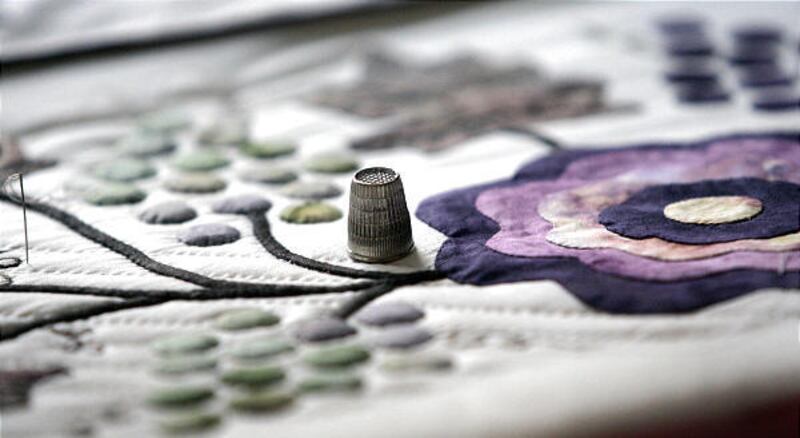
Marilyn Landry Toone shares some of her favorite tips for hand-quilting on a frame, which is her preferred method of quilting:
• When putting a quilt on the frame, cut the back two inches larger than the top all the way around. Toone has a piece of material that is stapled to the wooden frame, and she pins the quilt back to that material. She attaches the back, and then puts on the batting and top and bastes it in place. The extra fabric on the back gives you leeway in case any of the edges tear.
• Always use a thimble. Otherwise, you'll wreck your fingers. Especially on a frame, there is less flexibility and you will have to use some force on the needle.
• Make sure all your stitches are pulled tight. This will give you more texture in the quilt.
• Don't pull each stitch all the way through. Take three or four or five stitches and then pull the thread through to the end. This will help you go faster and use less arm motion.
• Quilt what is right in front of you in a large square, rather that moving from end to end. If there are times, such as on borders, when you have to move along, use several different needles, so you can go back and finish up middle work.
• Use fabric that you like, otherwise you will find that interest in finishing a project can lag. You may set it aside and forget it.
• Toone prefers to use a fine, short needle, a No. 10. "I find that a shorter needle helps me take shorter stitches." And yes, she does break some needles. That's OK.
• If you are quilting or appliqueing several individual objects, flowers, say, carry your thread inside between the layers from one object to another instead of tieing each one off and starting again. This makes for easier transitions but works best when objects are up to an inch or so apart.
• On long rows, circles or diamonds, start in the middle of the thread and work to each end. This avoids knots that can pull through and also means you don't have to work backward and you come around the other side.
• Whenever you use a knot, take one stitch backward before going forward. This will anchor in the knot so it won't pull through.
• Find a mentor or a teacher for things you want to learn. It is often easier to learn by watching someone else do it than by reading directions.