

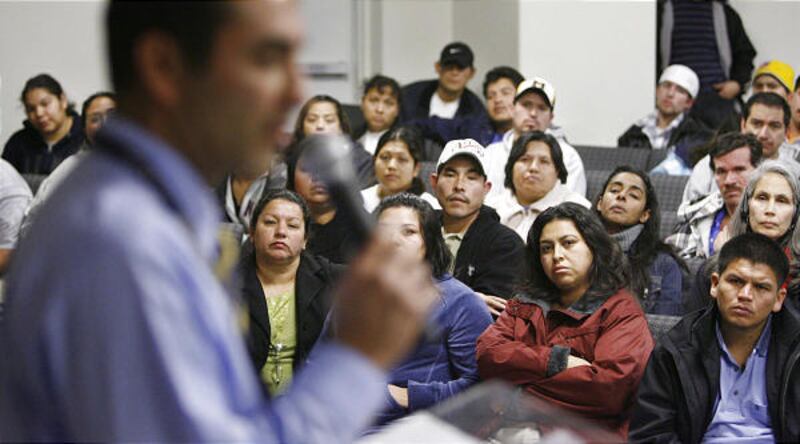
LOGAN — Leo Bravo's phone hardly stopped ringing in the days following the raid.
Everyone needed something after federal immigration officers arrested 145 employees accused of working illegally at the Swift & Co. meat-packing plant in nearby Hyrum on the morning of Dec. 12, 2006.
Community leaders rushed to provide legal aid and support for families that were torn apart. Hundreds called Bravo with requests, but the director of the Multicultural Center of Cache Valley remembers only one call.
"Mr. Bravo, do you know where my mommy is?" he recalls the young girl on the other end asking. "That killed me."
Two years later, life is slowly getting back to normal for the hundreds in Cache Valley who were caught in the middle.
But some say the Hispanic community is getting back on its feet just in time to start scrambling.
"The fear is still there," said Luis Espinoza, a real estate agent and advocate who lived in Cache County at the time of the raid. "The general feeling is that it's worse now than ever before. It's time to figure out somewhere else to go."
Part of that fear comes from Utah's 2008 immigration omnibus bill, SB81. The measure aims at preventing undocumented immigrants from getting jobs or public benefits and is set to take effect in July 2009.
Under SB81, employers would be required to use E-Verify, which compares citizenship status documentation from new employees to databases in the Social Security Administration and Department of Homeland Security. Critics of the bill have attacked flaws in the verification procedure, pointing out that errors in database information — by some estimates as many as 17 million in the SSA files alone — will lead to mistaken "non-confirmations" that could keep people who are legitimately in the country out of employment.
Tom Bingham, president of the Utah Manufacturers Association, said that the Swift raids of two years ago, in particular, revealed weaknesses in the procedure.
"What happened to Swift in Hyrum points out that E-Verify doesn't really do what they say it will," Bingham said. "Swift was using the system ... .an earlier version of it to screen their employees ... and ICE still came in and hauled all those people away and it just about put them under."
Bingham's group has urged legislators to delay implementation of the bill until problems can be worked out.
Even some groups seeking a tougher stance on undocumented workers are finding fault with the new legislation.
Eli Cawley, the chairman of the Utah Minuteman Project's board, called it a "hollow victory" and said the fiscal crisis would be the only reason for undocumented workers to be afraid.
"Language-wise it's a good bill, but there's no money for enforcement," he said. "I'm very pessimistic that this bill will have any affect on actually enforcing the law. Anything that happens will be more or less coincidental."
In Cache County, some who were deported after the raid have already returned to the valley only to find the jobs have dried up. The factories, where some said Hispanics could routinely find work, have tightened hiring practices or have fewer jobs in the struggling economy.
"A lot of people are getting ready to go back home," Espinoza said. "The doors are being shut on them and the opportunities that were there before are not there."
At the Swift plant in Hyrum, many of the jobs have been filled by Burmese refugees, said Kyaw Eh, who has worked at the plant for about a year.
Now families, many of whom have spent decades living in the United States, are eyeing a return to their homelands, Espinoza said.
Such an exodus would present a new set of problems for the nation, he said.
"A lot of them don't understand the process of leaving, just as they didn't understand the process of arriving here," Espinoza said. "A lot of these people, they haven't just been here one or two years. They've been here almost a lifetime. They never knew how to fix their situation and now they have to go back and they have to learn a whole new culture."
Espinoza said he also worries about the "wave of legal immigration" that could hit the United States when children with U.S. citizenship who follow their parents to Mexico and South America return to the United States in 15 to 20 years.
Like Espinoza, most hope for long-term solutions to immigration problems.
But for now, Bravo said his center must still find ways to support the people who were left to raise nieces and nephews alongside their own children after parents were arrested during the raid.
"The need is always the same," he said. "They're looking for a better life."
Contributing: Arthur Raymond
E-mail: afalk@desnews.com