

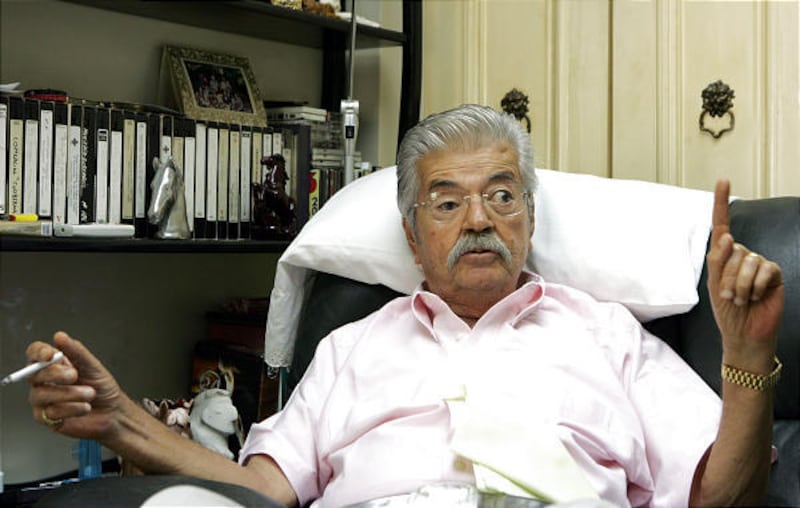
QUITO, Ecuador — Former President Leon Febres Cordero, the colorful, right-wing leader who dominated Ecuadorean politics for decades and was dubbed the "owner" of the nation by his opponents, died on Monday. He was 77.
Close friend and political confidant Alfonso Harb said Febres Cordero — who survived five heart bypass operations, two bouts with cancer and three bullet wounds — died of complications from pulmonary emphysema caused by a lifetime of chain-smoking.
The U.S.-educated mechanical engineer was the indisputable leader of Ecuador's right for half a century and was one of only three presidents in the past 27 years to finish their terms in this politically unstable Andean nation.
"He's the last caudillo (political strongman). There won't be any more like him," his former vice president, Blasco Penaherrera, once told The Associated Press.
Born in the Pacific port city of Guayaquil, Febres Cordero was president from 1984 to 1988 under the banner of the conservative Social Christian party. After leaving the presidency, he dominated Ecuador's Congress and courts until his failing health forced his withdrawal from politics in 2002.
A lover of horses and a prize-winning sharpshooter in his younger days, Febres Cordero carried a pistol as president. In his later years, he was known to tuck a miniature .38 caliber automatic under his shirt before going out, a gift from the U.S. Secret Service in 1985.
The first Latin American president to champion free-market economics in the 1980s, Febres Cordero won warm support from fellow conservative icon Ronald Reagan.
He survived politically despite an earthquake that crippled oil exports for six months, a leftist insurgency, two military rebellions, and a kidnapping by renegade paratroopers who killed three of his bodyguards. He was released 11 hours later after being roughed up.
He applied an iron fist to virtually eliminate the urban, Cuban-inspired guerrilla group Alfaro Vive.
"Exercising leadership, my friend, is not done with smiles," he told the AP in a 2006 interview. "Smiles are good for wooing a woman but not for governing."
His opponents considered him autocratic and accused him of using his party's control over the judicial system to harass his enemies by having them arrested or driving them into exile.
But Febres Cordero, known simply by his first name "Leon," or "Lion," enjoyed unconditional support from Ecuador's right and a large part of the country's population.
He rejected his opponents barb that he saw himself as the "owner" of Ecuador, for which he developed a quick rejoinder: "If I had the influence that people say I have, the country wouldn't be in the shape it is in."
After leaving the presidency in 1988, he served as mayor of Guayaquil from 1992 to 2000.
As head of the Social Christian party, Ecuador's largest and best organized, he still held national sway. His party typically controlled a third of Congress' 100 seats, enough to guarantee him a virtual veto over legislation given the fractured party structure of the long-unstable nation.
Forced to withdraw from politics due to his health in 2002, leadership of his party passed to the current mayor of Guayaquil, Jaime Nebot, who lacks the charisma of the ex-president.
He joked about his health problems and the smoking habit that eventually killed him.
"My best friends are my cigarettes and my pistols. They don't ask for anything and they're always ready," he told the AP in 2006. "I'm armed all the time because I've been shot at all my life."
To prove it, he showed the bullet wounds he sustained while campaigning for Congress in 1970. He tugged aside his collar to reveal a scar on his left shoulder and pulled up the cuff of his left pants leg to show where a bullet hit below his knee.
A third shot, he said, hit him in the lower back but missed vital organs.
Febres Cordero was not a fan of current leftist President Rafael Correa.
Prior to his election in 2006, Febres Cordero called Correa "a communist." Correa shot back: "A political dinosaur."
Born in Guayaquil on March 9, 1931, Febres Cordero married Eugenia Cordovez, with whom he had four daughters. He later married Cruz Maria Massu, but they had no children.
Funeral arrangements were not immediately known.