

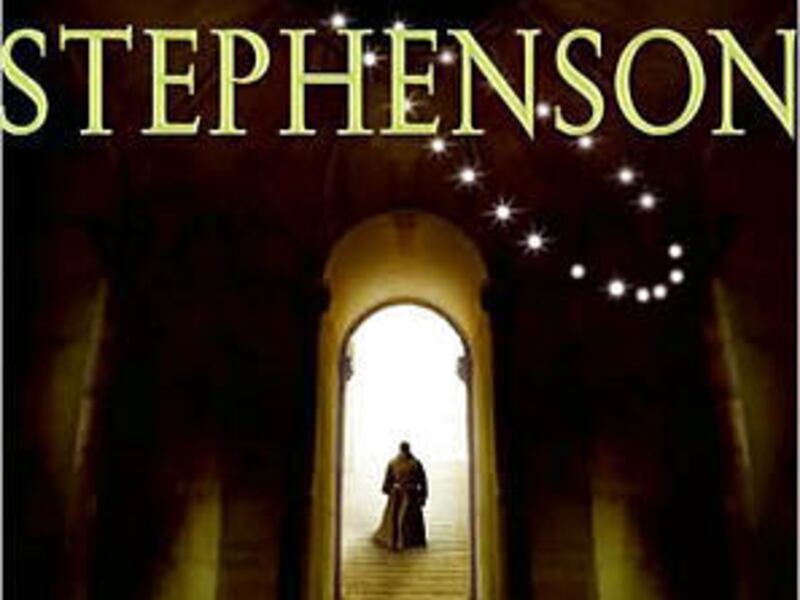
"ANATHEM," by Neal Stephenson, Morrow $29.95
Maybe I'm just not smart enough for science fiction anymore.
Much as I enjoyed Neal Stephenson's ravishingly brilliant, outrageously ambitious "Anathem," I can't help but think it would be a better novel with a lot less intellectualizing, and, oh — let me do the math, here — about 300 fewer pages.
Stephenson sets his story on an Earth-like planet, Arbre, where mathematicians have been relegated to a monastic existence, segregated from ordinary life after the "Terrible Events" of 3,000 years earlier, when science and technology wrought a worldwide calamity.
Erasmus, Stephenson's hero, is a young "fraa" (think "brother") studying theoretical physics at the "concent" (think "convent" plus "concentration camp") of St. Edhar ("saunt" equals "savant" plus "saint"). A likable lad, Raz, as his friends call him, is a slightly older Harry Potter, plucked from obscurity to be tutored in arcane lore, surrounded by fast friends, thumped by strict but mostly well-meaning instructors.
Raz goes against concent rules to learn why his mentor, Orolo, has been called to the outside world by the civilian government. Illicitly using a telescope atop a tower, Raz discovers an alien spacecraft in orbit around Arbre.
With "Anathem," Stephenson embarks on a mission of world-building, and he is thoroughly successful at it. He creates a plethora of terms for things like cell phones, movies and the Internet that are amusing and convincing at the same time, and which give his inventions a three-dimensional quality.
Alas, unlike that greatest of world-builders, J.R.R. Tolkien, Stephenson spends a long spell standing back and admiring his creation. "The Lord of the Rings," remember, has Frodo and Gandalf chased from the Shire by ghoulish horsemen before Bilbo's birthday candles are cold. Stephenson dawdles for 200 pages getting to a similar spot in the story.
Soon — or what passes for "soon" in Stephensonland — Raz and his pals are thrust into the outside world, too, where they undergo many thrilling and convincing adventures — a trek over the pole, for one — and meet many fascinating people, including an order of kung-fu monks who save him from a murderous mob. It all leads up to a gloriously imagined space battle.
The ironic thing is that Arbre doesn't come to life until Erasmus and company start doing things in it. Likewise, discussions of weighty scientific and/or philosophical ideas are a long tradition in sci-fi, but Stephenson indulges himself in this convention at inordinate length. Fiction is always — always — more effective when the ideas are suggested by action, not worried to death by conversation.
Still, "Anathem" is thought-provoking fun, at turns a post-graduate seminar of ideas, and a rousing yarn with characters you care about.
If only it could have been both at the same time, it would be a great piece of literature.