

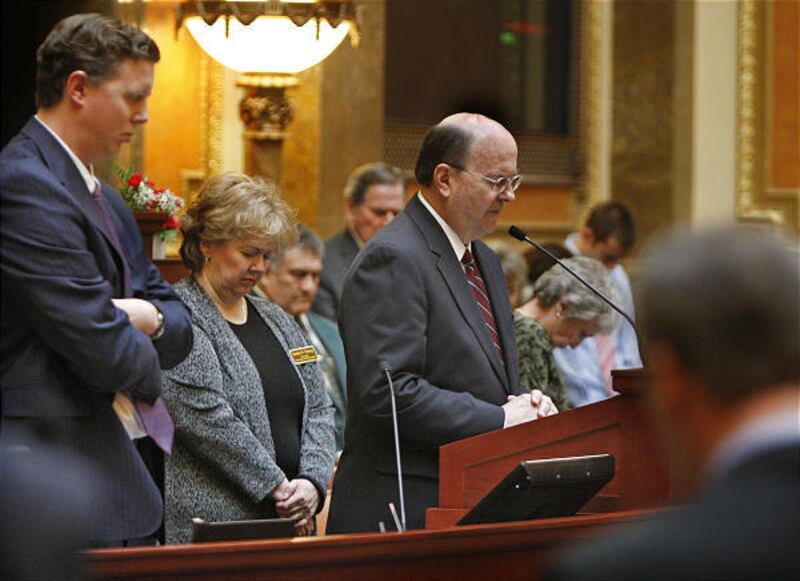
There's a rhythm of sorts that begins each day at the Utah State Capitol: First, a call for lawmakers to gather on the House or Senate floor. Then, a prayer, the pledge — and off to business.
"Father, we feel to thank thee for the great abundance of blessings we have," Sen. Carlene Walker, R-Cottonwood Heights, prayed last week. "Be with us that we might have the spirit of cooperation."
For more than two centuries, prayers have been used to open the government meetings of this nation. They are said before city council meetings, school board gatherings and at the beginning of each day in state Legislatures.
For the most part, Utah lawmakers say they view the prayers as a welcome intrusion.
A small minority say they feel uncomfortable at times with the prayers, many of which are offered by lawmakers who are members of The Church of Jesus Christ of Latter-day Saints — the primary religion of most legislators.
"I'd be lying if I didn't say that sometimes being of a minority faith, sometimes I feel excluded," said Rep. David Litvack, D-Salt Lake City, the only Jewish member of Utah's 104-person legislative body. "It's religious in nature because you can't run away from the nature of prayer."
In 1983, the Supreme Court ruled that prayers before a legislative meeting were constitutional and did not violate the First Amendment, which forbids a national religion and advocates a separation between church and state.
Rather, the prayers were seen as a sort of secular tradition, carried through the years since the beginning of the nation.
"This unique history leads us to accept the interpretation of the First Amendment draftsman who saw no real threat to the Establishment Clause arising from the practice of prayer similar to that now challenged," the court said in Marsh v. Chambers.
Separate cases have upheld the use of prayers during city council meetings, according to the Utah Chapter of the American Civil Liberties Union.
Senate President John Valentine, R-Orem, said he feels a prayer sets the tone of a legislative meeting. He said he has witnessed prayers by Muslims, Native Americans, members of the Jewish faith, Hindus and various Christian traditions.
The Senate secretary works to find people to pray at the start of each meeting and give the pledge. In the House, each member of the body is invited to either pray, or find a person to pray in their place.
"We don't give too much direction as to what is said," Valentine said. "Some people, in the form of a prayer, have called us to repentance and chided us."
House Minority Leader Brad King, D-Price, said he enjoys the daily prayers and finds them to be appropriate. He said he is comfortable with prayers offered by any religion, and that each appeal has a common theme of service and "remembering the voiceless."
"There are common themes, all of which are important for lawmakers to keep in mind, and those are rarely religious," he said. "To me, that's a positive thing as we try to understand about feelings and the beliefs of all constituents."
Rep. Ron Bigelow, R-West Valley, said he once invited a local clergyman to pray, and that opened a door to a different area of his community with which he had not connected. "It reminds us not only of our history and roots, and yes, the diversity of this state, but also the mere fact of being reminded that we are dealing with issues that impact people."
The Utah Legislature will be meeting for three more weeks. Floor sessions begin at 10 a.m., and prayers are said at the start of the meetings.
E-mail: nwarburton@desnews.com