
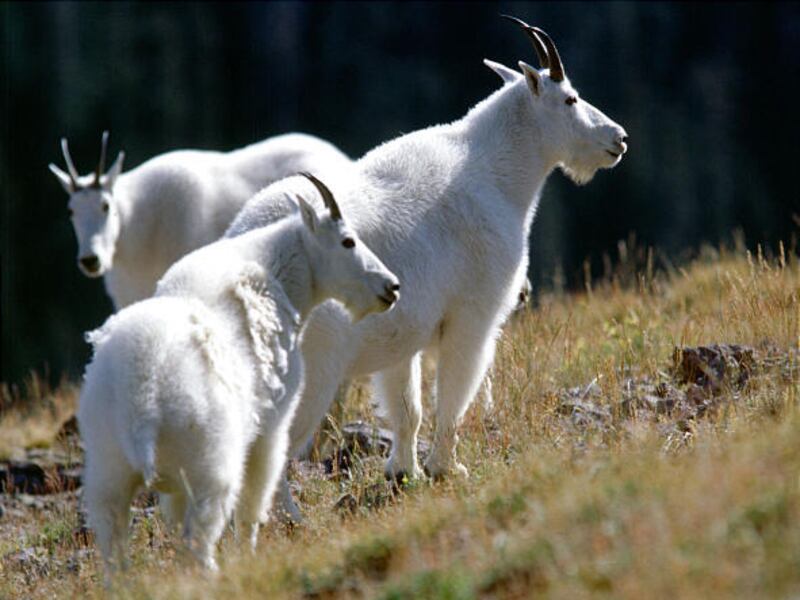


It is possible, at certain times of the year, to see Rocky Mountain goats hopping from rock to rock, completely unaware of the city life below them.
Now is one of those times and wildlife biologists will be on hand Saturday to spotlight goat sightings near the mouth of Little Cottonwood Canyon.
Bob Walters, watchable wildlife coordinator for the Utah Division of Wildlife Resources, will hold a goat-viewing event on Saturday.
It is, as Walters said, "A great opportunity to see and enjoy the sure-footed antics of these goats."
There is no evidence Rocky Mountain goats ever roamed Utah mountains before they were introduced in 1967. Their prehistoric cousins did, however, which is one reason the white goats were brought to Utah.
In 1967, two yearling male and four adult female goats were brought to Utah from the Cascade Range in Washington and released on the north side of Little Cottonwood Canyon near Twin Peaks.
For years, wildlife biologists looked for the new residents but had no firm sightings. Then, in the mid-1970s, a group of goats was spotted on the southern side of the canyon.
Since that time goat sightings have been common. And, while no official count is available, biologists suggest there are now "hundreds of goats" in the canyon.
It's impossible to say how many of the white animals will be there jumping from rocky surface to rocky surface.
Goats move down from the high country in the winter, but they blend into the snowy surroundings and are nearly impossible to spot.
Warmer weekend temperatures this week will melt snows that fell earlier in the week, which will make it possible to see the goats against the rocky outcroppings.
Powerful scopes and binoculars will be available at the park and ride lot near the entrance of the canyon to enhance viewing opportunities. Fact cards and posters on the goats will be available to attendees.
There will also be an exhibit showing goat horns and fur.
Biologists will be at the parking area on the north side of the canyon between 9 a.m. and 3 p.m.
After the initial transplant in 1967, 10 more goats were obtained from Olympic National Park and put onto Mount Timpanogos. An additional 10 were taken from the park in 1982 and released on Mount Olympus.
In 1986, six of the goats were captured from the Little Cottonwood herd and moved to the Tushar Range in Central Utah. To help build the herd, a mature male was captured from Mount Timpanogos and released into the Tushar herd.
Eight more goats were captured from the Cottonwood herd and moved to Bald Mountain in the Uintas.
The current Utah goat population is estimated to be more than 1,000.
The goats have white fur and black hoofs, horns and eyes. The rubber-like bottom of their hoofs allow them to climb steep rock ledges. Both male and female goats have horns.
An adult goat can stand upward of 45 inches and weigh 117 to 180 pounds.
Their natural range includes portions of Alaska, British Columbia, Washington, Montana and Idaho. Besides Utah, the goats have been introduced into areas of Oregon, Nevada, Colorado, Wyoming and South Dakota.
For more information call Walters at 801-538-4771.