

Listen to the interview
(47 minutes)
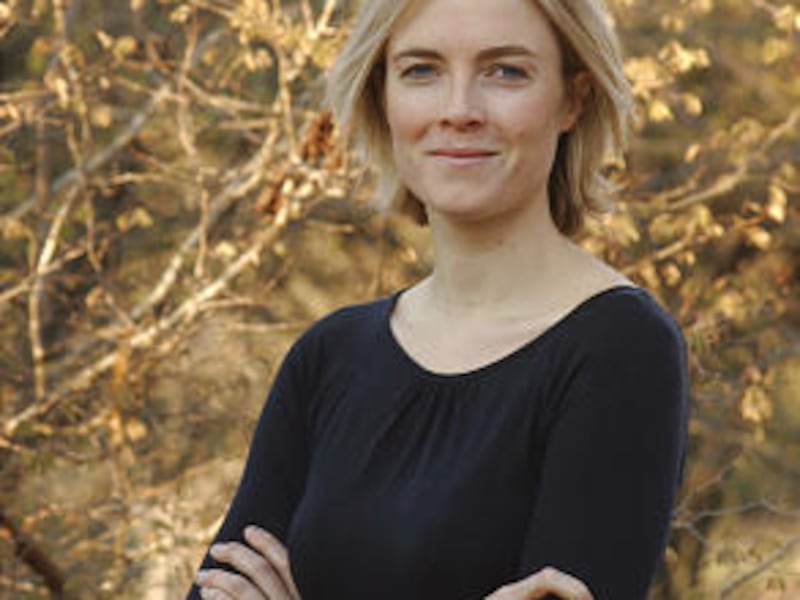
Robyn Scott, author of the delightful "Twenty Chickens for a Saddle: The Story of an African Childhood," now lives in London. She spent her first six years of life in lush New Zealand, then her family decided to move to a cow shed in Botswana, partly because of family connections there and because her mother and father loved a challenge.
Looking back on it, Scott, 27, referred to the "wonderful resilience of childhood, when you look forward and not back." During a phone interview from her London home, Scott asserted that "the excitement of living there was sufficient to obliterate any pangs of regret. Immersion in an environment as different as Africa was thrilling. My parents so enjoyed the change, too. We were so excited about the present that we were caught up with the infectious sense of living in the moment," Scott said.
Scott's eccentric grandfather, Ivor, had been a pilot for Seretse Khama, Botswana's first president; Linda, Scott's highly educated mother, is a scientist with a belief in holistic medicine and cultivates an inveterate love of life; Keith, Scott's father, is a doctor who would have rather been a vet, but who infused new life into his practice by learning to fly to treat his patients at a variety of bush clinics.
Meanwhile, the three kids, including Robyn, Damien and Lulu, enjoyed their unique environment, becoming familiar with snakes, crocodiles and baobab trees. They had extra time because their mother home-schooled them, held them to little structure and mostly read to them, often for days at a time.
"In retrospect," Scott said, "I really treasure the intellectual freedom of our childhoods. I grew up with a real thirst to try different things. My parents and grandparents were both intellectually curious. We learned extraordinary things in stimulating settings, and my parents always talked to us as if we were adults."
Scott's nature was to be a "serious, straightforward child, so my father tried to lighten me up."
Still, Scott realized there was a downside to home schooling. "When I eventually went to school, I wasn't used to interacting in big groups and I asked questions and demanded to know things. I lacked a bit of tact, so my teachers had a love/hate relationship with me," Scott said.
In her book, Scott provides detailed anecdotes of her activities and does so gracefully with just the right touch of wit. Her excellent memory was invaluable in writing the book, but she also kept "an intermittent diary" and her sister kept a "detailed diary" she was able to use.
"We also wrote a lot of letters to our grandparents. My mother encouraged us to write about the things we did, and we cultivated the practice of storytelling," Scott said.
Scott found that when she would dig into her memory that many other things would pop out. "Once you go down the corridors of your mind, a lot of memories return."
Scott also believes that their mother's habit of reading them stories and books taught them a lot about writing, while both grandfathers were "raconteurs." Scott said, "When writing my book, I found that I read it aloud sometimes and sometimes in my head, because I was so used to hearing books."
Ultimately, she claimed to have made a lot of "classic mistakes," such as providing too much back story or failing to capture the voice of a child. "I just learned through trial and error. I found that some stories I thought were great verbally fell flat on the written page. I had to adjust my approach when I was writing. I learned a lot about the subtle aspects of storytelling."
When Scott went to New Zealand to attend the University of Auckland, she selected a difficult major, bioinformatics, in which she used computational power to analyze biological material. "I loved the interface between science and society."
Then she took her master of philosophy degree from Cambridge University in bioscience enterprise. "It was like an MBA for people with a science background, the commercialization of early stage science. I focused on economics and the pricing of medicines in developing countries."
Today, she does consulting work on the carbon industry in Africa, encouraging the development of clean energy projects. She is about to begin work on her second book, a story of a group of maximum security prisoners in South Africa who have adopted some AIDS orphans. The prisoners sew clothes for them, help them grow food, help them with their homework and throw them birthday parties.
"I really admire the prisoners. They have demonstrated the ability of the human spirit to be triumphant by doing extraordinary things for people who have lost their families to AIDS. I feel passionate about AIDS orphans. This is a chance to tell a story about a happy Africa."
Scott "hugely enjoys living in Europe. I'm very happy here, but I return to Africa three, four times a year, and I think eventually the pull of Africa will get the better of me. It's my home."
If you go . . .
What: Robyn Scott, author of Twenty Chickens for a Saddle, will speak about and sign copies of her book.
When: Noon, Wednesday, April 23
Where: University of Utah Union Building, Saltair Room
How much: Free
E-mail: dennis@desnews.com