

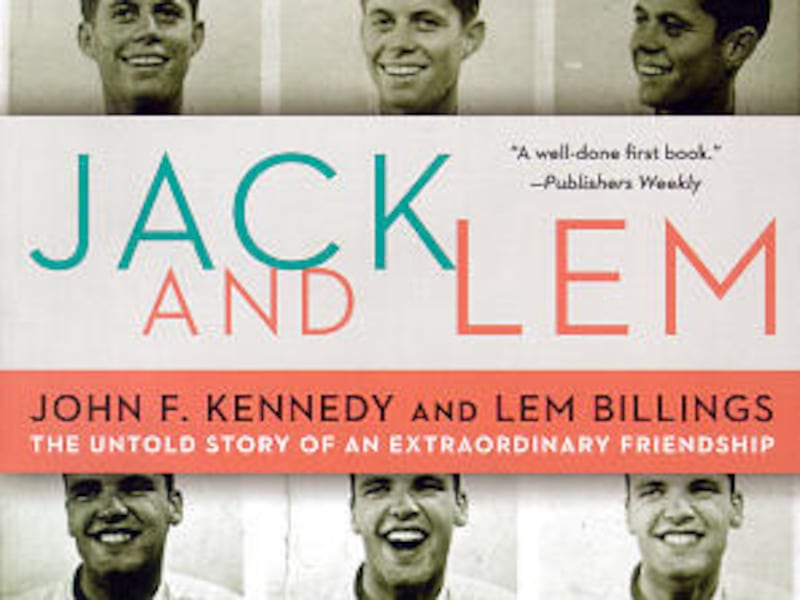
JACK AND LEM: JOHN F. KENNEDY AND LEM BILLINGS, THE UNTOLD STORY OF AN EXTRAORDINARY FRIENDSHIP, by David Pitts, Da Capo, 356 pages, $17 (softcover)
Largely unknown until now, John F. Kennedy's best friend was Kirk LeMoyne Billings, a young man he met at Choate Preparatory School for boys in Wallingford, Conn., in 1933.
Initially, they were drawn together by their mutual dislike of the school's headmaster, "the austere George St. John," and their mutual love of practical jokes.
Even when Kennedy discovered that Billings was homosexual while Kennedy was heterosexual, it did nothing to harm the friendship.
Their friendship endured for 30 years, even though Billings had little interest in politics. During summer breaks, Billings spent considerable time at the Kennedy compound in Hyannis Port or Palm Beach. In the summer of 1937, they vacationed together in Europe when it was on the brink of war.
The author, a British-born journalist, whose writing is serviceable but highly repetitious and formal, spent much time combing the sources that would help him understand the unique friendship Kennedy and Billings enjoyed. He drew on Billings' oral history from the Kennedy Library in Boston, the lengthy correspondence between the two men as well as interviews with Kennedy family members and also Ben Bradlee, Ted Sorensen and Gore Vidal.
Eunice Kennedy Shriver said that their friendship was much more than hanging out together but represented "a complete liberation of the spirit." Kennedy married Jacqueline Bouvier in 1953 at the age of 36, while Billings remained a bachelor.
Billings was often around when Kennedy's political career was in crucial stages, as when he ran for Congress, the U.S. Senate and when he was elected president in 1960. Some of Kennedy's political advisers found him to be a political lightweight because politics didn't interest him, and his high-pitched voice irritated them. But Jackie found his companionship to be delightful.
There is evidence that Kennedy was especially entertained by Billings' active sense of humor. It's important to note, however, that Kennedy had a number of other close friends, including Sorensen, his speech writer and altar ego; and Bradlee, Washington Post editor; Kenny O'Donnell, a political adviser; and Larry O'Brien, also a political adviser — as well as a number of others, none of whom were known to be gay.
Because of Kennedy's many physical complaints, Billings used to joke that if he wrote a Kennedy biography, he would call it, "John F. Kennedy, A Medical History." It took awhile before Kennedy realized that Billings was not interested in women. In fact, the author believes that Billings was physically attracted to Kennedy, and that Kennedy did not reciprocate.
But the evidence indicates that Kennedy always maintained the greatest respect for Billings as a close friend and an admirable human being.
Billings became an advertising executive in Manhattan and never married. He remained in the closet until his death at the age of 65. The fact that Billings lived through a period when gays were generally thought to be evil or degenerate, and that Kennedy never revealed his status or renounced his friendship, says a lot about Kennedy the man.
E-mail: dennis@desnews.com